
Entry Level Remote Jobs No Experience: The Complete Guide
Entry level remote jobs with no experience are real and hiring now. This guide covers the best roles, where to find them, and how to actually get hired.


Earning ranges in this guide reflect publicly listed rates on freelance platforms, job boards, and community-reported figures. Actual earnings vary by skill level, niche, and hours invested.
Entry-level remote jobs with no experience are real — and they're hiring right now. Customer service pays $14–$18/hr, virtual assistants earn $15–$25/hr, and social media managers start at $16–$22/hr. None require a degree. Most positions on FlexJobs, We Work Remotely, and Remote.co list under 2 years experience as their threshold, and hundreds of new openings post daily.
The confusion is understandable. Search "entry level remote jobs no experience" on any job board and you'll see postings that claim to be entry-level but quietly list "2-3 years required" in the fine print. That's not entry-level. But strip those out, and there's still a substantial market of legitimate roles — customer support, data entry, search evaluation, virtual assistance, and more — where companies routinely hire people with no prior work history and provide the training themselves.
This guide covers the roles worth pursuing, where to find them, what they actually pay, how to compete when you have no resume to speak of, and the mistakes that get applications deleted before anyone reads them. Whether you want entry level remote jobs no experience work from home as a full-time career move, or you're just looking for entry level remote jobs no experience part time to supplement your income, there's a path here for you.
Contents
- The Roles That Actually Hire Beginners
- Entry Level Remote Jobs No Experience No Degree Required
- Where to Find These Jobs and Which Platforms to Trust
- How to Get Hired With No Resume History
- Remote Jobs No Experience Training Provided
- How to Make $1,000 a Week Working Remotely
- Quick Comparison: Entry Level Remote Roles at a Glance
- Watch This First
- What Real People Are Saying
- Frequently Asked Questions
- Your Next Steps
The Roles That Actually Hire Beginners
Not every "entry-level" job is created equal. Some require a degree, a certification, or industry-specific vocabulary that takes years to learn. The roles below are genuinely accessible to someone starting from zero. They're high-volume, regularly posted, and many come with paid onboarding or training built into the role.
Customer Service Representative
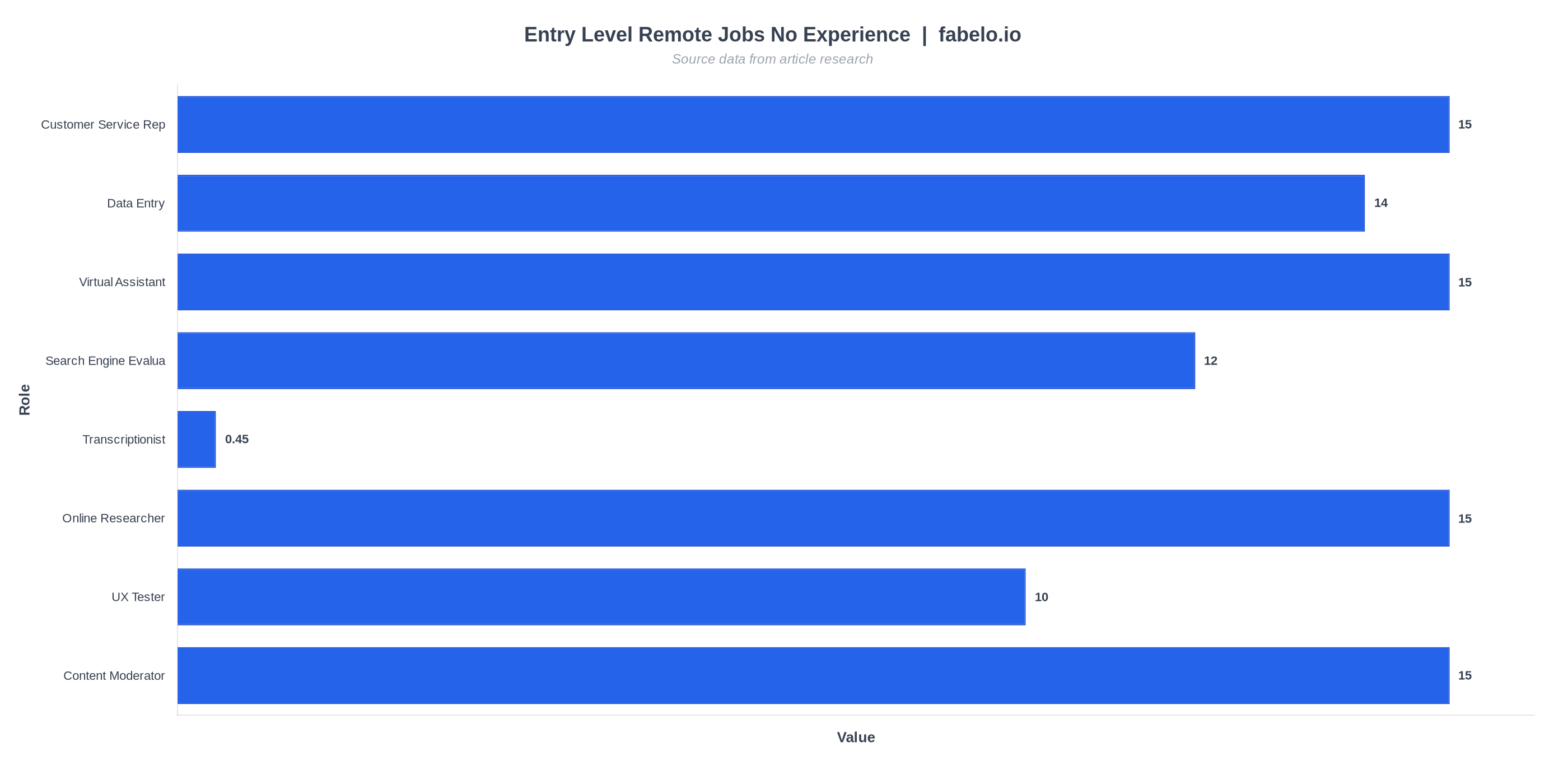
This is the single most common entry-level remote position in the United States. Companies like Amazon, Apple, American Express, and hundreds of smaller e-commerce brands hire remote customer service agents constantly. The job involves handling inbound calls, emails, or chat inquiries — and the skill requirement is essentially clear communication and basic computer literacy. Most companies provide scripts, internal wikis, and product training during a paid onboarding period that typically lasts one to three weeks. Pay commonly ranges from $15 to $20 per hour for chat and email roles, with phone support sometimes slightly higher.
If you can type reasonably fast, stay calm when someone's frustrated, and follow a process, you can do this job on day one. That's why it remains the most accessible gateway into remote work for people without a professional background.
Data Entry Specialist
Data entry is exactly what it sounds like: transferring, organizing, or cleaning up information across spreadsheets, databases, or internal systems. The barrier to entry is low — you need to type accurately, pay attention to detail, and understand basic tools like Google Sheets or Microsoft Excel. Pay typically runs from $14 to $18 per hour for standard roles, though specialized data entry for medical or legal records can push higher.
The catch? High-volume data entry jobs do exist but are increasingly competitive because they attract a lot of applicants. The best strategy is to target companies in specific industries — healthcare, logistics, real estate — where the data requires domain familiarity that makes the role slightly harder to fill.
Virtual Assistant
Virtual assistants handle administrative tasks for business owners, executives, or small teams — things like scheduling, inbox management, basic research, travel booking, and social media posting. The role has a wide pay range depending on the tasks involved. General admin VA work starts around $15 to $18 per hour, while more specialized VAs who handle bookkeeping, project coordination, or content creation can charge $25 to $40 per hour.
Many entry-level VA positions are available through platforms like Upwork and Fiverr, or through VA-specific agencies like Belay and Zirtual. The advantage here is that you can start part-time, build a track record quickly, and raise your rates as you specialize.
Search Engine Evaluator
This one flies under the radar but is a legitimate and surprisingly steady role. Companies like Appen and Telus International hire people to assess the quality and relevance of search results — essentially helping Google, Bing, and other platforms deliver better answers. You rate queries, evaluate pages, and flag issues based on written guidelines. Pay runs from $12 to $20 per hour, the schedule is flexible, and the application process involves passing a qualification exam rather than submitting a resume with work history. No degree, no experience, no problem.
Content Moderator
Platforms need humans to review user-generated content — social media posts, product reviews, forum threads — to ensure it meets community guidelines. Content moderation is frequently available as a remote position through companies like Concentrix and third-party moderation firms. The work requires careful attention and emotional resilience (some content is disturbing), but the entry barrier is minimal and training is always provided. Pay typically starts around $15 per hour.
Transcriptionist
Audio-to-text transcription is one of the most beginner-accessible remote jobs available. Platforms like Rev and Scribie hire beginners with no prior experience. You listen to audio recordings — interviews, podcasts, legal depositions, medical notes — and type what you hear. Starting pay on platforms like Rev is on the lower end (around $0.45 per audio minute for new transcribers), but the flexible, on-demand structure makes it a practical starting point while you build speed and accuracy. Faster, more accurate transcribers can earn considerably more.
Online Researcher
Companies, bloggers, and entrepreneurs frequently need detailed research on specific topics but lack the time to dig through sources themselves. Platforms like Wonder hire online researchers with no prior experience and assign topics ranging from market trends to product comparisons. Online researchers can earn between $15 and $30 per hour depending on task complexity and research speed — and the only requirements are solid internet research skills, attention to detail, and the ability to present information clearly.
UX Tester
Before any app or website launches publicly, companies need real people — not developers — to navigate through it and report on the experience. Platforms like UserTesting and TryMyUI pay regular people to complete 10-to-20-minute tests and record their screen and voice feedback. Pay runs from $10 to $60 per test depending on complexity. It's not a full-time income on its own, but it stacks well with other part-time remote work and requires absolutely zero technical background.
Entry Level Remote Jobs No Experience No Degree Required
A college degree is genuinely not required for most of the roles listed above — and that's not a workaround or a loophole. It's increasingly the explicit policy of major employers. Amazon, Apple, and many Fortune 500 companies have removed degree requirements from a broad range of customer-facing and administrative roles. What they care about is whether you can do the job, not what your transcript says.
The key is knowing which job titles to target. "Customer success associate," "intake coordinator," "remote support specialist," and "data operations assistant" are all roles that regularly appear without degree requirements. Avoid titles like "analyst," "coordinator" (in some industries), or anything with "specialist" in a technical context — those sometimes require formal education even at entry level.
For entry level remote jobs no experience no degree, the most reliable fields are:
- Customer service and support — the largest volume of no-degree remote openings
- Data entry and administrative support — skills-based, process-oriented, and easily verified by a brief test
- Sales development — many companies will train you on their product and pay a base salary plus commission
- Content moderation — judgment-based work that doesn't require formal credentials
- Transcription and captioning — pure skills test, no degree considered
One important note: "no degree required" does not mean "no learning required." Companies hiring for these roles still expect you to learn their systems, absorb their training, and perform consistently. The bar to get hired is lower. The bar to stay employed is the same as anywhere else.
If you want to strengthen your LinkedIn profile without going back to school, free and low-cost certifications can help. Google Career Certificates in IT support, data analytics, and project management are widely recognized and take weeks, not years. Coursera and LinkedIn Learning offer hundreds of courses that give you something concrete to list on a resume even when you have no job history.
Where to Find These Jobs and Which Platforms to Trust

The job boards matter. Some platforms are flooded with low-paying micro-task gigs that look like jobs but aren't. Others have strong legitimate postings but require a paid subscription to see the best ones. Here's where to actually spend your time.
LinkedIn has over a thousand no-experience remote job listings in the U.S. At any given time. Use the filter for "Entry Level" and "Remote" simultaneously, and sort by date posted. The platform also shows you if you have any connections at the company, which is a significant advantage even when applying cold.
Indeed remains the highest-volume general job board in the country and surfaces a large number of remote no-experience openings daily. Set up email alerts for your specific search string so new postings land in your inbox the hour they go live — early applications have a measurable advantage in high-volume roles.
FlexJobs
FlexJobs charges a monthly fee (around $14.95) but manually vets every listing for legitimacy. If your biggest concern is scams, this is worth the cost for a month or two of focused searching. The platform specifically curates remote, flexible, and part-time roles, many of which are entry-level.
ZipRecruiter aggregates listings from multiple sources and uses matching algorithms to surface relevant openings. It's free for job seekers and has a large volume of remote no-experience postings across all 50 states.
Company career pages directly
For customer service and remote support roles specifically, going directly to a company's careers page often surfaces openings that aren't posted publicly on job boards. Amazon, Concentrix, TTEC, Alorica, and Teleperformance all run large remote customer service operations and post regularly. Bookmark these pages and check weekly.
Freelance and micro-task platforms
For people who want to start earning while building a resume, platforms like Clickworker, Remotasks, and Amazon Mechanical Turk offer immediate access to small paid tasks. The pay per task is low, but these platforms provide something valuable: recent work history you can reference when applying to more substantial positions.
How to Get Hired With No Resume History
The resume problem is real. If you've never held a formal job — or your work history has nothing to do with remote knowledge work — it feels like a chicken-and-egg trap. You can't get hired without experience; you can't get experience without being hired. Here's how to break that loop.
Lead with skills, not jobs
A functional or skills-based resume format puts your capabilities front and center rather than leading with an empty job history. If you've managed schedules, handled communications, organized anything, or worked with spreadsheets in any context — school projects, volunteer work, freelance gigs, personal projects — those are transferable skills. List them specifically. "Managed scheduling and logistics for a 20-person volunteer event" is more compelling than leaving a section blank.
Complete a free certification before you apply
Even a short, free Google certification or a HubSpot course (free at HubSpot Academy) gives you something concrete to list. When a hiring manager sees that a candidate with no job history took time to learn a relevant tool or system, it signals initiative — which is exactly what remote employers are evaluating in entry-level candidates.
Write a cover letter that addresses the gap directly
Don't pretend the lack of experience isn't there. A brief, confident sentence like "I'm transitioning into remote work and have focused my preparation on [specific skills]" is more persuasive than vague language that tries to paper over an empty resume. Employers at the entry level are often hiring for attitude and trainability. Show both.
Apply volume, but apply smart
Sending 200 identical applications is less effective than sending 40 targeted, customized ones. Tailor each cover letter to the specific role, mirror the language in the job posting, and apply within 24 hours of the posting going live. High-volume roles fill fast, and applications submitted in the first few days typically get the most attention from recruiters.
Use your LinkedIn profile as a second resume
A complete LinkedIn profile — with a professional photo, a clear summary, and any skills or certifications you've earned — is increasingly a deciding factor. Many recruiters don't review resumes until after checking LinkedIn. If your profile is sparse or missing, fix it before you apply anywhere.
Remote Jobs No Experience Training Provided
Some employers don't just tolerate inexperienced candidates — they actively prefer them because it means no bad habits to unlearn. These companies are built around structured onboarding and ongoing support systems designed for people starting from scratch. This category is worth a dedicated search strategy.
Companies that consistently offer remote jobs no experience training provided include:
- TTEC — One of the largest remote customer experience companies in the world, TTEC regularly hires customer service representatives with no prior experience and runs structured paid training programs before you take your first call. They post dozens of remote openings at any given time across the U.S.
- Conduent — Offers remote work-from-home positions in customer service, healthcare support, and claims processing. Training is included and the company regularly posts entry-level openings.
- Alorica — A large outsourced customer service provider with a consistent remote hiring pipeline and paid onboarding. Many of their openings explicitly state no experience required.
- Amazon Customer Service — Amazon hires seasonal and permanent remote customer service associates with paid training built into the first two to three weeks. Their hiring process is structured and high-volume, which means the bar to get an interview is lower than at many smaller companies.
- Concentrix — Similar model to TTEC: high-volume hiring, remote-first, paid training included, no experience required for most customer-facing roles.
When searching for these opportunities, filtering by "training provided" on job boards doesn't always surface the right results. A better approach is to search for the company names directly, or use the keyword string "paid training remote" alongside your target role. You'll surface a much more relevant set of results.
For freelance platforms, Upwork also lists clients who explicitly mention training new hires — look for job descriptions that say "will train the right candidate" or "no experience necessary, we'll show you what to do."
How to Make $1,000 a Week Working Remotely
$1,000 a week is roughly $52,000 a year — a real, livable income in most parts of the country. Getting there from zero experience isn't instant, but there's a clear progression if you're strategic about it.
The fastest single-role path to that level with no experience is a full-time customer service or inside sales position at a company that pays $25 per hour or more. These roles exist but are more competitive — they typically go to candidates who have some kind of track record, even if it's from a lower-paying version of the same job. So the play is to land a $15 to $18 per hour role first, build six months of documented remote work history, and then use that to negotiate or apply upward.
The faster path for many people is combining roles. Consider this common structure:
- Part-time customer service role at $16/hour, 25 hours per week: roughly $400/week
- Freelance virtual assistant work at $20/hour, 10 hours per week: roughly $200/week
- Search engine evaluation at $15/hour, 15 hours per week: roughly $225/week
- UX testing and online research tasks, 5-10 hours per week: roughly $100 to $200/week
Combined, that's $925 to $1,025 per week — achievable within a few months of consistent effort, without any single employer needing to know what you're earning elsewhere. Each role builds skills and references that feed the others.
The ceiling rises quickly once you specialize. A virtual assistant who becomes proficient in a specific tool — Asana, Notion, or Mailchimp — or a specific industry — real estate, legal, e-commerce — can charge $35 to $50 per hour within a year. That's $1,000 a week from 20 to 28 hours of work. Specialization is the single most reliable lever available to someone who starts with no experience.
Quick Comparison: Entry Level Remote Roles at a Glance
| Role | Typical Pay Range | Degree Required | Training Provided | Part-Time Friendly | Best Platform to Find It |
|---|---|---|---|---|---|
| Customer Service Rep | $15–$20/hr | No | Yes, typically | Yes | , LinkedIn, direct company sites |
| Data Entry | $14–$18/hr | No | Sometimes | Yes | , |
| Virtual Assistant | $15–$40/hr | No | Rarely | Yes | Upwork, Belay, Zirtual |
| Search Engine Evaluator | $12–$20/hr | No | Guidelines provided | Yes | Appen, Telus International |
| Transcriptionist | $0.45/min audio+ | No | Style guides provided | Yes | Rev, Scribie |
| Online Researcher | $15–$30/hr | No | Guidelines provided | Yes | Wonder, Upwork |
| UX Tester | $10–$60/test | No | Yes | Yes | UserTesting, TryMyUI |
| Content Moderator | $15–$19/hr | No | Yes | Sometimes | Concentrix, LinkedIn |
Watch This First: Easiest Remote Jobs Beginners Actually Get Hired For

Before you start applying, watch this video for a grounded overview of what the remote job market actually looks like for beginners in 2025 and 2026.
Watch: the Funke Suyi YouTube channel on easiest remote jobs beginners actually get hired for →
According to the Funke Suyi YouTube channel, one of the most overlooked beginner-accessible roles is online research — specifically through platforms like Wonder, where you're paid to gather information, summarize findings, and deliver organized reports. The channel notes that this role requires nothing beyond solid internet research skills and an eye for detail, yet pays between $15 and $30 per hour based on complexity. That's a strong starting wage for someone with zero formal work history.
The channel also highlights UX testing as a particularly accessible income stream. Most tests take between 10 and 20 minutes and pay between $10 and $60 depending on the complexity of the product being evaluated. While it won't replace a full-time income alone, stacking multiple tests per week adds up meaningfully. The key insight is that companies launching new apps and platforms constantly need real users — not developers — to identify friction in the experience. That demand isn't going away.
One more point worth taking from that content: community moderation is a legitimate and growing remote role that most beginners never consider. Discord servers, private communities, and online membership platforms need people to welcome new members, answer questions, and keep engagement healthy. Many community owners are open to hiring part-time moderators and will often negotiate pay directly. It's the kind of opportunity that doesn't show up on traditional job boards — you have to go find it where the communities live.
What Real People Are Saying
The Reddit remote work community is blunt, honest, and full of people who've actually been through this process. The consensus is useful and worth paying attention to.
In r/RemoteJobs, users consistently point to data entry and chat support as the most immediately accessible roles for people with no background. The thread framing is that these jobs are "easy on the training" and that companies pay you while you learn — which aligns with what TTEC, Alorica, and Concentrix actually offer. The practical takeaway from that thread is to prioritize chat and email support over phone support if you're nervous about starting out, because asynchronous communication gives you more time to think through responses.
In r/RemoteJobs, one frequently upvoted suggestion is to start with micro-task platforms like Clickworker, Remotasks, or Amazon Mechanical Turk as a stepping stone rather than a destination. The logic: you build a recent work history, get comfortable with remote workflows, and have something to reference when applying to more substantial positions. Several users in that thread reported using this exact strategy — spending a month or two on micro-task work, then successfully landing a data entry or VA role by citing their micro-task experience as evidence of remote-readiness.
Users in r/remotework recommend setting up daily job alerts on platforms that focus specifically on entry-level remote and admin roles. The consistent advice across threads: apply early, apply often, and don't filter yourself out before applying. If a job posting asks for "1-2 years experience preferred" but not required, apply anyway. Many people in that community report getting hired for roles where they met only 60-70% of the stated qualifications.
Frequently Asked Questions
How do I land my first remote job when I have no remote work experience on my resume?
Start by targeting roles specifically designed for beginners: customer service, data entry, transcription, and search engine evaluation. These positions have built-in training, process-driven workflows, and hiring managers accustomed to onboarding people who have never worked remotely before. Complete one or two free certifications — Google Career Certificates or HubSpot Academy are good starting points — to give your resume something concrete beyond work history. Apply consistently and early. Most beginner-accessible remote jobs fill within 48 to 72 hours of posting.
How to make $1,000 a week remotely?
From a starting point of no experience, reaching $1,000 per week typically takes three to twelve months depending on the path. The fastest route is combining a part-time customer service role with freelance work as a virtual assistant or online researcher. A full-time customer service position at $25 per hour gets you there on its own, but those roles are more competitive. Specializing in a specific tool or industry as a VA or data professional is the most reliable long-term path — specialists commonly charge $35 to $50 per hour, which means $1,000 per week from 20 to 28 hours of work.
What entry-level remote job has the highest starting pay for someone without a college degree?
Customer service representative is the most accessible and highest-volume option for true beginners. The training is built in, the pay is reasonable starting out, and the skill set transfers directly to higher-paying roles like customer success, account management, or technical support. If you want more flexibility, virtual assistance and search engine evaluation are strong alternatives — both can be done part-time, require no degree, and build skills that increase your earning potential over time.
What is the easiest entry-level remote job to get hired for in under 30 days?
In terms of the lowest barrier to entry and fastest time from application to earning, UX testing and micro-task work on platforms like Amazon Mechanical Turk require no application process at all — you sign up, pass a brief qualification, and start working within hours. These aren't high-paying options, but they're the fastest way to start. For a more substantial role, data entry and chat-based customer support are the easiest to get hired for, with most people landing their first position within four to eight weeks of consistent, targeted applying.
Are there legitimate entry level remote jobs no experience part time?
Yes, and this is one of the most actively posted categories on job boards. Part-time remote openings are common in customer service (many companies offer 20-25 hour per week positions), virtual assistance, transcription, and UX testing. Platforms like FlexJobs specialize in flexible and part-time remote roles and are a reliable source. The advantage of starting part-time is that it lets you test a role, build experience, and potentially transition to full-time with the same employer once you've proven yourself.
How do I avoid scams when looking for remote jobs with no experience?
The most reliable protection is using established platforms: LinkedIn, FlexJobs, and direct company career pages. Red flags to watch for include any job that asks you to pay money upfront, requires you to purchase equipment through a non-standard process, or offers pay that seems dramatically above market rate for simple work. Legitimate entry-level remote positions don't require you to spend anything before your first paycheck. When in doubt, search the company name plus "scam" or "reviews" on Reddit — the community is quick to flag fraudulent postings.
Your Next Steps
The remote job market for beginners is real, active, and not as hard to break into as it sometimes appears from the outside. The barrier is mostly informational — knowing which roles to target, where to find them, and how to position yourself without a resume full of relevant work history. Here's how to move from reading to doing.
- Step 1: Pick one role and commit to it for 60 days. Choose from customer service, data entry, virtual assistance, or search engine evaluation based on your existing strengths. Don't apply to everything. Focused, targeted applications outperform scattered volume. Complete one free certification in your chosen area before sending your first application.
- Step 2: Set up alerts and apply early. Create saved searches on LinkedIn and Indeed for your target role with remote and entry-level filters. Apply within 24 hours of a posting going live. Early applications consistently get more attention from recruiters in high-volume roles.
- Step 3: Start earning while you search. Sign up for micro-task work on Clickworker or Remotasks, or take a few UX tests on UserTesting. This builds remote work habits, creates recent activity you can reference in cover letters, and generates income while you work toward a more substantial position. It's not a ceiling — it's a starting block.
About the Author
Written by Fabelo
The Fabelo editorial team covers career strategies, job market trends, and professional development. Research-backed guides for ambitious professionals.
Disclaimer: This article is for informational purposes only. Career data, salary figures, and job market trends reflect available research and may change. Always do your own research before making major career or education decisions.
Last updated: April 13, 2026 · fabelo.io