
Roth IRA Contribution Limits: The Complete Guide
Roth IRA contribution limits hit $7,500 in 2026, with $8,600 allowed for those 50 and older. Here's exactly who qualifies and how much you can save.


The 2024 Roth IRA contribution limit is $7,000 per year — $8,000 if you're 50 or older. But your income determines whether you can contribute at all: phase-outs begin at $146,000 for single filers and $230,000 for married couples filing jointly. Exceed $161,000 (single) or $240,000 (married), and direct contributions aren't allowed. These limits adjust annually for inflation.
For 2026, the Roth IRA contribution limits increased for the first time since 2024. The standard limit is now $7,500 per year for those under age 50, up from $7,000 in 2025. Those 50 and older can contribute $8,600 — an increase from $8,000 in 2025. These aren't huge numbers compared to a 401(k), but the tax-free growth advantage makes every dollar count. A 35-year-old who maxes out annually and earns a 7% average return could have well over $1 million in tax-free money by retirement. This guide breaks down every threshold, every edge case, and the strategies that make the most sense at every income level and age bracket.
All rates and contribution figures mentioned in this article are based on IRS-published limits for tax years 2025 and 2026. Limits can change annually — always verify current figures directly with the IRS or your financial institution before contributing.
Contents
- Roth IRA Contribution Limits 2025 vs 2026
- Roth IRA Contribution Limits Over 60 and Catch-Up Rules
- Roth IRA Income Limits, Who Can Contribute and Who Cant
- How to Calculate Your Roth IRA Contribution Limit
- Roth IRA Contribution Limits by Year, A Historical View
- Spousal Roth IRA Rules and the One-Income Household Strategy
- Backdoor Roth IRA, When Income Limits Block the Front Door
- Roth IRA vs Traditional IRA vs Roth 401k, A Comparison
- Watch This First Before You Contribute
- What Real People Are Saying
- Frequently Asked Questions
- Final Verdict and Your Next Steps
Roth IRA Contribution Limits 2025 vs 2026
The IRS adjusts retirement contribution limits periodically for inflation. For 2026, both the standard and catch-up limits got a meaningful bump. Here's the full side-by-side comparison:
These limits apply to the combined total of all your traditional IRA and Roth IRA contributions in a given year. You can split contributions between a traditional and Roth IRA, but the combined total cannot exceed $7,500 (or $8,600 if you're 50+) for 2026. That's a detail that trips up a lot of people who open multiple accounts thinking they get a separate limit for each.
The Roth IRA contribution limits are the same as for traditional IRAs — the accounts share a single annual cap. The difference is that traditional IRA contributions may be tax-deductible (depending on income and whether you have a workplace plan), while Roth contributions are made with after-tax dollars but grow and are withdrawn completely tax-free. For most people who expect their income — and tax rate — to increase over time, the Roth tends to win.
There's one hard rule that doesn't get enough attention: you cannot contribute more than your taxable compensation for the year. If you earned $5,000 in 2026 from part-time work, your Roth IRA contribution ceiling is $5,000 — not $7,500. This rule particularly affects teenagers, part-time workers, and anyone who took a year off from paid employment. Retirement income, Social Security, pension payments, and investment income don't count as "earned income" for IRA contribution purposes.
The contribution deadline is also widely misunderstood. You have until your federal tax filing deadline — typically April 15 — to make contributions for the prior tax year. That means you can contribute to your 2026 Roth IRA as late as April 15, 2027. This extra window gives you real flexibility to assess your total income and contribution room before committing.
Roth IRA Contribution Limits Over 60 and Catch-Up Rules
For anyone approaching or already in their 60s, the Roth IRA contribution limits over 60 deserve careful attention — because the rules shifted in a meaningful way starting in 2026. The SECURE 2.0 Act introduced a "super catch-up" provision for 401(k) plans for those aged 60 to 63, but for IRAs, the catch-up structure is simpler and applies from age 50 onward.
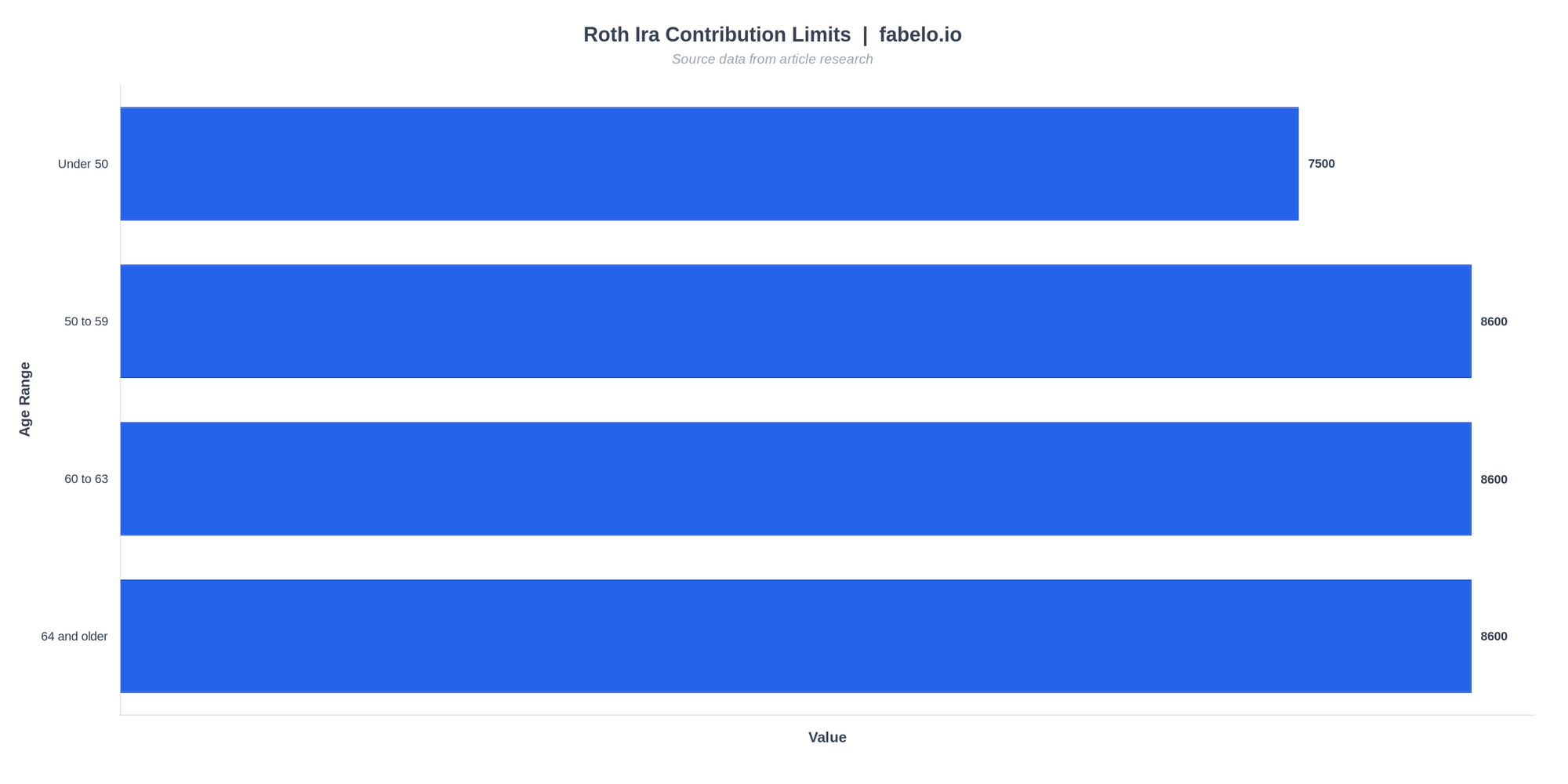
Here's how IRA catch-up limits break down for 2026 by age bracket:
| Age Range | 2026 Roth IRA Limit | Notes |
|---|---|---|
| Under 50 | $7,500 | Standard limit |
| 50 to 59 | $8,600 | +$1,100 catch-up |
| 60 to 63 | $8,600 | Same IRA catch-up; 401k has super catch-up |
| 64 and older | $8,600 | Same catch-up rate applies |
A quick clarification: the "super catch-up" that allows 60-to-63-year-olds to contribute up to $11,250 extra applies specifically to 401(k), 403(b), and similar workplace plans — not to IRAs. For Roth IRAs, anyone 50 or older gets the same $8,600 cap regardless of whether they're 52 or 72.
What makes the catch-up contribution valuable at this stage isn't just the extra $1,100 per year. It's the compounding window. A 60-year-old who starts maxing out their Roth IRA at $8,600 per year and earns an average 6% annual return will have contributed $86,000 over 10 years — and that money, plus its growth, comes out completely tax-free after age 59½. For someone who also has traditional IRA or 401(k) assets, building up a Roth balance specifically for tax diversification in retirement can reduce their effective tax rate on withdrawals significantly.
One important thing to know for those over 70½: there is no age cap on contributing to a Roth IRA. As long as you have earned income, you can keep contributing — and unlike traditional IRAs, Roth IRAs have no required minimum distributions (RMDs) during your lifetime. That makes them uniquely useful as a long-term holding vehicle or for passing tax-free wealth to heirs.
A concrete scenario: a 62-year-old consultant earning $60,000 per year from freelance work has $153,000 or less in MAGI (see income limits below) and is therefore eligible for the full $8,600 Roth IRA contribution for 2026. Over five years at 6% growth, that's roughly $48,500 in contributions compounding to approximately $57,000 by age 67 — all of which comes out tax-free. The same person contributing to a traditional IRA would owe ordinary income tax on every dollar withdrawn. The math favors Roth for most people in their peak earning years who have reason to believe their tax rate stays stable or increases.
Congress's rationale for catch-up contributions is straightforward: people in their 50s and 60s often have more disposable income (kids are grown, mortgage may be paid off) and less time for compounding to work. The higher limit is an explicit invitation to accelerate savings during this window.
Roth IRA Income Limits: Who Can Contribute and Who Can't

Unlike a traditional IRA, which anyone with earned income can contribute to, the Roth IRA phases out eligibility at higher incomes. Your Modified Adjusted Gross Income (MAGI) determines whether you get the full contribution, a reduced contribution, or nothing at all.
Here are the 2026 Roth IRA income limits by filing status:
| Filing Status | Full Contribution (MAGI below) | Phase-Out Range | No Contribution (MAGI above) |
|---|---|---|---|
| Single / Head of Household | $153,000 | $153,000 – $168,000 | $168,000+ |
| Married Filing Jointly | $242,000 | $242,000 – $252,000 | $252,000+ |
| Married Filing Separately | $0 | $0 – $10,000 | $10,000+ |
The married-filing-separately row is worth flagging. If you're married, lived with your spouse at any point during the year, and file separately, your Roth IRA phase-out starts at $0. That's not a typo — almost any income disqualifies you from contributing directly to a Roth IRA in that filing situation. This is one reason why tax planning matters as much as contribution planning.
For the 2025 tax year (contributions due by April 15, 2026), the Roth IRA income limits were slightly lower: $146,000 for single filers (phase-out through $161,000) and $230,000 for married couples (phase-out through $240,000). Each year the IRS adjusts these thresholds upward, which means people who were phased out in prior years may qualify for partial or full contributions in 2026.
Within the phase-out range, your contribution limit reduces proportionally. If you're a single filer earning $160,500 in 2026, you're $7,500 into a $15,000 phase-out range — exactly 50% of the way through. Your allowed contribution is reduced by 50%, meaning you can contribute approximately $3,750 (or $4,300 if you're 50+). The IRS rounding rules apply, but this proportional reduction is the core mechanic.
High earners above the income ceiling aren't necessarily locked out of Roth benefits — but they need to use the backdoor Roth strategy instead of making direct contributions. More on that in a dedicated section below.
How to Calculate Your Roth IRA Contribution Limit
This is where a Roth IRA contribution limits calculator becomes genuinely useful — but you can also do the math yourself with three inputs: your filing status, your MAGI, and your age.
Step 1: Determine your MAGI. Modified Adjusted Gross Income starts with your AGI (line 11 on Form 1040) and then adds back certain deductions — student loan interest, IRA deductions, tuition and fees deductions, and a few others. For most W-2 employees without unusual deductions, MAGI roughly equals gross income. The IRS has a specific worksheet for this calculation. Common things that increase your MAGI include rental income, self-employment income, and taxable Social Security benefits.
Step 2: Compare your MAGI to the phase-out range. Using the 2026 thresholds above, determine whether you fall below the phase-out (full contribution), inside the phase-out (partial), or above it (no direct contribution).
Step 3: Calculate the reduction if you're in the phase-out range. The formula is:
Reduced Contribution = Maximum Limit × [(Phase-Out Ceiling − Your MAGI) ÷ Phase-Out Range Width]
For single filers in 2026 under 50: Maximum Limit = $7,500 | Phase-Out Ceiling = $168,000 | Range Width = $15,000
Example: MAGI of $162,000 → $7,500 × [($168,000 − $162,000) ÷ $15,000] = $7,500 × 0.40 = $3,000
Round up to the nearest $10. If your calculated limit is less than $200, the IRS allows you to contribute up to $200 — a small minimum floor so people in the phase-out range aren't completely excluded by rounding.
Step 4: Check the earned income floor. Your contribution can't exceed your taxable compensation for the year, regardless of what the phase-out formula produces. If you earned $4,000 from a summer job and your formula-based limit is $7,500, your actual limit is $4,000. As noted in r/Bogleheads discussions, the earned income threshold is calculated on pre-tax income — if you make $7,500 and pay FICA taxes, you can still contribute the full $7,500 because the limit is based on your gross earned income, not your take-home pay.
Online calculators from TIAA, Vanguard, and Fidelity can automate this in about 60 seconds. But understanding the underlying formula matters — especially if your income fluctuates year to year or if you're trying to plan contributions before your W-2 arrives.
What counts as earned income? Wages, salaries, tips, self-employment income, and taxable alimony received under pre-2019 divorce agreements. What doesn't count: dividends, capital gains, rental income, Social Security, pension payments, or interest income. This distinction matters enormously for retirees who want to continue contributing to a Roth IRA after leaving traditional employment.
Roth IRA Contribution Limits by Year, A Historical View
The Roth IRA contribution limits by year tell a story of slow but steady upward movement tied to inflation adjustments. The Roth IRA was established by the Taxpayer Relief Act of 1997, and the contribution limit started at $2,000 per year. It sat there for years before Congress began indexing it to inflation.
| Tax Year | Under 50 | Age 50 and Older |
|---|---|---|
| 2019 | $6,000 | $7,000 |
| 2020 | $6,000 | $7,000 |
| 2021 | $6,000 | $7,000 |
| 2022 | $6,000 | $7,000 |
| 2023 | $6,500 | $7,500 |
| 2024 | $7,000 | $8,000 |
| 2025 | $7,000 | $8,000 |
| 2026 | $7,500 | $8,600 |
From 2019 to 2022, the limit sat completely flat at $6,000 despite meaningful inflation. The jump to $6,500 in 2023 was the first increase in four years. Then $7,000 in 2024. And now $7,500 for 2026 — the IRS skipped an increase for 2025, making 2026's bump the first in two years for standard contributors.
Looking at this trajectory, projecting the 2027 limit is reasonable. The IRS adjusts in $500 increments tied to the Consumer Price Index. If inflation stays moderate, $8,000 for those under 50 is a plausible projection for 2027 — but that's speculative until official IRS announcement, typically in October or November of the prior year. The catch-up limit uses different inflation indexing under SECURE 2.0, which is why the 2026 increase for 50+ savers was $600 rather than $500.
The historical pattern reveals something important: long stretches of flat limits erode purchasing power. Someone who maxed out their Roth IRA at $6,000 in 2019 was effectively contributing less in real dollars than the person maxing out at $7,500 in 2026 — even though the account mechanics are identical. Consistent annual contributions at the maximum, regardless of the specific limit, remain the most reliable wealth-building behavior.
| Contributor Age | 2025 Limit | 2026 Limit | Annual Increase |
|---|---|---|---|
| Under age 50 | $7,000 | $7,500 | +$500 |
| Age 50 and older (catch-up) | $8,000 | $8,600 | +$600 |
Spousal Roth IRA Rules and the One-Income Household Strategy
One of the most underutilized provisions in IRA law is the spousal IRA rule. Normally, you can only contribute to an IRA if you personally have earned income. But if you're married and filing jointly, a working spouse can fund an IRA for a non-working spouse — as long as the working spouse has enough earned income to cover both contributions.
For 2026, a single-income married couple can theoretically contribute $15,000 to Roth IRAs ($7,500 × 2) or $17,200 if both spouses are 50 or older. The only requirement is that their combined MAGI falls below $242,000 for the full contribution.
Real-world scenario: a teacher earning $85,000 who is married to a stay-at-home parent can contribute $7,500 to her own Roth IRA and another $7,500 to her spouse's Roth IRA — as long as the couple files jointly and their MAGI is under the threshold. The spouse doesn't need a job. The spouse doesn't need a separate income stream. They just need their own IRA account and a household filing status that works.
The spousal IRA is one of the most overlooked planning tools in retirement strategy — particularly because it gives non-employed spouses their own separate retirement account with their own financial security, independent of the working spouse's employer plan.
The contributions go into the non-working spouse's IRA as their own account, under their own name and Social Security number. In a divorce, that account belongs to the non-working spouse. It also creates separate Roth balances for each spouse, which has tax planning benefits in retirement — two pools of tax-free money rather than one large pool in one person's name.
One constraint: the contributions still count toward the household's aggregate limit. You cannot contribute $7,500 to your own Roth and $7,500 to a spousal traditional IRA and $7,500 to a spousal Roth IRA. Each individual's combined Roth + traditional IRA contribution is capped at $7,500 (or $8,600). But two spouses means two separate $7,500 caps — a $15,000 household total.
Backdoor Roth IRA, When Income Limits Block the Front Door
If your income exceeds the Roth IRA income limits — $168,000 single or $252,000 married in 2026 — you cannot make direct Roth IRA contributions. But "can't contribute directly" doesn't mean you're locked out of Roth entirely. The backdoor Roth IRA strategy has been widely used by high-income earners for well over a decade and remains legally sound as of 2026.
The mechanics are straightforward. You contribute to a traditional IRA (no income limit for contributions, though the deductibility phases out based on income and workplace plan access). You then convert that traditional IRA balance to a Roth IRA. The conversion is a taxable event, but if you had no pre-existing pre-tax IRA balances and contribute on a non-deductible basis, your tax liability on the conversion is minimal — essentially zero on the principal if done immediately after contribution.
The critical wrinkle is the "pro-rata rule." If you have other traditional IRA money sitting in pre-tax accounts — a rollover IRA from an old 401(k), for instance — the IRS treats all your traditional IRA funds as a single pool when calculating the taxable portion of a conversion. That can make the backdoor strategy expensive or complicated for people with large existing pre-tax IRA balances. The solution for many high earners is to roll pre-tax IRA money back into their current employer's 401(k) plan, leaving only non-deductible IRA funds behind to convert cleanly.
Step by step for 2026:
- Confirm you have no pre-tax IRA balances (or have a plan to handle the pro-rata issue).
- Contribute $7,500 (or $8,600 if 50+) to a traditional IRA. Do not deduct it — mark it as non-deductible on IRS Form 8606.
- Wait a short period (a few days to a few weeks is typical) and convert the full balance to your Roth IRA.
- Report the conversion on your tax return. With a zero-basis conversion, your taxable income from the conversion should be minimal — just any small earnings that accrued between the contribution and conversion dates.
Couples where both spouses are above the income limit can each do this separately, contributing up to $17,200 total to Roth accounts through the backdoor method. For high-income households, this strategy represents tens of thousands of dollars in potential tax-free retirement savings over a career.
The strategy does require attention to detail — particularly Form 8606 filings every year — and rules can change. For anyone with significant pre-tax IRA balances or complex tax situations, a CPA or financial advisor familiar with IRA rules is worth the consultation fee.
Roth IRA vs Traditional IRA vs Roth 401k, A Comparison
Choosing between account types is one of the most common retirement planning questions. The right answer depends on your current tax rate, your expected tax rate in retirement, and how much flexibility you need. Here's a direct comparison for 2026:
| Feature | Roth IRA | Traditional IRA | Roth 401(k) |
|---|---|---|---|
| 2026 Contribution Limit (under 50) | $7,500 | $7,500 | $24,500 |
| 2026 Catch-Up (age 50+) | $8,600 | $8,600 | $32,500 (50–59 and 64+) |
| 2026 Super Catch-Up (age 60–63) | N/A | N/A | $35,750 |
| Income Limits for Contributions | Yes (phase-out) | No (deductibility has limits) | No |
| Tax on Contributions | After-tax (no deduction) | Pre-tax (may be deductible) | After-tax (no deduction) |
| Tax on Qualified Withdrawals | Tax-free | Ordinary income tax | Tax-free |
| Required Minimum Distributions | None (owner's lifetime) | Yes (starting at age 73) | Yes (unless rolled to Roth IRA) |
| Investment Choice | Full brokerage options | Full brokerage options | Limited to plan menu |
| Employer Tied | No | No | Yes |
The Roth IRA's lower contribution limit compared to a Roth 401(k) is the most common frustration — and a genuine limitation. In r/Bogleheads, this topic comes up regularly. Users point out that when you combine a 401(k) ($24,500), a Roth IRA ($7,500), and an HSA if eligible, total annual tax-advantaged contributions can reach $40,000 or more — which reframes the IRA limit as one piece of a larger strategy rather than the only vehicle.
The Roth IRA's real advantage over the Roth 401(k) is flexibility. You control the account, you choose the investments (any ETF, stock, bond, or mutual fund at any brokerage), and there are no RMDs during your lifetime. A Roth 401(k) technically requires RMDs starting at age 73 unless you roll it to a Roth IRA — a simple move, but one that requires action. The Roth IRA also allows penalty-free withdrawal of your contributions (not earnings) at any time for any reason — a feature that makes it function as a secondary emergency fund for disciplined savers.
The optimal strategy for most people in their working years: contribute enough to a 401(k) to capture the full employer match first, then max the Roth IRA, then return to the 401(k) up to the limit if additional savings capacity exists. This sequencing captures free money (the match), prioritizes the most flexible account (Roth IRA), and then uses the 401(k)'s higher limit for additional tax-advantaged savings.
Watch This First Before You Contribute

Before you make your 2026 Roth IRA contributions, this breakdown of the updated limits is worth watching. the Erin Talks Money YouTube channel published a thorough walkthrough of the 2026 retirement limits across IRA and 401(k) accounts, covering both the standard and catch-up thresholds with specific income phase-out ranges for single and married filers. One particularly useful point the channel makes: the contribution deadline is not December 31st — it's your tax filing deadline, which gives you until April 15, 2027 to make 2026 contributions. That flexibility matters if your income is variable or if you're waiting to assess your final MAGI before contributing.
The channel also highlights a planning move that many people miss: if you haven't fully funded last year's IRA, prioritize that first before contributing to the current year. That way you keep both years' contribution windows open simultaneously — potentially doubling up on contributions during a high-income year or using a tax refund efficiently.
Watch: the Erin Talks Money YouTube channel on 2026 Roth IRA and Retirement Limits →
What Real People Are Saying
The online retirement planning communities spend a lot of time on the practical mechanics of contribution limits — and the questions reveal where the real confusion lies.
In r/personalfinance, a common question involves whether the $7,500 limit is per person or per household. It's per individual. A married couple can contribute $7,500 each to their own separate Roth IRAs, for a household total of $15,000 in 2026 — provided their combined income is below the phase-out threshold. This surprises people who assumed the IRA limit worked like a joint filing rule.
Over in r/RothIRA, users reacted to the IRS's official 2026 announcement with a mix of appreciation for the increase and frustration that the limit is still relatively low compared to 401(k) ceilings. One user summarized the math accurately: the 2026 limit of $7,500 represents about 150% of the original $5,000 limit from 2008, which has barely kept pace with the actual cost of retirement. The broader community consensus is that maxing out whatever you're allowed to contribute — Roth IRA, 401(k), HSA — and doing it consistently is far more important than the specific limit in any given year.
In r/fidelityinvestments, users clarify a timing question that catches people: you can contribute to last year's Roth IRA (for 2025) any time until April 15, 2026. But contributions to the current year (2026) can only be made between January 1 and December 31, 2026 — except that the April deadline extends it. This means right after January 1, 2026, you technically have two years of IRA contribution room available at the same time, which is a real opportunity for anyone with the cash flow to take advantage.
A useful note from r/RothIRA: brokerages don't automatically verify your income when you contribute — they don't have real-time access to your tax data. You're responsible for self-reporting the correct contribution amount. If you over-contribute and the IRS catches it during a tax audit or review, the 6% excise penalty applies retroactively. The fix is to withdraw the excess (plus any earnings on it) before your tax filing deadline, or recharacterize the excess as a prior or future year's contribution if eligible.
Frequently Asked Questions
Is it smart to max out your Roth IRA every year?
For most people, yes — maximizing annual Roth IRA contributions is one of the highest-return decisions available to a retirement saver. The combination of tax-free growth, no RMDs, and flexible contribution withdrawal makes it difficult to find a better tax-advantaged vehicle. The only scenarios where it might not be the top priority: if you have high-interest debt (credit cards, personal loans above 7-8%), or if you're not capturing a full 401(k) employer match yet. Capture the match first, eliminate high-interest debt, then max the Roth IRA. The order matters.
What happens if you put more than $8,600 in a Roth IRA in 2026?
The IRS charges a 6% excise penalty on any excess contribution — and that penalty applies every single year the excess remains in the account. It compounds. If you over-contribute by $1,000 and don't fix it for three years, you've paid $180 in penalties on that $1,000. The fix is to withdraw the excess plus any earnings attributable to it before your tax filing deadline (including extensions). If you miss that deadline, you can still remove the excess in a future year, but the 6% hits for each year it sat there. Northwestern Mutual's guidance on Roth IRA excess contributions explains the correction process clearly.
Can I contribute to a Roth IRA if I also have a 401(k) at work?
Yes. Having a 401(k), 403(b), or any other employer-sponsored plan doesn't affect your Roth IRA eligibility at all. The only thing that affects Roth IRA eligibility is your MAGI relative to the income phase-out thresholds. You can max out both your 401(k) and your Roth IRA simultaneously — and many financial planners recommend doing exactly that, in that order after capturing any employer match.
Can I withdraw Roth IRA contributions before age 59½?
Your contributions — the money you put in — can be withdrawn at any time, at any age, for any reason, with no taxes and no penalties. This is a unique feature of the Roth IRA that traditional IRAs don't share. However, earnings on those contributions are subject to taxes and a 10% early withdrawal penalty if taken out before age 59½ and before the account has been open for at least five years. The five-year rule is a separate clock from the age-59½ rule, and both conditions typically need to be met for a fully qualified, completely tax-free distribution of earnings.
What is the Roth IRA contribution limit for someone age 55 in 2026?
A 55-year-old who meets the income requirements can contribute up to $8,600 to a Roth IRA in 2026. The catch-up provision kicks in at age 50 and applies uniformly through all subsequent ages — there's no additional bump between 50 and 60 for IRAs specifically. The super catch-up for ages 60-63 is only available through 401(k)-type employer plans, not IRAs.
Does Roth IRA contribution room carry over if I don't use it?
No. This is a common misconception. If you don't contribute your full $7,500 in 2026, you cannot add that unused amount to your 2027 limit. Each year's limit is a use-it-or-lose-it cap. Once April 15, 2027 passes, the 2026 contribution window closes permanently. This is one strong argument for automating monthly Roth IRA contributions rather than trying to deposit a lump sum at year-end — it removes the risk of missing the window entirely.
Are there alternatives to the Roth IRA for tax-free retirement savings?
Yes. A Roth 401(k) through your employer offers the same tax-free growth and withdrawal benefits with a much higher contribution limit ($24,500 under 50, up to $35,750 for ages 60–63 in 2026). An HSA (Health Savings Account) — available only to people with qualifying high-deductible health plans — is arguably the most tax-efficient account available: contributions are pre-tax, growth is tax-free, and withdrawals for qualified medical expenses are tax-free. Maxing the HSA ($4,300 single / $8,550 family in 2026) before or alongside the Roth IRA is a strategy worth serious consideration. Municipal bonds and certain life insurance products can also provide tax-advantaged income, but they lack the simplicity and historical return potential of index fund investing.
Final Verdict and Your Next Steps
The 2026 Roth IRA contribution limit increase — from $7,000 to $7,500 for those under 50, and from $8,000 to $8,600 for those 50 and older — is real money. An extra $500 or $600 per year invested in a tax-free account over a long career compounds into something meaningful. The more important number, though, is zero: the amount of tax you'll owe on qualified Roth IRA distributions in retirement. That's the structural advantage that makes every dollar contributed worth fighting for.
Here's a clear three-step action plan based on everything covered above:
Step 1: Verify your 2026 contribution eligibility now. Calculate your estimated MAGI using last year's tax return as a baseline. If you're below $153,000 (single) or $242,000 (married), you're likely eligible for the full $7,500. If you're in the phase-out range, use the formula in the calculator section above to determine your reduced limit. If you're above the threshold, start planning your backdoor Roth IRA strategy before year-end.
Step 2: Set up automatic monthly contributions. Divide $7,500 by 12 — that's $625 per month. Automating this eliminates decision fatigue, removes the risk of forgetting, and gives your contributions more time to compound. Contributing $625 in January rather than $7,500 in April gets your money working two to three months sooner. At a 7% return, that timing difference on a $7,500 contribution adds roughly $130–$175 in growth over a year — trivial on its own, but meaningful compounded over decades.
Step 3: Don't let last year's window close without checking. If you haven't maxed out your 2025 Roth IRA yet, you have until April 15, 2026 to do it. That's two years of contribution room available right now. Fund 2025 first if you have the cash, then build toward 2026's limit. Closing both windows in the same tax year is one of the highest-leverage moves a retirement saver can make.
The Roth IRA doesn't require a financial advisor, a high income, or a complex strategy. It requires income, an account, and the discipline to contribute consistently. The limits are the rules of the game — knowing them precisely means you never leave money on the table and never pay a penalty for overstepping. Both outcomes are entirely within your control.
About the Author
Written by Varn Kutser
Personal finance writer covering savings, investing, and budgeting with a data-first approach. Every rate, limit, and claim is verified against official sources — FDIC, IRS, and Federal Reserve. No clickbait, no guesswork, just numbers.
Disclaimer: Rates and terms mentioned in this article are subject to change. Verify current rates directly with financial institutions before opening any account.
Last updated: April 13, 2026 · fabelo.io