
Ai Proof Jobs Of The Future: The Complete Guide
The best AI-proof jobs of the future combine human judgment, physical presence, and emotional intelligence — qualities no algorithm can replicate. Here's y

A widely cited 2023 Goldman Sachs analysis estimated that AI could displace the equivalent of 300 million full-time jobs globally. That number gets thrown around a lot — sometimes to frighten people, sometimes to sell courses. But the more useful question isn't "what will AI replace?" It's "what can't it replace, and how do I get there?" That's what this guide answers.
The honest reality is that AI is genuinely dangerous to a specific slice of the workforce: anyone doing repetitive cognitive work that can be pattern-matched and automated. Data entry clerks, paralegals doing document review, junior copywriters grinding out templated content — these roles are already shrinking. But the jobs that require physical presence in the real world, high-stakes human judgment, genuine emotional connection, or the ability to build and secure the AI systems themselves? Those are growing fast, and in many cases they pay exceptionally well.
This guide covers the most durable, high-paying AI proof jobs of the future — with projected growth rates, salary ranges, and honest advice for freshers trying to break in. Whether you're a recent grad, a mid-career professional considering a pivot, or just someone who wants a realistic read on which careers are genuinely safe from AI automation, you're in the right place.
Contents
- Why Some Jobs Survive AI (And Others Don't)
- Healthcare: The Strongest AI-Proof Careers
- Skilled Trades and Physical Roles AI Can't Touch
- High-Paying AI-Proof Jobs in Tech
- Creative and Human-Centered Careers
- AI-Proof Jobs of the Future: Tips for Freshers
- Quick Comparison: AI-Proof Careers at a Glance
- Watch This First
- What Real People Are Saying
- What Readers Ask
- Your Next Steps
Why Some Jobs Survive AI (And Others Don't)
Not all automation risk is equal. The jobs most vulnerable to AI share a common trait: they're primarily about processing information and producing a predictable output. Think of loan underwriters running the same checklist, or customer service reps reading from a script. AI handles those tasks faster, cheaper, and without coffee breaks.
The jobs that resist automation share a different set of traits. Three categories keep coming up in every serious analysis of careers safe from AI automation:
1. Physical presence in an unpredictable environment. AI is software. It cannot run a pipe through a wall, adjust a patient's position on an operating table, or respond to an electrical fault in a building that wasn't built to code. Robots exist, but deploying them in the chaotic, variable conditions of real-world physical labor is still enormously expensive and error-prone. A licensed electrician working in an older building faces problems that no training dataset prepared any model for.
2. High-stakes human-centered judgment. A psychiatrist deciding whether to involuntarily commit a patient. A judge weighing sentencing factors against a defendant's life circumstances. A nurse practitioner catching that the patient's "anxiety" is actually a thyroid problem because she noticed something in the interaction a chart wouldn't show. AI can surface data and probabilities, but the legal, ethical, and emotional weight of these decisions still lands on humans — and regulators are deliberately keeping it that way.
3. Building, managing, and securing AI itself. The more AI proliferates, the more it needs humans to design the infrastructure it runs on, audit its outputs, and protect those systems from attack. AI infrastructure engineers, cybersecurity specialists, and technical project managers who understand AI systems are seeing explosive demand precisely because of the AI boom — not despite it.
These three pillars are what separate roles with strong long-term prospects from those facing serious disruption. Keep them in mind as you evaluate any career path.
Healthcare: The Strongest AI-Proof Careers
Salary ranges in this guide are based on BLS occupational data, job board listings, and community-reported figures from Reddit. Actual compensation varies by location, experience, certifications, and employer.
Healthcare dominates every credible list of jobs that will survive AI, and the data backs it up. The U.S. Bureau of Labor Statistics projects that nurse practitioners will see 45.7% job growth through 2032 — that's not a typo. Physician assistants are close behind at 27.6%, and mental health counselors at 22.1%. Physical therapists are projected to grow at 16.9%.
Why is healthcare so resilient? Several reasons working together:
Nurse Practitioners (NPs) are among the most future-proof professionals in any field. They diagnose, treat, and prescribe — and an aging American population is creating demand faster than schools can graduate them. Median NP salaries sit above $120,000 annually, with specialties like acute care and psychiatric NPs pushing well past $140,000. The combination of physical examination, patient relationship, and clinical judgment is extraordinarily difficult to automate. Healthcare analysis consistently identifies nursing as one of the most automation-resistant fields, precisely because so much of the work happens through touch, observation, and genuine human rapport.
Mental Health Counselors and Psychologists occupy a particularly protected position. Apps like Woebot and AI chatbots have made some inroads into mental wellness support, but licensed therapy — especially for serious conditions like PTSD, severe depression, or psychosis — requires human connection that patients actively require. Many people seeking therapy specifically cite the human relationship as the therapeutic mechanism itself. A patient disclosing trauma to an AI interface is a fundamentally different experience than disclosing it to a trained clinician who can read body language, adjust their approach in real time, and make legally defensible clinical decisions. With mental health counselors projected to grow at 22.1%, this is a field with both job security and genuine social purpose.
Physicians in high-complexity specialties are commanding jaw-dropping salaries that reflect their irreplaceability. In r/cscareers, users recently compiled median specialty physician incomes that paint a vivid picture: oncology and hematology at $472,000, dermatology at $454,000, general surgery at $434,000, critical care at $418,000, and ophthalmology at $409,000. These are not jobs AI is taking anytime soon — regulators, liability frameworks, and patients themselves are powerful barriers.
Nursing Instructors and Post-Secondary Healthcare Educators round out this category with a 21.5% projected growth rate (Bureau of Labor Statistics). The healthcare system is desperately short on teachers who can train the next generation of NPs, PAs, and nurses. If you're already a licensed clinician considering a career evolution, academia is a natural — and very stable — path.
Skilled Trades and Physical Roles AI Can't Touch
Every serious Reddit thread about AI-proof careers eventually circles back to the trades, and for good reason. In r/careerguidance, users consistently point out that any job requiring physical presence and hands-on work — plumbers, electricians, HVAC technicians — is inherently protected from the current wave of AI disruption. Robots capable of navigating the variability of real-world construction and repair environments simply don't exist at scale, and they won't for a long time.
Electricians earn median wages around $61,000 nationally, but master electricians in high-cost markets frequently earn $90,000–$120,000+. The work requires problem-solving on the fly in environments no AI model was trained on. Every building is different. Every retrofit is a puzzle.
HVAC Technicians are increasingly in demand as climate change drives both heat events and the shift to more complex climate control systems. New heat pump technology, commercial refrigeration systems, and smart building HVAC all require licensed humans to install, maintain, and diagnose. Entry-level HVAC techs can earn $40,000–$55,000, but experienced commercial HVAC specialists frequently break $80,000–$100,000.
Plumbers are among the highest-paid tradespeople in markets like New York, California, and the Pacific Northwest, where union plumbers regularly earn $80,000–$130,000 with overtime. Plumbing is notoriously variable work — old pipe materials, unusual configurations, building code variations by municipality — and that variability is AI's enemy.
Athletic Trainers and Coaches also fall into this category from a different angle. Athletic trainers are projected to grow at 17.5% through 2032, and coaches and scouts at 20%. These roles demand real-time physical assessment, motivational judgment, and the kind of relationship-building that AI can observe but not replicate. A strength coach watching an athlete's movement pattern and adjusting technique based on subtle cues is doing something genuinely irreplaceable with current technology.
The practical upside of skilled trades: many of these careers don't require a four-year degree. An apprenticeship program, community college credential, or trade certification can put you in a well-paying, automation-resistant career faster and cheaper than a traditional university path. For anyone looking at AI proof jobs of the future tips for freshers, the trades deserve serious consideration.
High-Paying AI-Proof Jobs in Tech
Here's the counterintuitive truth: some of the most secure jobs in the AI era are in tech — specifically in roles that build, protect, and manage AI systems. The people most at risk in tech are those doing routine, templatable work. The people thriving are those whose value scales with AI's growth.
AI/ML Infrastructure Engineers are at the top of the salary range. These are the professionals who design and maintain the complex computing environments that AI models run on — working with technologies like Kubernetes, high-speed networking fabrics, and specialized GPU hardware. This is a role that literally could not exist without AI's proliferation. Salaries typically start around $140,000 and experienced engineers can earn well over $250,000 annually.
Cybersecurity — Governance, Risk, and Compliance (GRC) is another standout. GRC specialists create security policy, assess organizational risk, and ensure regulatory compliance. This work requires human judgment about how much risk a business should accept, negotiation with auditors, and building a culture of security across an organization — none of which AI can do autonomously. GRC analysts earn between $90,000 and $160,000, and senior security control assessors can clear $200,000. The SSCP, CISSP, and emerging AI governance certifications (like the AIGP) are the credentials that open these doors.
Technical Project Managers (TPMs) are the human connective tissue in complex AI deployments. Their job is managing budgets, timelines, stakeholder relationships, and team dynamics — all fundamentally human challenges. AI tools can assist with scheduling and status tracking, but a TPM navigating a conflict between engineering and product teams, or presenting a delayed roadmap to a skeptical executive, is doing something no algorithm manages well. TPM salaries range from $110,000 to $400,000+, with senior roles at major tech firms occasionally exceeding $700,000 in total compensation.
Data Center Technicians and Engineers are often overlooked but represent one of the most physically irreplaceable roles in tech. The AI cloud isn't actually a cloud — it's physical servers in physical buildings that need to be racked, cabled, cooled, and maintained by human hands. With AI driving a massive global buildout of data center infrastructure, demand for these technicians is outpacing supply. Entry-level technicians earn around $60,000; experienced data center engineers earn $120,000–$150,000+. Certifications like the Cisco CCNA and CompTIA Security+ are common entry points.
Cleared Government System Administrators and Cloud Engineers represent perhaps the most protected tech roles of all. These positions require security clearances, which creates an enormous moat around the talent pool. Cleared cloud engineers working on national security infrastructure — systems that are increasingly AI-powered — can earn $200,000+ annually. The clearance process takes time, but the payoff in job security and salary is substantial. A government contractor role that requires physical access to a secure facility, involves critical infrastructure, and demands human judgment about national security is about as AI-proof as it gets.
Creative and Human-Centered Careers
The creativity question is genuinely complicated. AI can generate images, write copy, compose music, and produce video content at scale. But the creative roles that are proving most durable are those where the human being is the product — not just the producer.
Choreographers are projected to grow at 29.7% through 2032, according to the Bureau of Labor Statistics, which surprises most people. But think about it: a choreographer's work is fundamentally about embodied human movement, the relationship between a choreographer and their dancers, and the live performance experience that audiences pay to share. AI can generate movement sequences, but it can't lead a rehearsal, read a dancer's fatigue and adjust the session, or create a work that resonates with a specific company's history and identity.
Teachers and Educators remain deeply human-essential roles, particularly at the K-12 level. While AI tutoring tools are genuinely useful supplements, the classroom involves behavior management, emotional attunement to dozens of students simultaneously, mentorship, and the long-term relationship between a teacher and students that shapes young people's lives. The automation risk here is real for certain administrative and content-delivery functions, but the core teaching role — especially in special education, early childhood education, and physical education — is well-protected.
Social Workers and Therapists are another category where human presence isn't just preferred — it's often legally required. Child protective services, court-mandated counseling, and social support for people experiencing homelessness or domestic violence require practitioners who can be physically present, exercise professional judgment under ambiguous conditions, and testify in legal proceedings. These aren't glamorous, high-paying roles in most cases, but they're stable and genuinely meaningful. Career training resources increasingly highlight social work and mental health as strong picks for those prioritizing long-term job security over maximum salary.
Surgeons and High-Complexity Physicians fit both this section and the healthcare section. Surgery involves tactile judgment, real-time adaptation to unexpected findings, and split-second decisions that affect whether someone lives or dies. While robotic surgery assists surgeons, it requires a human surgeon to operate it. General surgery pays approximately $434,000 annually, per data compiled in r/cscareers.
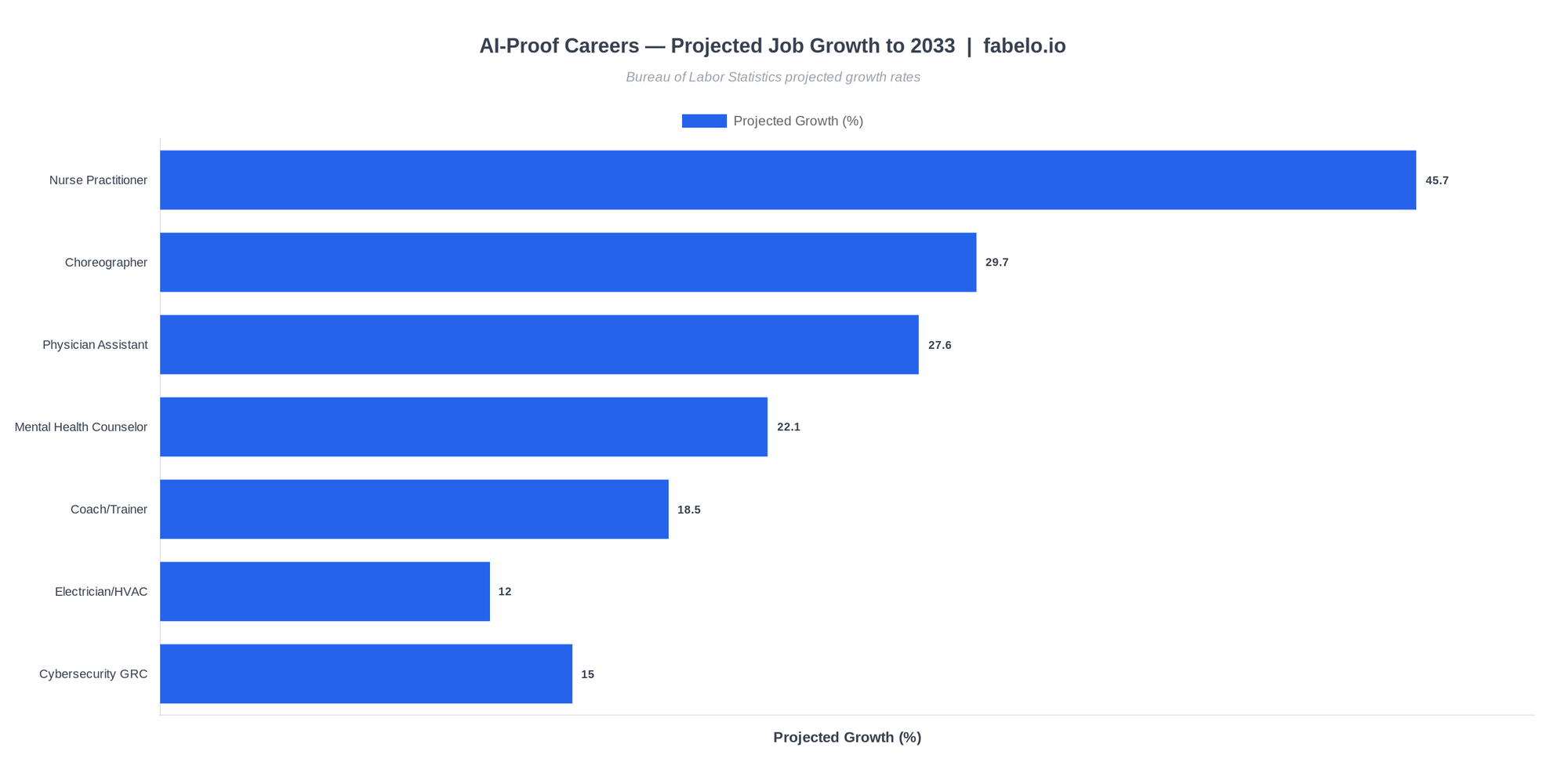
| Career | Projected Growth (to 2032) | Salary Range | Degree Required? | Primary AI Shield |
|---|---|---|---|---|
| Nurse Practitioner | 45.7% | $120K–$145K+ | Yes (Master's) | Physical exam + clinical judgment |
| Choreographer | 29.7% | $40K–$90K+ | No (portfolio-based) | Embodied human creativity |
| Physician Assistant | 27.6% | $115K–$135K | Yes (Master's) | Clinical decision-making |
| Mental Health Counselor | 22.1% | $55K–$90K | Yes (Master's) | Therapeutic relationship |
| Coach / Athletic Trainer | 17.5%–20% | $45K–$80K+ | Varies | Physical presence + motivation |
| Electrician / HVAC Tech | Strong (verify on BLS) | $55K–$120K+ | No (apprenticeship) | Physical labor, variable environment |
| Cybersecurity GRC Analyst | Strong (verify on BLS) | $90K–$200K+ | No (cert-based entry) | Human risk judgment + compliance |
| AI/ML Infrastructure Engineer | Very High (verify on BLS) | $140K–$250K+ | No (experience + certs) | Builds AI infrastructure itself |
| Technical Project Manager | High (verify on BLS) | $110K–$400K+ | No (experience-based) | Human relationship management |
| Cleared Govt Cloud Engineer | Very High (verify on BLS) | $150K–$200K+ | No (clearance + certs) | Security clearance + physical access |
AI-Proof Jobs of the Future: Tips for Freshers
If you're entering the workforce now — or early enough in your career that you're still making foundational decisions — here's what actually matters.
Don't start with salary. Start with automation risk. The single most important question to ask about any career you're considering is: does this job require a human to be physically present and make high-stakes judgment calls? If the answer is yes, you're in a relatively safe zone. If the job is primarily information processing and output generation — writing reports, reviewing standard contracts, entering and formatting data — you're in a vulnerable zone regardless of what it pays today.
Credentials that open AI-proof doors without a four-year degree:
- CompTIA Security+ → entry into cybersecurity ($60K–$90K starting)
- Cisco CCNA → networking and data center roles ($55K–$80K starting)
- AWS or Azure Cloud Practitioner → cloud support and engineering roles
- Licensed Practical Nurse (LPN) → healthcare entry point, median $54K
- Electrical Apprenticeship (IBEW or NECA programs) → path to master electrician
- HVAC certification (EPA 608) → entry into a growing, physically irreplaceable trade
AI fluency is a multiplier, not a threat. The freshers who will thrive in AI-resistant careers are those who learn to use AI tools as productivity amplifiers. A nurse practitioner who uses AI diagnostic assistance tools well is more valuable than one who ignores them. A cybersecurity GRC analyst who understands AI governance frameworks commands a premium. The goal isn't to hide from AI — it's to sit in a role AI can't do while wielding AI as a tool that makes you more effective.
Prioritize fields with structural labor shortages. Healthcare and skilled trades both have documented shortages that aren't going away. These shortages exist because the training pipelines are long (healthcare) or because the talent has aged out faster than new workers entered (trades). Both dynamics create hiring leverage and wage growth for people who commit to these fields now.
For specific AI proof jobs of the future tips for freshers in tech: entry-level IT support roles at government contractors are an underrated starting point. The job itself is modest, but the security clearance sponsorship that comes with it is the golden ticket to cleared engineer roles paying $150,000–$200,000+ within five to eight years.
Quick Comparison: AI-Proof Careers at a Glance
Watch This First
Watch: the Symoné B. Tech YouTube channel — The Best AI-Proof Tech Jobs (2026–2030) →
According to the Symoné B. Tech YouTube channel, what makes a job genuinely AI-proof comes down to three factors: it requires physical interaction with the real world, it demands high-stakes human-centered decision-making, or it involves building and securing the AI systems themselves. The channel makes a point that's easy to overlook — for every job AI displaces, it creates new demand for the people managing the infrastructure AI runs on. The roles that benefit most from AI's growth are the ones positioned closest to it.
The video also makes a compelling case for government-sector tech roles that require security clearances as the single most AI-proof category in tech. The clearance requirement creates a talent moat that no amount of AI advancement eliminates — you can't automate the need for a human with verified trustworthiness managing classified national security infrastructure. That combination of physical access requirements, critical infrastructure stakes, and security clearance barriers puts cleared cloud engineers and system administrators in an exceptionally protected position through the foreseeable future.
One specific data point from the video worth highlighting: Technical Project Manager roles at major tech companies have been documented at total compensation packages exceeding $700,000 annually for senior positions. That's not the median — but it illustrates how far the ceiling goes for human relationship management roles in high-stakes technical environments, where AI tools can assist with project tracking but cannot replace the human navigating team dynamics and stakeholder trust.
What Real People Are Saying
Reddit's career and future-of-work communities have been wrestling with this question seriously, and the consensus is more nuanced than most headlines suggest.
In r/Career_Advice, users consistently point to teachers, nurses, and social workers as the most reliably human-essential careers. Several commenters also pushed back on the panic itself — noting that AI tends to be overhyped in the short term and underhyped in the long term, and that wholesale replacement of professions happens much more slowly than tech press suggests.
In r/Futurism, the trades argument comes up repeatedly and forcefully. Users point out that vocational careers — the ones requiring physical skill in variable real-world environments — are fundamentally different from the white-collar work AI is disrupting. The point isn't that robots can't theoretically do physical labor someday; it's that deploying and maintaining general-purpose physical robots at scale remains economically and technically prohibitive for the foreseeable future.
In r/findapath, one user did detailed research ranking AI-proof jobs by both salary above $100K and number of job openings — landing on airline pilots, clinical healthcare practitioners, and cleared tech workers as the top three. The thread is worth reading for anyone trying to balance automation safety with earning potential. The consensus there: you don't have to choose between a well-paying career and an AI-resistant one. The overlap is significant.
In r/careerguidance, the most upvoted perspective is blunt: any job requiring physical presence and hands-on work is structurally protected. Plumbers, electricians, and nurses get cited most often. One commenter noted that the real risk isn't AI replacing these workers — it's management using AI productivity tools as justification to squeeze headcount in adjacent administrative roles.
What Readers Ask
What jobs make $3,000 a month without a degree?
Several AI-proof roles hit $3,000 per month ($36,000 annually) without a four-year degree — and many go well beyond it. Electrician and HVAC apprentices typically earn in this range within their first two years, with journeymen clearing significantly more. Entry-level cybersecurity roles, data center technicians, and licensed practical nurses all can reach or exceed this threshold with certifications rather than degrees. Dental assistants and medical assistants also fit this range in many markets. The key is choosing a trade or credential-based path in a field with structural labor demand.
What job pays $400,000 a year without a degree?
This is achievable but requires either exceptional performance in commission-based roles or reaching senior levels in high-compensation fields. Commercial real estate brokers, enterprise tech sales professionals, and successful self-employed software developers can earn at this level. In the AI-proof category specifically, senior cleared government cloud engineers and AI/ML infrastructure engineers with deep specialization can approach or exceed this in total compensation. Technical Project Managers at major tech firms have been documented at $400,000–$700,000+ total comp at senior levels — no degree required for many of these roles, only demonstrated expertise and track record.
Which jobs will AI replace by 2030?
The highest-risk roles in the near term are those centered on predictable information processing: data entry clerks, certain paralegal functions, basic customer service roles, junior copywriters doing templated content, and some accounting functions like routine bookkeeping. Radiology is frequently cited as a medical specialty where AI is making inroads, though radiologists are adapting rather than disappearing. The jobs most at risk share the trait of converting a defined input into a defined output according to consistent rules — exactly what current AI models do best.
Are engineering jobs safe from AI?
It depends heavily on the type of engineering. Civil engineers, structural engineers, and mechanical engineers working on physical-world projects — buildings, bridges, water systems, manufacturing equipment — are well-protected because their work is inherently about physical reality in all its complexity. Electrical engineers and hardware engineers designing chips and systems have strong prospects. Software engineers in certain specialties (AI/ML, security, systems architecture) are safer than those doing routine coding tasks that AI is increasingly capable of generating. The higher the stakes and the more variable the physical environment, the safer the engineering role.
What are the best AI-proof jobs for someone just starting out?
For freshers, the clearest paths are: (1) Trade apprenticeships in electrical, plumbing, or HVAC — most programs are free or low-cost and put you in a physically irreplaceable career within four years; (2) Entry-level IT at a government contractor — modest starting salary but a direct path to security clearance and $150K+ roles; (3) Licensed Practical Nursing — community college programs run 12–18 months and open the door to a healthcare career ladder; (4) Cybersecurity certifications (CompTIA Security+) paired with an entry-level help desk role — a proven path into GRC and higher cybersecurity positions. The common thread: choose a field with structural labor shortages and genuine human-presence requirements, then get the minimum viable credential to enter it.
Is remote work possible in AI-proof careers?
Some of the most AI-proof careers are inherently on-site (trades, clinical healthcare, surgery). But there's meaningful overlap between automation-resistance and remote capability. In r/findapath, users specifically discuss project management, consulting, and customer experience roles as combining automation resistance with remote flexibility. Cybersecurity GRC roles are increasingly hybrid or remote. Therapy and mental health counseling has moved substantially online post-pandemic, with telehealth platforms enabling licensed therapists to practice across state lines.
Your Next Steps
The question of which AI proof jobs of the future are worth pursuing isn't hypothetical anymore — it's one of the most practically important career decisions you can make right now. The displacement is real, it's underway, and waiting to see what happens is itself a choice with consequences.
Here's a concrete three-step action plan:
- Step 1: Audit your current or target role against the three AI shields. Does it require physical presence in a variable environment? Does it demand high-stakes human judgment with real legal or ethical accountability? Is it building or securing AI itself? If none of these apply, take that seriously. If at least one does, you're in a structurally sound position — focus on deepening that advantage.
- Step 2: Get one credential that opens a protected field within the next 12 months. You don't need a five-year plan right now. You need a CompTIA Security+ or an HVAC EPA 608 or an LPN program application. Pick the field that aligns with your interests and the AI shield it offers, then take the smallest concrete step to enter it. Smaller barriers to entry than you think separate you from these fields.
- Step 3: Learn AI tools as a practitioner in your chosen field — not instead of your field. A nurse practitioner who understands AI diagnostic tools, a GRC analyst who knows AI governance frameworks, a plumber who uses AI-assisted project management — these professionals earn more and face less displacement than those who treat AI as something happening to other people. The winning position is human expertise plus AI fluency, not human expertise versus AI.
The careers that will define the next two decades reward physical presence, emotional intelligence, irreplaceable judgment, and the ability to manage the AI systems everyone else relies on. Those aren't exotic skills. They're deeply human ones. The people who build toward them now will be the ones with options when the disruption accelerates.
About the Author
Written by Ufuk Yorulmaz
Digital entrepreneur and AI systems builder based in Istanbul. Founder of Fabelo.io, Aicall.pw (AI voice call automation), and WPcare. Has led digital strategy, automation, and SEO systems at PanicWorkz for over 16 years. Writes about AI tools, automation trends, and the future of work at Fabelo.
Disclaimer: This article is for informational purposes only. AI tool capabilities and pricing change frequently — verify before committing.
Last updated: April 12, 2026 · fabelo.io