

A compound interest calculator shows exactly what your money becomes when interest earns interest on itself. $10,000 at 7% annual return grows to $19,672 in 10 years — and $76,123 in 30 years, with no additional contributions. The difference between a 6% and 8% return on that same $10,000 over 30 years is more than $35,000. That math is why compounding is the foundation of every long-term savings plan.
This guide breaks down exactly how compound interest works, explains the compound interest formula in plain English, walks through a full worked example with monthly contributions, and shows you the difference between daily, monthly, and yearly compounding. Whether you're planning a retirement account, evaluating a high-yield savings account, or just trying to understand why starting early matters so much — this is the explainer you need.
Contents
- What Is Compound Interest?
- The Compound Interest Formula Explained
- How to Use a Compound Interest Calculator
- Compound Interest Calculator with Contributions: A Real Worked Example
- Daily vs. Monthly vs. Yearly Compounding: Does Frequency Matter?
- Compound Interest vs. Simple Interest: The Actual Difference
- How to Calculate Compound Interest in a Spreadsheet
- Compounding Frequency Comparison Table
- Watch This First
- What Real People Are Saying
- Quick Answers
- Your Next Steps
What Is Compound Interest?
Compound interest is interest calculated on both your original principal and the accumulated interest from previous periods. That's the entire concept. Simple in theory, extraordinary in practice.
With simple interest, you earn a fixed return on your starting balance only. Deposit $10,000 at 5% simple interest for 10 years and you earn $500 per year — exactly $5,000 in total interest, no more. Compound interest breaks that ceiling. In year one you earn $500. In year two, you earn 5% on $10,500 — so $525. In year three, 5% on $11,025 — $551.25. The amounts keep climbing because the base keeps growing. After 10 years, that same $10,000 at 5% compounded annually grows to $16,288.95. Simple interest would have produced $15,000. The $1,288.95 difference is purely the effect of compounding.
All rates and APYs mentioned in this article are for illustration purposes. Rates change frequently — always verify current rates directly with your financial institution before making decisions.
Now extend that timeline to 30 years. Same $10,000, same 5% annual rate. Compounded annually: $43,219.42. Simple interest: $25,000. The gap widens dramatically as time increases — which is exactly why financial advisors hammer on the importance of starting early. Time is the fuel that makes compounding explosive.
Compounding also works against you when you're the borrower. Credit card debt compounds daily at rates often exceeding 20% APR. A $5,000 balance at 22% APR, compounded daily, with no payments becomes a serious problem fast. Understanding compound interest means understanding both sides of that equation — the engine that builds wealth and the force that deepens debt.
The SEC's Investor.gov compound interest calculator exists specifically to help everyday Americans visualize this growth — it's free, clean, and requires no account. It's a solid starting point if you want to run quick projections before diving deeper.
The Compound Interest Formula Explained
The standard compound interest formula is:
A = P(1 + r/n)^(nt)
Where:
- A = the final amount (principal + interest)
- P = the principal (your starting amount)
- r = the annual interest rate as a decimal (so 6% = 0.06)
- n = the number of times interest compounds per year (12 for monthly, 365 for daily)
- t = time in years
Here's a concrete example. Say you deposit $5,000 at a 6% annual interest rate, compounded monthly, for 10 years. Plug in the numbers:
A = 5,000(1 + 0.06/12)^(12×10)
A = 5,000(1 + 0.005)^120
A = 5,000(1.005)^120
A = 5,000 × 1.8194
A = $9,096.98
Your $5,000 grew to over $9,000 — almost doubling — without you adding a single extra dollar. The interest earned is $4,096.98. That's money generated purely by compounding over a decade.
One thing worth highlighting: the formula above only handles a lump sum with no additional contributions. In r/MathHelp, users frequently point out exactly this — the standard A = P(1+r/n)^nt formula doesn't account for regular deposits. That requires a more involved formula, which we cover in the next section.
The formula also highlights three levers you can pull to grow your final balance: increase P (save more upfront), increase r (earn a better rate), or increase t (start earlier). Of those three, time has the most dramatic effect because it's the exponent. Doubling your time period doesn't double your return — it can quadruple or more, depending on the rate.
A quick side note on converting rates: if you see a monthly interest rate instead of an annual one, multiply it by 12 to get the annual rate. A 0.5% monthly rate equals a 6% annual rate. Always confirm whether a rate you see quoted is monthly or annual before plugging it into any compound interest calculator — getting that wrong throws off every number downstream.
How to Use a Compound Interest Calculator

Online compound interest calculators — like those at TheCalculatorSite.com or Calculator.net — ask for four to six inputs. Here's exactly what each field means and how to fill it in correctly.
Starting Amount (Principal): This is the money you have right now that you're putting to work. If you're starting from zero, enter 0. Don't inflate this number hoping it'll look better — accurate inputs produce useful projections.
Annual Interest Rate: Enter the rate as a percentage, not a decimal. A high-yield savings account might offer around 4–5% APY. An index fund historical returns would use something like 7–10%. Be realistic here. Using an overly optimistic rate will give you projections that fall apart in real life.
Compounding Frequency: This is where many people get tripped up. Most savings accounts compound daily. Most bond calculators default to annually. The more frequently interest compounds, the slightly higher your final balance. For a compound interest calculator monthly projection, set n = 12. For a daily compound interest calculator simulation, set n = 365.
Time Period: How many years do you plan to let the money grow? Even adding five extra years can add tens of thousands of dollars to a retirement projection. This input is arguably the most important — treat it honestly.
Regular Contributions: Many calculators include a field for monthly or annual deposits. This is where projections get really interesting. Even small monthly additions — $100, $200, $500 — stack up enormously over 20 or 30 years because each contribution starts its own compounding cycle.
Once you enter all inputs, the calculator outputs a final balance and usually a breakdown of principal vs. Interest earned. Some tools, like the one at myfsbonline.com, also generate a year-by-year growth schedule so you can see exactly when your accumulated interest starts outpacing your contributions. That crossover point — where growth starts doing the heavy lifting — is one of the most motivating things you can show someone who's skeptical about long-term investing.
One common mistake: confusing APY and APR. APY already bakes in the effect of compounding. APR does not. If a savings account advertises 5% APY compounded daily, you don't need to manually calculate compounding — the APY already reflects it. If you're using a rate listed as APR, you'll need to apply the compounding formula yourself.
Compound Interest Calculator with Contributions: A Real Worked Example
Here's where the real power shows up. Most people don't invest a lump sum and walk away. They contribute regularly — $200 a month from their paycheck, $500 a month into a Roth IRA, whatever the budget allows. A compound interest calculator with contributions handles this scenario differently than the basic formula.
The formula for future value with regular contributions is:
A = P(1 + r/n)^(nt) + PMT × [((1 + r/n)^(nt) - 1) / (r/n)]
Where PMT = the regular periodic payment amount.
Here is a walkthrough of a real example step by step.
Scenario: You're 30 years old. You have $10,000 already saved. You plan to contribute $400 per month. You expect an average annual return of 7%, compounded monthly. You want to know your balance at age 60 — 30 years from now.
Step 1 — Set your variables:
- P = $10,000
- r = 0.07 (7% annual)
- n = 12 (monthly compounding)
- t = 30 years
- PMT = $400/month
Step 2 — Calculate the growth of your initial lump sum:
10,000 × (1 + 0.07/12)^(12×30)
= 10,000 × (1.005833)^360
= 10,000 × 8.1165
= $81,165
Step 3 — Calculate the future value of your monthly contributions:
400 × [((1.005833)^360 - 1) / 0.005833]
= 400 × [(8.1165 - 1) / 0.005833]
= 400 × [7.1165 / 0.005833]
= 400 × 1,219.97
= $487,990
Step 4 — Add them together:
$81,165 + $487,990 = $569,155
What you actually put in: $10,000 + ($400 × 360 months) = $10,000 + $144,000 = $154,000
Total interest earned: $569,155 - $154,000 = $415,155
You contributed $154,000 over 30 years and ended up with $569,155. More than two-thirds of your final balance was generated by compounding — not by your own deposits. That ratio is what makes this concept so important to internalize.
In r/investingforbeginners, one user ran a similar projection — $500 per month at an 8% average return — and used it to visualize how small monthly investments snowball over time. The takeaway from that thread was consistent: the numbers only start looking impressive once you pass the 15-year mark. Before that, contributions dominate. After that, compounding takes over.
Daily vs. Monthly vs. Yearly Compounding: Does Frequency Matter?
The honest answer: compounding frequency matters, but probably less than you think — especially compared to the interest rate itself and how long you invest.
A daily compound interest calculator will produce a marginally higher balance than a monthly one, which produces a marginally higher balance than an annual one. The differences at typical savings account rates (4–5%) are real but not dramatic over a 10-year window.
Here's a concrete illustration. Starting with $10,000 at 5% for 10 years:
- Compounded annually: $16,288.95
- Compounded monthly: $16,470.09
- Compounded daily: $16,486.65
The difference between annual and daily compounding on $10,000 over 10 years is about $198. Not nothing, but not life-changing at that scale. Where frequency starts to matter more is at higher balances and longer time horizons — and especially with higher interest rates.
For savings accounts, most major banks compound daily and credit monthly. That means interest accrues every single day but shows up in your account balance once a month. For practical purposes, what matters most is the APY — which already accounts for the compounding frequency in a single standardized number.
For loans and credit cards, daily compounding is where you want to pay close attention. A credit card at 24% APR compounding daily is meaningfully worse than one at 24% APR compounding monthly. On a $5,000 balance with no payments: daily compounding produces a balance of roughly $6,356 after one year, versus $6,341 with monthly compounding. Again, not enormous — but over five years with minimum payments, the gap widens. The frequency penalty on debt is real.
For investment projections — stock market returns, index funds, 401(k) growth — annual compounding is standard. Most retirement calculators use it. The compound interest calculator monthly format is more common in savings and CD contexts, where the compounding schedule is explicit in the account terms.
Compound Interest vs. Simple Interest: The Actual Difference
Simple interest is calculated only on the original principal. Every period, you earn the same fixed dollar amount. The formula: A = P(1 + rt). Clean, predictable, and ultimately limited.
Compound interest calculates interest on principal plus all previously accumulated interest. The base grows every period, so the interest earned grows every period. That's the fundamental structural difference.
Simple interest shows up most often in short-term loans, certain auto loans, and some bonds. When you see a personal loan advertised with a fixed monthly payment that doesn't change over the life of the loan, it's usually simple interest — the math is calculated upfront and baked into your installment. That's actually fine for borrowers because there's no interest-on-interest penalty.
Compound interest governs savings accounts, CDs, mortgages (where your balance affects future interest charges), credit cards, and most investment vehicles. For savings, you want compounding. For debt, you want simple interest — or to pay it off fast enough that compounding doesn't have time to compound against you.
The crossover where compound interest gets dramatically better than simple interest happens around the 10–15 year mark at moderate rates. Before that, the difference is visible but modest. After that, the gap accelerates. This is the mathematical reason why "start saving in your 20s" is not just motivational talk — it's arithmetic.
How to Calculate Compound Interest in a Spreadsheet
You don't always need an online tool. Google Sheets and Excel both have a built-in function that handles compound interest projections including regular contributions — and it's faster than manually applying the formula.
The function is =FV(rate, nper, pmt, pv). Here's what each argument means:
- rate = interest rate per period (annual rate ÷ 12 for monthly)
- nper = total number of periods (years × 12 for monthly)
- pmt = payment per period (enter as negative if it's money leaving your pocket)
- pv = present value or starting balance (also negative if you're investing it)
Using the same scenario from our worked example above — $10,000 starting balance, $400/month contributions, 7% annual return, 30 years — the formula in a spreadsheet looks like this:
=FV(7%/12, 30*12, -400, -10000)
Result: $569,155 — matching our manual calculation exactly.
In r/personalfinance, a user confirmed this approach, noting that the =FV() function in Google Sheets gives results identical to specialized online calculators — and it's easy to build a personal version where you can swap assumptions and run scenarios instantly. The spreadsheet approach also lets you model variable contributions, which most online tools can't do.
TUTOR BASE's Google Sheets tutorial on compound interest calculations demonstrates exactly this workflow — showing how to set up a dynamic spreadsheet that recalculates your projected balance automatically as you adjust the rate, contribution amount, or time period. The advantage over fixed online calculators is full control: you can add a column for inflation-adjusted returns, model a contribution pause, or stress-test your assumptions.
For anyone serious about financial planning, building your own spreadsheet model is worth the 30-minute setup. You'll understand your numbers far better than if you just plug values into a black-box calculator and accept the output.
Compounding Frequency Comparison Table
| Compounding Frequency | Balance After 5 Years | Balance After 10 Years | Balance After 20 Years | Balance After 30 Years |
|---|---|---|---|---|
| Annually (n=1) | $12,762.82 | $16,288.95 | $26,532.98 | $43,219.42 |
| Monthly (n=12) | $12,833.59 | $16,470.09 | $27,126.40 | $44,677.44 |
| Daily (n=365) | $12,840.03 | $16,486.65 | $27,179.10 | $44,811.57 |
| Simple Interest | $12,500.00 | $15,000.00 | $20,000.00 | $25,000.00 |
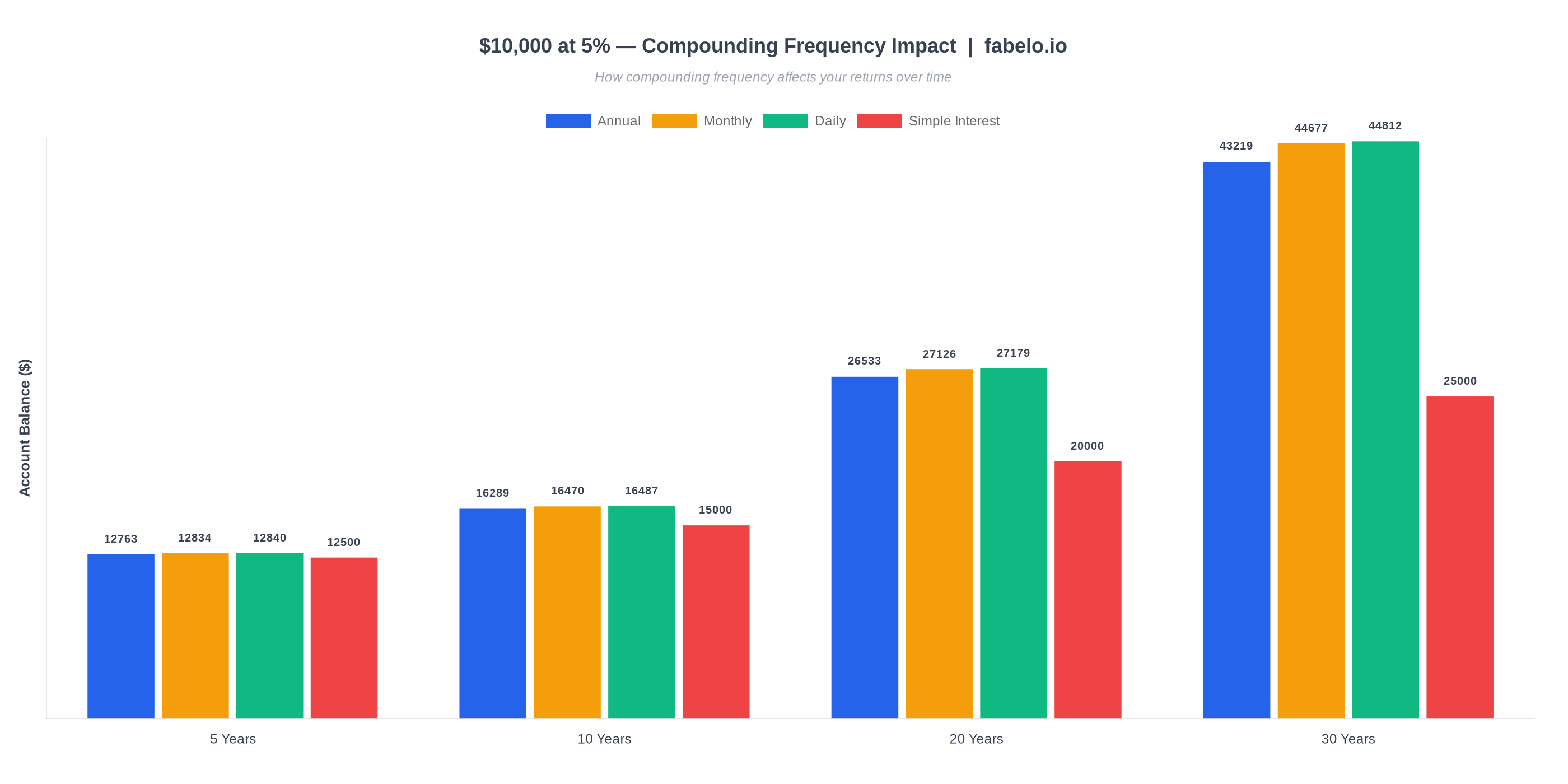
This table shows the final balance on a $10,000 deposit at various compounding frequencies and time horizons, assuming a 5% annual interest rate and no additional contributions. Use it as a quick reference when comparing savings products or evaluating how much compounding frequency actually changes your outcome.
The gap between daily and monthly compounding is small — under $135 over 30 years on a $10,000 deposit. The gap between any compounding and simple interest, on the other hand, is enormous: $19,811 over 30 years. The lesson is clear: compounding frequency is a minor optimization. Compounding versus not compounding is a major one.
Watch This First

Before setting up your own compound interest projections, this walkthrough is worth your time: Watch: TUTOR BASE — How to Calculate Compound Interest in Google Sheets →
the TUTOR BASE YouTube channel covers the practical side of building a working compound interest model directly in Google Sheets — the kind of hands-on setup that lets you adjust variables in real time rather than re-entering inputs into an online form. The specific value of this approach is being able to test scenarios side by side: what happens if your return drops from 8% to 6%? What if you pause contributions for two years? A dynamic spreadsheet answers those questions instantly.
The tutorial also demonstrates how the spreadsheet's =FV() function mirrors the manual compound interest formula exactly — which is useful for confirming that your calculations are correct and building real intuition for how each variable affects the output. If you've ever looked at a compound interest calculator result and wondered "where does that number actually come from," this type of walkthrough makes the mechanics transparent.
What Real People Are Saying
Reddit communities are where you see compound interest calculators used in genuinely real financial planning contexts — and the threads reveal some patterns that online calculators don't always address.
In r/TheMoneyGuy, users wrestle with an important and underappreciated question: when a compound interest calculator projects $3 million in 20 years, does that number account for inflation? The thread consensus was no — most calculators output nominal dollars, not inflation-adjusted dollars. At a 4% withdrawal rate, $3 million nominal in 2045 isn't the same as $3 million today. Users recommended running a parallel calculation with a rate reduced by expected inflation (typically 2–3%) to get a more realistic real-dollar projection. It's a smart adjustment that most people skip.
Over in r/personalfinance, the recurring challenge was modeling variable contributions in a spreadsheet — months where someone saves more or less depending on income. Standard online calculators assume a fixed monthly contribution, which doesn't reflect reality for freelancers, commission earners, or anyone with irregular cash flow. The thread documented several spreadsheet approaches for building row-by-row compounding calculations that can handle changing deposit amounts each month.
And in r/Rich, a user highlighted how even a basic, no-frills compound interest calculator can be valuable for quick sanity-checking during investment planning sessions — running projections fast without needing to open a spreadsheet. The post got traction because it captured something real: the best calculator is the one you'll actually use consistently, not the most feature-rich one.
Quick Answers
What is compound interest in simple terms?
Compound interest means you earn interest on your interest. Once interest is added to your balance, it becomes part of the principal for the next period, so the amount you earn grows over time. It's the reason $10,000 invested at 7% for 30 years grows to over $76,000 — not just $21,000 (which is what simple interest would produce).
What is the compound interest formula?
The standard compound interest formula is A = P(1 + r/n)^(nt), where A is the final amount, P is the principal, r is the annual interest rate (as a decimal), n is the number of compounding periods per year, and t is the number of years. For calculations that include regular contributions, use the future value formula: A = P(1 + r/n)^(nt) + PMT × [((1 + r/n)^(nt) - 1) / (r/n)].
How does a daily compound interest calculator differ from a monthly one?
A daily compound interest calculator sets n = 365, meaning interest is recalculated and added to your balance every single day. A monthly calculator uses n = 12. The resulting balance from daily compounding is slightly higher, but the practical difference is small at typical savings rates. On $10,000 at 5% for 10 years, daily vs. Monthly compounding produces a difference of about $16.56. The rate itself matters far more than the frequency.
How do I calculate monthly compound interest?
To calculate monthly compound interest manually, use the formula with n = 12. Take your annual rate, divide by 12 to get the monthly rate, add 1, raise it to the power of total months, then multiply by your principal. For $5,000 at 6% annual (0.5% monthly) for 24 months: 5,000 × (1.005)^24 = 5,000 × 1.1272 = $5,636. Or in a spreadsheet: =FV(6%/12, 24, 0, -5000).
Does compounding frequency make a big difference?
At typical savings rates, the difference between daily and monthly compounding is minimal — usually under 0.1% of the final balance over a decade. What makes a substantial difference is the interest rate itself and how long you stay invested. Moving from a 2% APY savings account to a 5% APY account has a far greater impact on your balance than moving from annual to daily compounding at the same rate.
Can I use a compound interest calculator for debt?
Yes, and you should. The same formula works for both growth (savings) and cost (debt). Plug in your current balance as P, your APR as r, and your compounding frequency (daily for most credit cards). This shows you how fast your debt grows with minimum payments — and how much you save by paying extra each month. It's a useful reality check for anyone carrying a balance.
What's the difference between APY and APR in compound interest calculations?
APR (Annual Percentage Rate) is the base interest rate before compounding. APY (Annual Percentage Yield) is the effective rate after compounding is applied. If a savings account offers 4.89% APR compounded daily, the APY comes out to approximately 5.00%. When using a compound interest calculator, if you have the APY, you can use it as your rate with annual compounding (n=1) and get the correct answer. If you have APR, you need to use the actual compounding frequency.
Your Next Steps
Compound interest is not a complicated concept — but seeing it in action with your actual numbers is different from understanding it abstractly. Here's a clean three-step action plan to put this to use immediately.
Step 1: Run your own projection today. Use Investor.gov's free compound interest calculator with your real numbers — your current savings balance, your monthly contribution, and an honest expected return rate. See what your balance looks like in 10, 20, and 30 years. Most people find the 30-year number either motivating or alarming, and both reactions are useful.
Step 2: Identify your biggest lever. After seeing your projection, ask: am I limited by the interest rate I'm earning, the amount I'm contributing, or the time I have left? If you're in a savings account earning 0.5% when high-yield accounts are available at 4–5%, the rate is your problem. If your rate is solid but your monthly contribution is $50, the contribution is your problem. Focus on the variable that moves your final number the most.
Step 3: Build a spreadsheet model. Use the =FV() function in Google Sheets to create a version you can stress-test. Model what happens if your return drops by 2%. See what one extra year of contributions adds. Build in an inflation adjustment. A working model you control is more valuable than any fixed-number projection from an online tool — because your financial life will change, and your model should change with it.
The math behind compounding is simple. The discipline to let it work is harder. But once you've seen your own numbers grow on a projection sheet, the case for consistent investing becomes a lot easier to maintain.
About the Author
Written by Varn Kutser
Personal finance writer focused on savings, budgeting, and building wealth at Fabelo.io. Cuts through the noise to find accounts that actually earn.
Disclaimer: Rates and terms mentioned in this article are subject to change. Verify current rates directly with financial institutions before opening any account.
Last updated: April 11, 2026 · fabelo.io