
How To Earn Passive Income Online Without Investment: A Complete Step-by-Step Guide
You can earn passive income online without investment using affiliate marketing, digital products, and content creation — starting with $0 and a free platf


You can start earning passive income online without investment by using free platforms, skills you already have, and business models that cost nothing to launch. Affiliate marketing, digital product sales, and content monetization through free tools can all generate recurring income — some people report building streams that reach $50–$100/day within 6–12 months of consistent effort.
The catch nobody tells you upfront: "passive" is a spectrum. Every strategy here requires real work on the front end. But the payoff is income that keeps arriving after the initial effort is done — a blog post you wrote six months ago still earning affiliate commissions, a digital template you made in Canva still selling on Etsy. That's the actual goal. Not magic, just leverage.
This guide covers the most proven, zero-cost methods ranked by realistic income potential and beginner accessibility. If you're also exploring other ways to supplement your income, the best side hustle ideas for beginners guide covers additional options worth stacking alongside these approaches.
Contents
- Understand What Zero-Investment Passive Income Actually Means
- Step One: Start With Affiliate Marketing on Free Platforms
- Step Two: Create and Sell Digital Products for Free
- Step Three: Monetize Content With Google AdSense and Display Ads
- Step Four: Build a Niche Website or Blog at Zero Cost
- Step Five: Use Print on Demand to Earn Without Inventory
- How These Passive Income Streams Compare
- Watch This First
- What Real People Are Saying
- Frequently Asked Questions
- Your Next Steps
Understand What Zero-Investment Passive Income Actually Means
Before picking a method, get honest about what "no investment" actually covers. It means no money — but not no effort, no time, and no learning curve. The strategies that generate passive income with no initial funds all follow the same pattern: you invest significant time upfront to build an asset (content, a product, an audience), and that asset then generates income with minimal ongoing maintenance.
Physical products need inventory. Services need your active time. But digital assets are different. A well-written blog post, an Etsy template, or an affiliate link embedded in a YouTube video can generate income every single day without you touching it. That's the model this guide focuses on exclusively.
There's also a mindset trap worth naming directly. Many beginners jump between five different strategies simultaneously, make zero traction on any of them, and conclude "passive income online is a scam." It's not — but spreading thin across multiple untested models is. The most effective approach is to pick one method, build it properly, and only add a second stream once the first is generating consistent income. Consistent effort compounds. Random effort doesn't.
As one user in r/sidehustle put it plainly: there is no guaranteed path to earning a living online without either capital or risk tolerance — but reducing financial risk while maximizing time investment is absolutely achievable and is exactly what the strategies below are designed to do.
Earning ranges in this guide reflect publicly listed rates on freelance platforms, job boards, and community-reported figures. Actual earnings vary by skill level, niche, and hours invested.
Step One: Start With Affiliate Marketing on Free Platforms
Affiliate marketing is the single most accessible way to generate passive income streams with no investment because the barrier to entry is essentially zero. You sign up for a free affiliate program, get a unique tracking link, share it in content you create on free platforms, and earn a commission every time someone buys through your link. No product creation, no inventory, no customer service.
Here's how to actually do it:
- Pick one niche. Not "everything." One focused topic — personal finance tools, fitness gear, kitchen gadgets, software for freelancers. Niche focus is what makes your recommendations credible and your content findable.
- Join free affiliate programs. Amazon Associates accepts beginners with no traffic requirements. ShareASale and CJ Affiliate have thousands of merchants across every niche. For software products, Impact connects you to SaaS brands that often pay 20–40% recurring commissions.
- Create content on free platforms first. Medium, Pinterest, and YouTube all have massive built-in audiences and require $0 to start publishing. A Medium article targeting a specific search query — "best budgeting apps for freelancers 2026" — can rank on Google and drive affiliate clicks for years.
- Write reviews and comparison content. These convert far better than general informational posts because the reader is already close to a buying decision. "X vs. Y: which is better for [specific use case]" is a proven format.
- Add links naturally and disclose them. The FTC requires clear disclosure that you earn commissions from affiliate links. This isn't just legal compliance — readers trust transparent recommenders more, which actually increases conversion rates.
Commission rates vary dramatically by program. Amazon typically pays 1–10% depending on category. Software affiliate programs regularly pay 30–50% recurring monthly commissions, which means a single referral can generate income every month indefinitely as long as the customer stays subscribed. That's true passive income. If you want to track the compounding effect of recurring commissions over time, a compound interest calculator can model how small monthly amounts stack up.
Realistic timeline: most beginners see their first affiliate commissions within 30–90 days if they're publishing consistently. Reaching $100/day from affiliate marketing alone typically takes 12–24 months of consistent content output. That's not discouraging — it's an honest timeline that sets you up for success instead of disappointment.
Step Two: Create and Sell Digital Products for Free

Digital products are arguably the purest form of how to make passive income online for free. You create something once — a template, an ebook, a Notion dashboard, a Canva graphic pack — and it sells repeatedly with zero additional effort or cost per unit. No shipping. No inventory. No refund logistics for physical goods. Just a file that gets downloaded.
The best part for beginners: you can create professional-looking digital products entirely with free tools.
- Canva (free tier) — Use it to create resume templates, wedding invitation suites, social media content calendars, Instagram post packs, or business card designs. The free version is genuinely capable.
- Notion (free) — Build dashboards, productivity systems, habit trackers. Notion templates sell well on Etsy and Gumroad for $5–$25 each.
- Google Sheets (free) — Budget trackers, content calendars, client management spreadsheets. Functional spreadsheet products consistently outsell prettier alternatives because buyers care about utility.
Where to sell with no upfront fees:
- Etsy — Listing fee is $0.20 per item (minimal, not zero, but very low). The marketplace has built-in search traffic, which is enormously valuable for new sellers with no existing audience.
- Gumroad — Free to start, takes a percentage of each sale. No monthly fee. Great for creators who want to sell directly without building a full e-commerce site.
- Ko-fi — Free plan available, lets you sell digital products and accept tips. Works well for creators with a small but loyal social following.
The strategy that works: research what's already selling. On Etsy, sort by "most reviews" in your category to see what buyers actually want. Don't create what you think is clever — create what the market is already buying. Users in r/passive_income consistently recommend starting with Canva-customized templates priced at the lower end of the market to generate early reviews, then raising prices once you have social proof.
Step Three: Monetize Content With Google AdSense and Display Ads
Display advertising through Google AdSense is one of the most genuinely passive income models available — once the content is live and approved, ads run automatically and you earn revenue based on impressions and clicks with no additional work required. As outlined in Forbes' breakdown of ways to earn $100/day online, AdSense tops many lists precisely because it's hands-off once established.
Here's the realistic picture:
AdSense RPM (revenue per 1,000 pageviews) varies hugely by niche. Finance content can earn $15–$30 RPM. Lifestyle or general interest content might earn $3–$8 RPM. To make meaningful money, you need traffic. A site getting 50,000 monthly pageviews in a finance niche could realistically generate $750–$1,500/month in display ad revenue with zero ongoing effort once the content is written.
Getting there requires publishing consistently on a free platform (WordPress.com, Blogger) or a self-hosted blog. The path:
- Create a blog focused on one topic with clear audience intent
- Publish 20–30 pieces of high-quality, search-optimized content
- Apply for AdSense (requires a working site with original content)
- As traffic grows, consider upgrading to higher-paying ad networks like Mediavine (requires 50,000 sessions/month) or Raptive (formerly AdThrive)
Combining AdSense with affiliate links on the same site stacks two passive income streams on top of the same content — which is why content creators who understand this model can eventually hit $100/day without any ongoing active work.
Step Four: Build a Niche Website or Blog at Zero Cost
A niche website is the infrastructure that supports multiple passive income streams simultaneously. The same piece of content can earn affiliate commissions, display ad revenue, and even drive email subscribers who eventually buy your digital products. It's the highest-leverage asset you can build for free.
Free platforms to start:
- WordPress.com (free plan) — Functional, credible, and widely respected. The free plan has limitations, but it's more than sufficient to get started and prove the concept before investing in hosting.
- Blogger — Google's free blogging platform. Supports AdSense natively and is completely free to use with a .blogspot.com subdomain.
- Medium — Built-in audience, Partner Program that pays based on reading time, and strong SEO authority. Writing on Medium can surface your content to new readers without any traffic-building work on your part.
The key to a successful niche site is specificity. "Health" is not a niche. "Recovery nutrition for recreational marathon runners" is a niche. The narrower your focus, the less competition you face for search traffic, and the more authoritative your site appears to both Google and your readers.
Users in r/povertyfinance consistently note that niche websites and blogs remain one of the most reliable long-term passive income sources — one that doesn't require selling your time. Digital products (templates, planners, spreadsheets) combined with a niche blog create a particularly strong combination because the blog drives traffic and the products monetize that traffic more efficiently than ads alone.
Building a niche site also pairs naturally with disciplined financial habits. If you're reinvesting early earnings to eventually upgrade to paid hosting, following a zero-based budgeting approach helps you allocate those small wins intentionally.
Step Five: Use Print on Demand to Earn Without Inventory
Print on demand (POD) is how to generate passive income with no initial funds while still selling physical products. The model: you upload a design to a platform like Printful, Redbubble, or TeePublic, and when a customer orders, the platform prints and ships the product directly to them. You collect the margin. You never touch inventory, you never pay upfront, and the product only gets made when someone orders it.
As Yahoo Finance noted in its roundup of low-effort online income methods, print on demand consistently ranks among the most accessible models for beginners because the only input required is design work — and free tools like Canva handle that.
Steps to launch a POD income stream for free:
- Create a free account on Redbubble or TeePublic. Both are free to join and have built-in marketplaces — you don't need to drive your own traffic initially.
- Design for a passionate niche. Pet owners, hobby groups, specific professions, fandoms, and regional pride communities all buy merchandise consistently. "Generic funny quote" shirts compete against millions of listings. "Golden retriever owners who also do CrossFit" is an example of specificity that cuts through.
- Upload consistently. POD is a volume game at first. Creators who earn meaningful passive income from POD typically have hundreds of designs live, not dozens.
- Use Pinterest and free social posts to drive traffic to your store listings, especially in the first 6 months before organic marketplace traffic kicks in.
Realistic monthly earnings from POD range widely — beginners might earn $20–$100/month in their first few months. Creators with large catalogs and niche-focused stores commonly report $500–$2,000/month. The ceiling is genuinely high, but the base requires patience and volume.
How These Passive Income Streams Compare
| Strategy | Startup Cost | Time to First Income | Passive Scale Potential | Best For |
|---|---|---|---|---|
| Affiliate Marketing | $0 | 30–90 days | High | Writers, content creators |
| Digital Products | $0 (Gumroad/Ko-fi) or minimal (Etsy) | 1–30 days | Very High | Designers, teachers, organizers |
| Display Ads (AdSense) | $0 | 3–12 months | Medium-High | Bloggers, writers |
| Niche Blog / Website | $0 | 3–18 months | Very High (stacks streams) | Long-term thinkers |
| Print on Demand | $0 | 2–8 weeks | Medium | Designers, niche community fans |
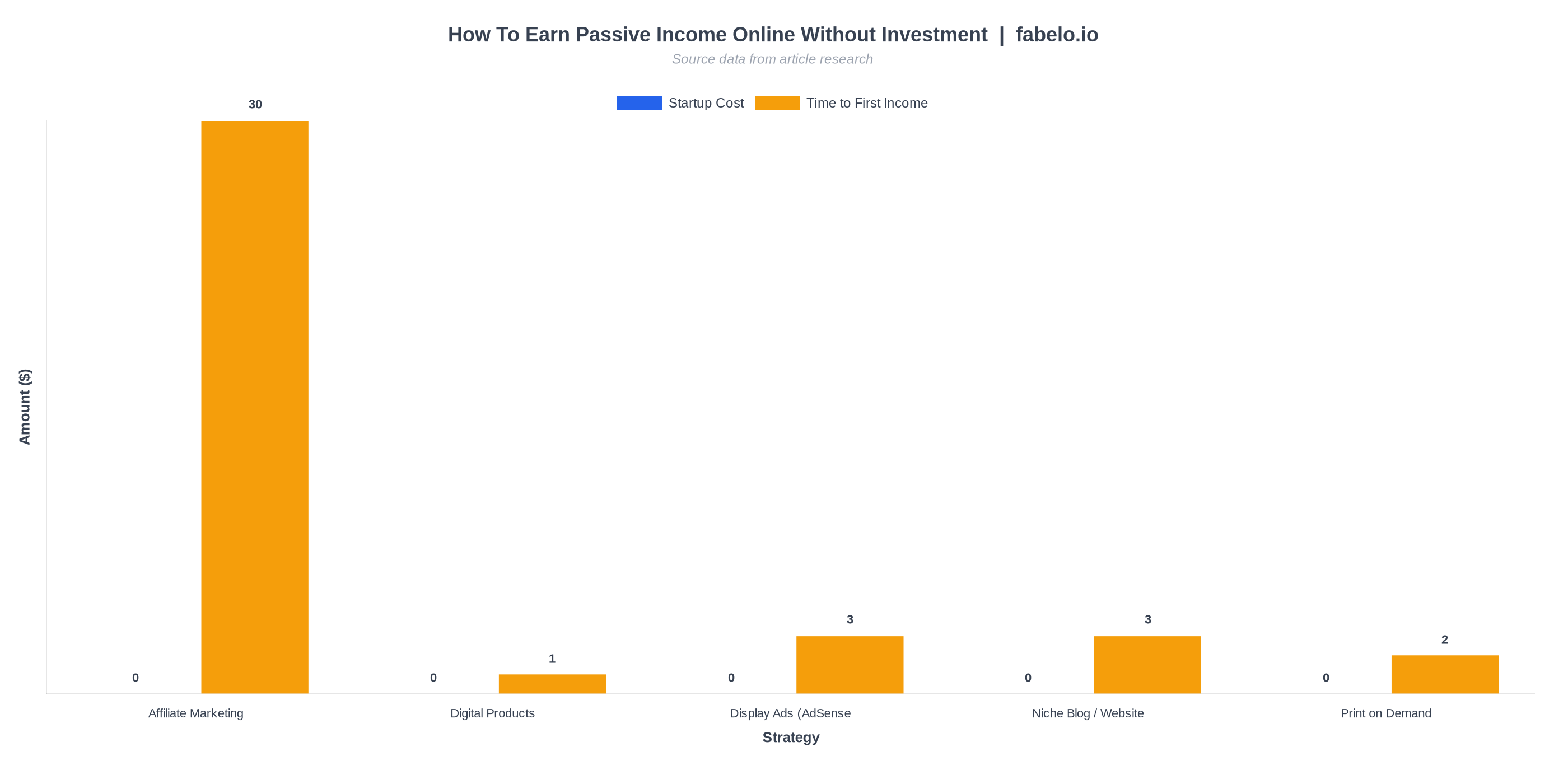
Picking the right strategy depends on your existing skills, available time, and patience for building. Here's an honest side-by-side look:
The highest-leverage combination for most beginners: start with digital products (fastest time to first sale), use a free blog or Medium to support affiliate marketing (long-term passive traffic), and stack display ads once the blog reaches meaningful traffic. Three income streams, all built on the same content effort.
Watch This First
Watch: the Sean Dollwet YouTube channel on building passive income from zero →
According to the Sean Dollwet YouTube channel, one of the most important filters beginners should apply before choosing any online income model is checking two things simultaneously: whether real market demand exists for what you're building, and whether the model requires significant upfront capital. Most beginners fail because they optimize for only one of these — they chase low-cost ideas nobody wants, or they chase in-demand models that cost too much to test safely.
The channel's analysis of digital products is particularly instructive: unlike physical inventory, digital products have no per-unit cost, no storage requirements, and no logistical risk. If a product doesn't sell, you've only lost time — not money. That asymmetry makes digital products uniquely well-suited to zero-investment income building. The channel also highlights that service businesses (freelancing, consulting) are often mistaken for passive income — you're actually just trading time for money in a different format, which creates an income ceiling and burnout risk that purely passive models avoid.
What Real People Are Saying
The ground-level reality from actual practitioners is more nuanced than most guides admit — and more encouraging than the skeptics suggest.
Reddit users in r/passive_income frequently point to affiliate marketing combined with free blogging platforms like Medium and WordPress as the most accessible entry point for people with zero capital. The recurring theme: start on a platform with existing traffic (so you're not building an audience from scratch), pick one niche, and be consistent for at least 90 days before evaluating results.
In r/passive_income, users specifically recommend FreeCash as a beginner-friendly starting point — it pays in cash or crypto and mixes surveys, tasks, and app offers. It won't replace a full income, but several users report it as a useful way to generate the first $20–$50 online, which builds enough confidence to pursue bigger strategies.
Users in r/sidehustle who earn consistently from online income describe daily consistency as the non-negotiable ingredient. One commonly cited approach: treat the first income online — even if it's $5 from a digital template sale — as validation, not a payday. That first sale proves the model works and funds the motivation to scale.
Frequently Asked Questions
What's the easiest passive income stream to start with absolutely no money or experience?
Affiliate marketing on a free platform like Medium is the lowest barrier entry point. Sign up for Amazon Associates, write a detailed product review or comparison article on Medium, and embed your affiliate links. The first commission can arrive within weeks if the article targets a specific buyer-intent search query. No website, no investment, no experience required — just useful writing.
Can you realistically earn $100 a day without investment, and how long does it typically take?
Yes, but not immediately. Reaching $100/day from purely passive sources typically takes 6–18 months of consistent effort, depending on the strategy. Affiliate marketers who publish 3–5 solid articles per week, digital product sellers with 20+ listings live, and bloggers with growing organic traffic all report crossing the $100/day threshold within that window. The timeline compresses significantly when you stack multiple streams (affiliate + digital products + ads) on the same content.
Which free platforms pay you to write content without needing your own website?
Medium's Partner Program pays writers based on reading time from paying Medium members — some writers report earning $200–$1,000/month from a catalog of 30–50 articles. Vocal Media also pays per read. Both platforms have built-in audiences and require zero investment to start publishing. Neither replaces a personal blog for long-term affiliate income, but both are excellent starting points for testing your niche before building your own site.
How do digital product sellers on Etsy make passive income, and what sells best?
Etsy's best-selling digital products in the no-investment category include resume templates, wedding printables, Notion productivity dashboards, social media content calendars, and budget planners. Sellers create these using free Canva or Google Sheets, list them for $5–$20, and the files deliver automatically upon purchase. A single well-optimized listing can generate dozens of sales per month with no additional work after the initial setup. Research what's selling by sorting Etsy's category pages by "Most Reviews" — this surfaces proven demand instantly.
What's a realistic first-month income expectation for someone starting from zero?
Brutally honest answer: probably $0–$50 in month one. Most passive income strategies have a lag period where you're building before you're earning. Print on demand and digital products on established marketplaces can generate the first sale within days if you target the right niches. Affiliate marketing and blogging take longer. Setting a 90-day target of $100 total — not per month — is a more realistic and motivating benchmark that keeps most beginners in the game long enough to see real results.
Are survey sites like Swagbucks worth including as part of a passive income strategy?
Survey sites are not passive income — they're low-paid active work. Swagbucks and similar platforms pay anywhere from $0.50 to $5 per survey, and completing enough to reach meaningful income requires several hours daily. They're useful as a very first step to generate your first few dollars online, but they have no compounding effect and no scalability. Use them to build initial confidence, then redirect that time toward affiliate content or digital products that pay you repeatedly for effort you put in once.
Your Next Steps
The biggest mistake people make when learning how to earn passive income online without investment is spending weeks researching instead of hours building. Here's a focused three-step action plan that gets you moving today:
- This week: Pick one strategy from this guide — ideally digital products if you're creative, or affiliate marketing if you prefer writing. Create your first asset: one Canva template listed on Gumroad, or one affiliate review article published on Medium. Done is infinitely better than perfect here.
- Days 8–60: Publish or create consistently. For affiliate content, target at least 8–10 articles before evaluating performance. For digital products, aim for 10+ listings. Volume creates data, and data tells you what to double down on.
- Month 3 onward: Stack a second income stream on top of your first. If affiliate articles are getting traffic, add AdSense. If digital products are selling, create a free blog that drives buyers to your Etsy or Gumroad store. Each stream you add multiplies the value of the work you've already done.
The path to generating passive income with no initial funds isn't mysterious — it's just longer than most people expect and more achievable than most people believe. The strategies outlined here are the same ones people in r/passive_income and finance communities report actually working. Start one thing. Build it consistently. Then scale what proves itself.
If you're building online income alongside a regular job and want a system for managing what you earn, the paycheck budgeting guide covers how to allocate income from multiple sources without losing track of your finances.
About the Author
Written by Fabelo
The Fabelo editorial team covers career strategies, job market trends, and professional development. Research-backed guides for ambitious professionals.
Disclaimer: This article is for informational purposes only. Earning figures and income estimates in this article reflect publicly available data and general market research. Your results will vary based on effort, niche, and market conditions. Always do your own research before making financial decisions.
Last updated: April 16, 2026 · fabelo.io