
How To Budget Your Paycheck: A Complete Step-by-Step Guide
Learn how to budget your paycheck step by step — with real formulas, a worked example, and free calculator tools to manage your money every month.


Budgeting your paycheck means assigning every dollar a job before you spend it. The most effective starting point: the 50/30/20 rule — 50% to needs, 30% to wants, 20% to savings and debt. On a $4,000 take-home, that's $2,000 for bills, $1,200 for discretionary spending, and $800 toward financial goals. Takes 15 minutes to set up. Works on any income.
The core framework is simpler than most people think: calculate your actual take-home pay, choose a budget rule that fits your life, assign spending categories with specific dollar caps, and reconcile what's left. Do that consistently and you'll know exactly where every dollar goes — which is the only thing that separates people who save money from people who wonder where it all went.
Contents
- Step One: Calculate Your Real Take-Home Pay
- Step Two: Choose a Budget Rule That Matches Your Life
- Step Three: Assign Every Dollar to a Category
- Step Four: Work Through a Real Example From Start to Finish
- Step Five: Handle Biweekly and Variable Paychecks
- How To Budget Your Paycheck Using Free Online Calculators
- Budget Method Comparison Table
- Watch This First
- What Real People Are Saying
- Frequently Asked Questions
- Your Next Steps
Savings estimates in this guide are based on national averages, community-reported figures, and published household spending data. Actual savings vary by location, household size, and spending habits.
Step One: Calculate Your Real Take-Home Pay
Your salary is not your budget number. Your take-home pay — what actually lands in your bank account after taxes, insurance premiums, and retirement contributions are deducted — is the only figure that matters for budgeting purposes. This distinction trips up a lot of first-time budgeters who plan based on their gross salary and then wonder why the numbers never add up.
Here's the formula:
Take-Home Pay = Gross Pay − Federal Tax − State Tax − FICA (Social Security + Medicare) − Health Insurance Premium − 401(k) or 403(b) Contribution − Any Other Pre-Tax Deductions
If you're a salaried employee, the easiest source of truth is your most recent pay stub. Look for the "net pay" line — that's your real number. If you're trying to estimate before your first paycheck arrives, tools like the ADP Salary Paycheck Calculator run gross-to-net calculations across all 50 states and account for filing status, allowances, and benefit deductions. It's free and requires no account.
For example, someone earning $60,000 a year in Texas (no state income tax) with a single filing status, standard deduction, and no 401(k) contribution will take home roughly $48,000 annually, or about $4,000 per month. That's the number you budget against — not $5,000.
If you're paid hourly, the calculation adds one step. Multiply your hourly rate by your average weekly hours, then multiply by 52 to get annual gross, then apply the same deduction logic. An hourly paycheck calculator (ADP offers one as well) handles this automatically if you don't want to do the arithmetic manually.
One detail many people overlook: pre-tax deductions like 401(k) contributions and health insurance premiums actually reduce your taxable income, so the take-home hit is smaller than the dollar amount suggests. A $200/month 401(k) contribution doesn't cost you $200 in take-home pay — it costs you somewhere between $140 and $170 depending on your marginal tax bracket. Worth keeping that in mind when deciding how much to contribute.
Step Two: Choose a Budget Rule That Matches Your Life
Once you know your take-home number, you need an allocation framework. There are several worth knowing about, and the right one depends on your income level, financial goals, and how much tracking detail you can realistically sustain.
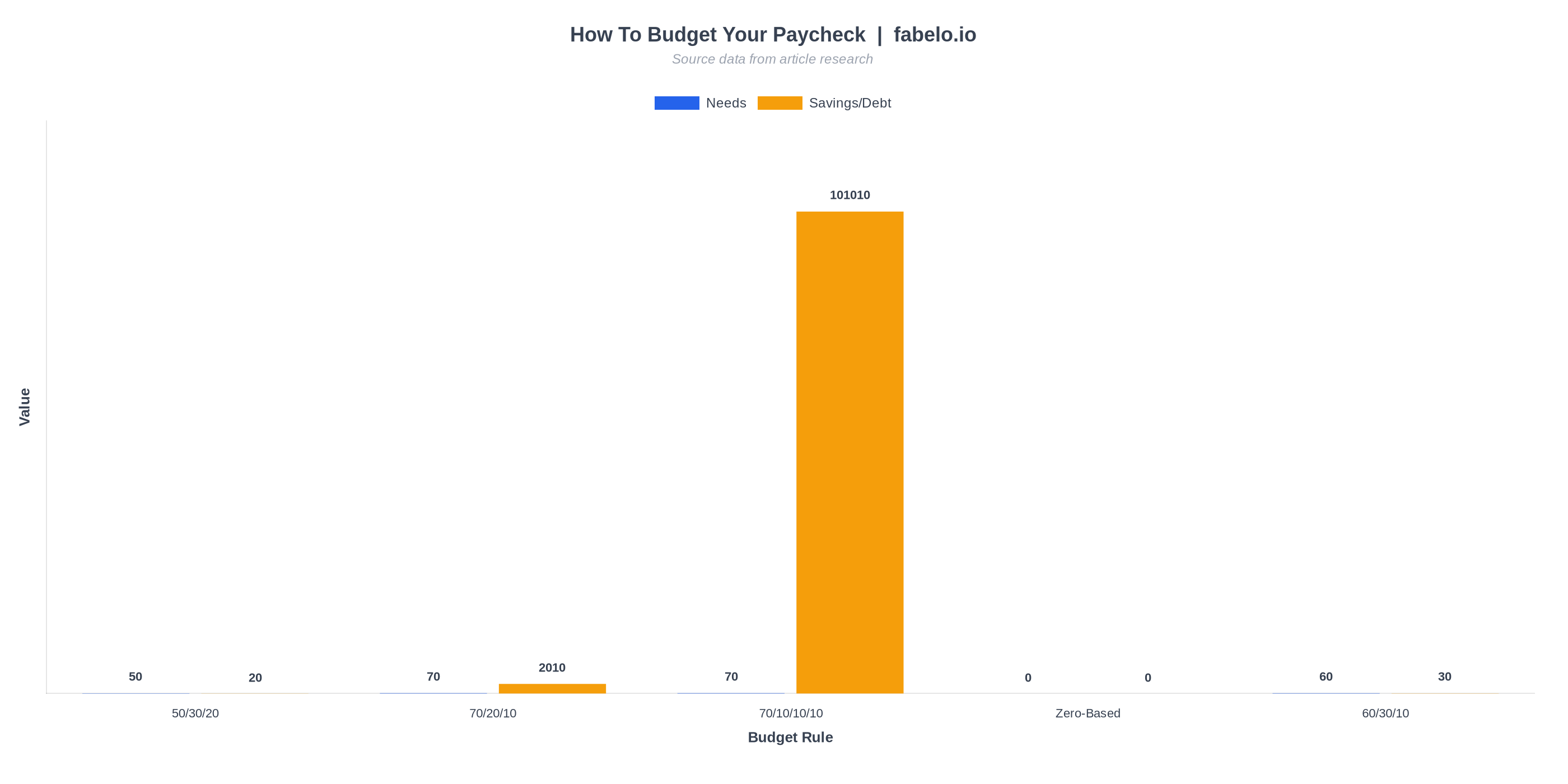
The 50/30/20 Rule is the most widely recommended starting framework. As Voya's budget calculator describes it: up to 50% of after-tax income goes toward needs, 30% toward wants, and 20% toward savings and debt repayment. It's flexible enough for most income levels and simple enough to stick with. The main weakness: in high cost-of-living cities, 50% often isn't enough to cover housing, transportation, and groceries — which forces you to either cut wants aggressively or revisit the percentages.
The 70/20/10 Rule is a looser version that allocates 70% to living expenses (needs and wants combined), 20% to savings, and 10% to debt repayment or giving. This works well for people early in their careers who have student loans but also want a meaningful savings rate.
The 70/10/10/10 Rule goes further by breaking down the savings bucket: spend 70%, save 10%, invest 10%, and give or donate 10%. The philosophy here is "pay yourself first" — the first 30% of your paycheck is directed to your future, not your present. This rule is particularly strong for people who want to build both an emergency fund and long-term investments simultaneously without having to manually decide each month.
Zero-Based Budgeting is the most rigorous approach. Every dollar of take-home pay is assigned a specific purpose until the balance reaches exactly zero. This doesn't mean you spend everything — savings and investments count as categories. Ramsey Solutions' budget calculator is built on this methodology. It's the most effective system for people who have struggled with overspending, but it requires more upfront work and monthly maintenance than percentage-based rules.
The 60/30/10 Rule flips the priorities toward saving: 60% to needs, 30% to savings and investments, and 10% to wants. This is aggressive and typically suited to higher earners or people in a debt-elimination sprint. Most people find the 10% "wants" allocation painfully restrictive.
For most beginners learning how to budget money, the 50/30/20 rule is the right starting point. It's forgiving enough to let you build the habit without feeling deprived, and structured enough to produce real results.
Step Three: Assign Every Dollar to a Category

This is where most budgets collapse. People pick a rule, do the percentage math, and then never translate percentages into actual spending categories with actual dollar caps. Saying "I'll spend 30% on wants" is not a budget — it's an intention. A budget is "$240/month on dining out, $80/month on streaming subscriptions, $120/month on clothing."
Here's a standard category breakdown for a 50/30/20 budget:
Needs (50%): Rent or mortgage, utilities (electric, gas, water), groceries, transportation (car payment, gas, insurance, or public transit), minimum debt payments, health insurance (employee share), phone bill, and household supplies. These are non-negotiables — expenses you'd have to pay even in an emergency.
Wants (30%): Dining out and takeout, streaming services, gym membership, clothing beyond basics, hobbies, travel, entertainment, and any subscriptions you could cancel tomorrow without real consequences.
Savings and Debt Repayment (20%): Emergency fund contributions, retirement account contributions (beyond any employer-matched amount), high-interest debt paydown above minimums, sinking funds for large planned expenses (car repair, vacation, home appliance replacement), and any other financial goal you're actively building toward.
The key discipline here is ordering your categories by priority. Fund needs first, then savings (yes, savings before wants — this is the "pay yourself first" principle), then allocate what's left to wants. If the wants bucket runs dry before the end of the month, you stop spending on wants. Simple, but genuinely effective.
Also track irregular expenses by averaging them into monthly amounts. Car registration might cost you $180 once a year — that's $15/month to budget. An annual Amazon Prime membership at $139 is about $12/month. These "invisible" costs destroy budgets because people forget to account for them and then treat the expense as an emergency when it arrives.
Step Four: Work Through a Real Example From Start to Finish
Here's a complete worked example using a 50/30/20 budget for someone earning $55,000 per year in a state with a moderate income tax rate.
Starting figures:
- Annual gross salary: $55,000
- Estimated federal + state taxes: ~$9,500
- FICA (Social Security + Medicare): ~$4,208
- Health insurance premium (employee share): ~$1,800/year
- 401(k) contribution (5%): ~$2,750/year
- Annual take-home pay: approximately $36,742
- Monthly take-home pay: approximately $3,062
50/30/20 Allocation:
- Needs (50%): $1,531/month
- Wants (30%): $919/month
- Savings/Debt (20%): $612/month
Category-Level Budget Breakdown:
Needs — $1,531/month:
- Rent: $950
- Groceries: $280
- Utilities (electric, gas, water): $120
- Transportation (gas + insurance): $101
- Phone bill: $50
- Household supplies: $30
- Needs subtotal: $1,531
Wants — $919/month:
- Dining out and takeout: $200
- Streaming services (Netflix, Spotify, etc.): $45
- Gym membership: $40
- Clothing and personal care: $100
- Entertainment and hobbies: $150
- Travel sinking fund: $200
- Miscellaneous fun spending: $184
- Wants subtotal: $919
Savings and Debt — $612/month:
- Emergency fund: $250
- Roth IRA contribution: $250
- Car repair sinking fund: $62
- Additional student loan payment (above minimum): $50
- Savings subtotal: $612
Total: $1,531 + $919 + $612 = $3,062 ✓ (matches take-home exactly)
Every dollar is accounted for. There's no mystery about where the money goes, and there's no "leftover" that silently disappears into impulse purchases. This is what a working budget looks like at the category level — not just percentages on paper.
Notice that the 401(k) contribution was already deducted before the take-home pay figure, so it doesn't appear in the savings bucket again. The 20% savings allocation in the budget covers the Roth IRA and emergency fund on top of the workplace retirement contribution. This person is actually saving closer to 25–28% of their gross income when you include the pre-tax 401(k) — a strong position for someone in their late 20s or early 30s.
Step Five: Handle Biweekly and Variable Paychecks
Most of the above assumes a clean monthly paycheck, but the majority of American workers are paid biweekly — 26 paychecks per year, not 24. That creates two "extra" paycheck months annually, and how you handle those months makes a significant difference in your annual savings rate.
The standard approach for biweekly earners is to budget based on two paychecks per month (the baseline), then treat the two "three-paycheck months" as windfalls to direct toward financial goals — emergency fund, vacation sinking fund, or extra debt paydown. This prevents lifestyle creep from absorbing those extra checks.
For biweekly budgeting, the math looks like this:
- Monthly take-home = (Biweekly paycheck × 26) ÷ 12
- Two-paycheck monthly budget = Biweekly paycheck × 2
- Three-paycheck month surplus = One additional biweekly paycheck
Variable income is a separate challenge. People who work hourly jobs with fluctuating schedules, or who are self-employed or freelance, can't base a budget on a consistent take-home figure. The most effective strategy for variable income — widely recommended in r/budget discussions — is to budget based on your lowest expected paycheck rather than your average. Cover all fixed expenses and savings goals from that floor amount. When a check exceeds the baseline, direct the surplus according to a pre-set priority list: top up the emergency fund first, then accelerate savings goals, then allow discretionary spending.
For people paid monthly rather than biweekly, dividing take-home into weekly mental "allowances" is a popular technique. Instead of thinking about $3,000 all at once, treating it as roughly $700 per week creates a natural check-in rhythm that prevents front-loading spending in the first two weeks of the month.
One smart calendar trick from the r/MiddleClassFinance community: mark your paydays on your phone calendar at the start of each year. This lets you identify the three-paycheck months in advance and plan how to allocate that extra check before it arrives — rather than scrambling to decide in the moment when the temptation to spend is highest.
How To Budget Your Paycheck Using Free Online Calculators
If you want to skip the manual math entirely, several solid free tools handle the calculations for you. Each works a bit differently, so the right one depends on how much detail you want to input and what you want to get out.
Voya Budget Calculator — A clean, straightforward tool built around the 50/30/20 framework. You enter your monthly take-home pay and it pre-populates a spending template you can adjust. Best for beginners who want a guided starting point without feeling overwhelmed by options.
Ramsey Solutions Budget Calculator — Built on zero-based budgeting principles. You type in your monthly take-home and work through every spending category until you hit zero. Includes recommended percentage ranges for each category, which is useful for first-timers who aren't sure what a reasonable grocery or transportation budget looks like.
ADP Salary Paycheck Calculator — Not a budget tool per se, but an essential first step. Use this to figure out your actual net pay from your gross salary before you open any budget calculator. Covers all 50 states, accounts for filing status, and handles hourly and salaried employees.
Quicken Budget Calculator — A free, easy-to-use web calculator that lets you enter income and monthly expenses to see how much remains. Useful for a quick snapshot, though less detailed than the Ramsey or Voya tools for full category breakdowns.
Economic Policy Institute Family Budget Calculator — A different kind of tool. Instead of helping you allocate your income, this one tells you what a basic but adequate family budget actually costs in your specific county or metro area. Useful for benchmarking your spending against regional cost-of-living data, particularly for housing and childcare figures.
For people who want more than a one-time snapshot, a monthly budget calculator built in Excel or Google Sheets gives you a live document you can update each pay period. There are dozens of free templates available — search "biweekly budget calculator" or "monthly budget calculator Excel" and you'll find options ranging from simple to highly detailed. The advantage over web-based tools is that your data persists month to month, making it easier to spot trends in your spending over time.
One practical consideration when using any how to budget your paycheck calculator online: most tools ask for monthly income but display results in monthly terms. If you're paid biweekly, use the annualized ÷ 12 figure rather than the two-paycheck-per-month figure, or your budget will technically be underfunded two months per year and overfunded two months per year.
Budget Method Comparison Table
| Budget Rule | Needs | Wants | Savings/Debt | Best For | Tracking Effort |
|---|---|---|---|---|---|
| 50/30/20 | 50% | 30% | 20% | Most beginners; moderate income | Low |
| 70/20/10 | 70% (needs + wants) | Included above | 20% save / 10% debt | Early career, student loan debt | Low |
| 70/10/10/10 | 70% | Included in needs | 10% save / 10% invest / 10% give | Goal-oriented savers, givers | Medium |
| Zero-Based | Variable | Variable | Variable | Overspenders, debt elimination | High |
| 60/30/10 | 60% | 10% | 30% | High earners, aggressive savers | Medium |
Watch This First

Before you finalize your budget approach, this video is worth watching: Watch: the Party Of 1 Podcast YouTube channel on budgeting after you get paid →
The Party Of 1 Podcast channel makes a point that many budgeting guides gloss over: your salary and your real take-home pay are two completely different numbers, and building a budget from the wrong one is the single most common reason people feel like their budget isn't working. The channel emphasizes starting with actual net deposits — not gross salary, not an estimate — and then prioritizing bills sequentially by due date rather than by category importance alone. That due-date sequencing is particularly useful for people paid biweekly, where some bills fall between paychecks and need to be mentally pre-funded from the prior check.
The channel also addresses the lived reality of budgeting while running tight on cash — a situation where the order in which you pay expenses matters just as much as the amounts themselves. If you're in that position, the practical bill-prioritization framework covered in the video fills a gap that most generic percentage-rule guides don't touch.
What Real People Are Saying
Real budgeters have learned some things through experience that don't appear in any textbook formula.
In r/MiddleClassFinance, users advise first-time salary earners to mark all their paydays on their phone calendar at the start of the year — specifically to identify the two months that contain three biweekly paychecks rather than two. The consensus: earmark that third check for a savings goal or debt paydown before the money arrives, because once it's in your checking account it tends to disappear into discretionary spending.
In r/budget, a user managing variable paychecks ranging between $1,500 and $2,500 per period shared a practical baseline strategy: budget as if every check will be the minimum. Cover all fixed expenses and savings targets from the floor amount, then create a written priority list for surplus funds. This removes the monthly decision-making burden and prevents the "I got paid more this week so I can spend more" mental trap that derails variable-income budgets.
In r/personalfinance, budgeting beginners frequently ask the same specific question: not just what percentage to allocate, but how to physically split a paycheck between checking and savings accounts. The community's answer is consistent — automate the transfer. Set up a direct deposit split or an automatic transfer on payday so the savings portion never touches your spending account. If you have to manually transfer money to savings, it's far easier to rationalize not doing it when the balance looks thin.
Users in r/budget who receive a single monthly paycheck strongly recommend mentally dividing it into weekly spending allowances. Taking a $3,200 monthly check and treating it as four weekly allowances of $800 creates a natural weekly check-in that prevents front-loading spending in week one and running short by week four — a pattern that's common and surprisingly easy to fix with this one mental reframe.
Frequently Asked Questions
What is the 70/10/10/10 budget rule?
The 70/10/10/10 rule allocates each dollar of income across four buckets: 70% for living expenses (both needs and discretionary spending), 10% for savings (typically an emergency fund or short-term goals), 10% for investing (retirement accounts, index funds, or other long-term vehicles), and 10% for giving or donating to causes you care about. The defining principle is "pay yourself first" — the 30% directed to savings, investing, and giving comes off the top before any spending decisions are made. This structure is particularly effective for people who want to build wealth and practice generosity simultaneously without having to make those choices monthly under pressure.
Can a family of 3 live off $5,000 a month?
Yes, in most parts of the United States — though it's tight in high cost-of-living metros like San Francisco, New York, or Seattle. A family of three bringing home $5,000 after taxes has $60,000 annually in real spending power. Using a 50/30/20 framework, that's $2,500 for needs, $1,500 for wants, and $1,000 for savings. Rent or mortgage is the critical variable: if housing costs stay below $1,400/month, the remaining $1,100 in needs covers groceries, utilities, transportation, phone bills, and insurance for a family of three at a lean but manageable level. Childcare is the wildcard — in many markets, full-time childcare for one child costs $1,200–$2,000/month alone, which would consume the entire needs bucket. Families making this work typically rely on school-age children, subsidized childcare, or a stay-at-home parent to eliminate that cost.
How do I budget my paycheck if I'm paid biweekly?
Calculate your monthly budget baseline using two paychecks rather than your annual salary divided by 12. The formula: (biweekly paycheck × 2) = your monthly budget. This means two months per year you'll have a "bonus" third paycheck — treat those proactively by directing the extra check toward your emergency fund, a sinking fund, or accelerated debt payoff. Build your bill payment schedule around which paycheck covers which bills, and use automatic transfers on payday to move savings contributions before the money hits your spending account.
What's the best free online calculator for budgeting a paycheck?
For beginners, the Ramsey Solutions budget calculator is the most guided option — it walks you through every spending category and gives you target percentage ranges. For a quick take-home pay estimate from a gross salary, the ADP Salary Paycheck Calculator is the most accurate, covering all 50 states. If you want to understand what a basic budget actually costs in your specific city, the EPI Family Budget Calculator benchmarks real regional costs for housing, food, childcare, transportation, and healthcare. Using all three together gives you the most complete picture before you set your final category allocations.
How do I start budgeting money as a complete beginner?
Start with three numbers: your monthly take-home pay, your total fixed monthly expenses (rent, insurance, minimum debt payments), and whatever's left. That leftover amount is your discretionary budget — the money you actually control. From there, apply the 50/30/20 rule as a rough framework and spend one month tracking every transaction against your categories. Don't aim for perfection in month one. The goal is to build awareness of where the money goes. Most people are surprised to discover their actual spending distribution looks nothing like what they assumed. Once you have one month of real data, adjusting the categories becomes straightforward.
Should savings come before or after paying bills?
Savings should come immediately after paying essential bills (rent, utilities, minimum debt payments) and before any discretionary spending. This is the core of "pay yourself first" — treating your savings transfer as a fixed expense rather than an optional move you make with whatever's left over. In practice, the easiest way to enforce this is automating the transfer: set up a direct deposit split so your savings contribution goes directly to a separate savings account on payday, before you can spend it. What you never see in your spending account, you generally don't miss.
How do I budget if my income changes every month?
Use your lowest expected monthly income as the foundation for your fixed expense budget. Cover rent, utilities, groceries, minimum debt payments, and your baseline savings contribution from that floor figure. Then create a written priority list for surplus funds — for example: (1) top up emergency fund to three months, (2) contribute to Roth IRA, (3) pay extra on student loans, (4) increase discretionary spending. This system eliminates decision fatigue during high-income months and ensures that essential obligations are always funded even during low-income months.
Your Next Steps
Budgeting your paycheck is not complicated once you reduce it to three concrete actions:
- This week: Find your actual take-home pay from your most recent pay stub or use the ADP Salary Paycheck Calculator to estimate it. This is your real budget number — not your salary.
- This weekend: Apply the 50/30/20 rule to that take-home number. Write down your dollar caps for at least five spending categories: rent, groceries, transportation, dining out, and savings. Post it somewhere visible.
- Next payday: Set up one automatic transfer — even $50 — from your checking account to a separate savings account on payday. Automation removes the willpower requirement and makes saving a default behavior rather than a choice you have to remake every month.
The budget methods covered here — 50/30/20, zero-based, 70/10/10/10 — all work. The one you'll actually stick with is the one that matches your income rhythm, your tracking tolerance, and your specific goals. Start with the simplest version, build the habit, and add detail as you get comfortable. A rough budget you actually follow beats a perfect spreadsheet you abandon by week three.
About the Author
Written by Varn Kutser
Personal finance writer covering savings, investing, and budgeting with a data-first approach. Every rate, limit, and claim is verified against official sources — FDIC, IRS, and Federal Reserve. No clickbait, no guesswork, just numbers.
Disclaimer: Rates and terms mentioned in this article are subject to change. Verify current rates directly with financial institutions before opening any account.
Last updated: April 14, 2026 · fabelo.io