
Future-proofing your career against AI starts with one data point: jobs requiring creativity, empathy, and complex judgment are 10× less likely to be automated than routine task-based roles. The World Economic Forum projects 85 million jobs displaced by 2025 — and 97 million new ones created. The difference between those two lists comes down to skill-building choices you make this year.
According to the career strategy platform Leland, AI is no longer a distant disruption — it's already reshaping hiring, restructuring teams, and automating tasks that employed millions of people just five years ago. The question isn't whether AI will affect your career. It's whether you'll be positioned on the right side of that shift.
This guide gives you eight concrete, prioritized steps to future proof your career from AI. No vague advice about "staying curious." Real actions you can start this week, whether you're 22 and entering the workforce or 45 and mid-career with a mortgage and zero interest in starting over.
Contents
- Understand Which Parts of Your Job Are Actually at Risk
- Build Genuine AI Literacy, Not Just Tool Familiarity
- Invest Hard in Human-Centered Skills
- Become the Person Who Uses AI to Do More
- Build a Hybrid Skill Stack That Crosses Domains
- Create Visible Proof of Your Evolving Skills
- Protect and Grow Your Professional Network Deliberately
- Develop Learning Agility as a Core Career Habit
- AI-Proof Career Strategies at a Glance
- Watch This First
- What Real People Are Saying
- Frequently Asked Questions
- Your Next Steps
Understand Which Parts of Your Job Are Actually at Risk
Most people treat "AI will take my job" as binary. Either AI replaces you entirely, or it doesn't. The reality is much more granular — and much more actionable. AI doesn't replace jobs wholesale. It replaces tasks. Your job is a bundle of tasks, and some of those tasks are far more vulnerable than others.
Sit down and list every repeating task in your current role. Be specific. Not "I write reports" — write out: pull data from dashboard, format into spreadsheet, summarize key trends, write narrative, send to team. Now go through each line. Which steps involve pattern recognition on structured data? Which require judgment on ambiguous information? Which require managing a human relationship, reading a room, or making a call that carries accountability?
Pattern recognition on structured data — that's where AI is strongest. Data entry, templated writing, invoice processing, basic code generation, transcription, scheduling. These are the tasks getting automated fastest. Judgment, accountability, interpersonal complexity, and cross-domain synthesis — those are much harder to automate and remain the foundation of durable careers.
Once you've mapped your task exposure, you have two choices: reduce your dependence on the vulnerable tasks, or become the person who manages and directs the AI doing those tasks. Both are viable. What isn't viable is ignoring the map entirely. This step is the diagnostic that makes every other step in this guide more precise for your specific situation.
As a practical tool, try running your job description through an AI tool like ChatGPT and asking it directly: "Which tasks in this role could AI automate within five years?" The answer won't be perfect, but it will show you how AI systems currently think about your work — which is genuinely useful signal.
Build Genuine AI Literacy, Not Just Tool Familiarity
There's a meaningful difference between knowing how to use an AI tool and understanding how AI works. The first makes you a power user. The second makes you genuinely hard to replace.
AI literacy means understanding the underlying concepts well enough to work with AI outputs critically. You don't need to write machine learning models. But you do need to understand concepts like training data bias, hallucination, prompt sensitivity, and the difference between generative AI and predictive AI. These concepts directly affect how you evaluate AI outputs in a business context — and how you explain AI limitations to colleagues and clients who don't understand them.
Start with free resources. Coursera offers AI literacy courses from Google, IBM, and Duke University. DeepLearning.AI has short, practical courses that go a layer deeper without requiring a computer science background. Microsoft's AI learning paths on Microsoft Learn are free and frequently updated.
Once you have foundational literacy, map it to your specific industry. A finance professional understanding AI's role in fraud detection reads the landscape very differently than a marketer understanding how large language models generate content. The combination of domain expertise and AI literacy is exceptionally rare — and exceptionally valuable. Most people in any given field either deeply understand the domain or understand AI. Almost nobody has both. That gap is your opportunity.
Beyond courses, make a habit of reading about AI developments in your specific sector. Subscribe to one or two newsletters. Follow practitioners on LinkedIn who work at the intersection of AI and your field. The goal isn't to become a technologist — it's to never be surprised by an AI development that affects your work.
Invest Hard in Human-Centered Skills

This is the step most people underestimate because it sounds soft. It isn't. Human-centered skills are the most durable AI-proof career strategies available — not because AI can't imitate them superficially, but because the economic and social value of these skills comes from the fact that they're being exercised by a human with genuine stake in the outcome.
Leadership is the clearest example. A manager who can read team dynamics, navigate conflict, mentor someone through a difficult period, and make unpopular calls with integrity cannot be automated. The organizational function of leadership is fundamentally social — it runs on trust built over time through consistent human behavior. No AI system has accountability in the way a person does, and organizations understand this.
Negotiation is another. Whether you're negotiating a contract, a salary, a vendor relationship, or internal resources, the process involves reading the other party, adjusting your approach in real time, and managing relationship dynamics that extend beyond a single conversation. AI can support negotiation preparation. It cannot negotiate on your behalf in high-stakes, relationship-dependent contexts.
Communication — specifically the ability to translate complex or technical information for non-expert audiences — is increasingly rare and increasingly valued. As AI generates more content, the ability to communicate with precision, empathy, and strategic intent becomes a differentiator rather than a baseline. Anyone can generate a draft with AI. Very few people can make that draft land with the right audience in the right way.
According to Harvard Business Review's analysis of AI-proof career strategies, professionals who combine domain expertise with high emotional intelligence consistently outperform peers in roles that require stakeholder management and ambiguous decision-making — two areas where AI has minimal competitive advantage.
Invest in these deliberately. Take on more cross-functional projects. Volunteer to lead team meetings, client calls, or internal presentations. Get a coach or mentor if you can. Request feedback specifically on your communication and leadership impact. These aren't passive skills you develop by osmosis — they require intentional practice with feedback loops.
Become the Person Who Uses AI to Do More
The single fastest way to future proof your career from AI is to stop treating AI as a threat and start using it as leverage. The people who get displaced by AI aren't replaced by the technology itself — they're replaced by other people who use AI to do the same work faster, at higher quality, and with less overhead.
This means getting hands-on with AI tools in your actual work, not just experimenting with them recreationally. If you're in marketing, use Jasper or ChatGPT to draft campaign briefs and then sharpen them with your judgment. If you're in finance, use AI to automate the first pass on financial modeling. If you're in HR, use it to draft job descriptions and screening questions, then apply your understanding of culture fit and role nuance to refine them. If you're a developer, integrate tools like GitHub Copilot into your workflow to handle boilerplate while you focus on architecture and problem-solving.
The practical result: you accomplish in four hours what previously took eight. Your output quality increases. Your manager sees you producing more with greater consistency. You become the team member who makes others more productive by sharing your AI workflow knowledge. That combination — personal productivity gain plus organizational contribution — is career capital that compounds quickly.
In r/careerguidance, professionals describe exactly this approach: using AI for debugging, writing internal tools, and log analysis — not to replace their expertise, but to free up time for the higher-level work only they can do. That's the right frame entirely.
Start this week. Pick one recurring task in your job that involves information processing or content generation. Spend 30 minutes building an AI workflow around it. Measure the time saved. Then document the workflow so you can share it with your team — that act alone signals initiative and leadership.
Build a Hybrid Skill Stack That Crosses Domains
Pure specialists are increasingly exposed. The accountant who only does accounting, the developer who only writes code, the HR professional who only manages compliance — these narrow profiles are the most susceptible to AI augmentation that reduces headcount. The reason is simple: if AI can do 60% of a specialist's tasks, a company can do the same work with fewer specialists.
The protection comes from building what's often called a T-shaped or hybrid skill stack — deep expertise in one domain combined with meaningful functional knowledge across two or three adjacent areas. A marketer who understands data analysis and basic Python scripting is far harder to replace than one who only knows brand strategy. A product manager who can read financial models and write technical specifications bridges gaps that pure specialists cannot.
Think about your current skill set and ask: what adjacent capability would make me dramatically more useful in my current role? For most knowledge workers, the highest-leverage additions are data literacy (the ability to read, query, and interpret data), basic AI/automation competency, and either financial acumen or communication/storytelling ability depending on your field.
The goal isn't to become a generalist who does everything mediocrely. It's to combine deep expertise with cross-domain fluency so that you operate at intersections where AI has no equivalent. As noted in discussions on r/longform, as automation absorbs routine work, value increasingly shifts to those who can interpret AI results, connect domains, negotiate ambiguity, and translate insights across organizational functions. That's hybrid skill work. And it can't be easily automated.
Concretely: identify your primary domain, then choose one technical skill and one business/communication skill to develop over the next twelve months. Set a specific learning goal for each — not "learn Python" but "complete a data analysis project using Python that I can show an employer." Tangible outputs, not passive consumption.
Create Visible Proof of Your Evolving Skills
Skills you've developed but haven't demonstrated don't exist professionally. This is always true, but it's especially true in an environment where every candidate claims AI fluency and every job description mentions "data-driven decision-making." You need visible proof — not just a checkbox on a resume.
Certifications are one layer. Google's AI courses through Google Career Certificates, IBM's AI badges on Coursera, and Microsoft's certifications on Azure AI are all recognized by employers and free or low-cost to obtain. They signal that you took the time to formalize your knowledge, which matters in hiring decisions. Users in r/AskMenOver30 specifically note that light AI-related certifications signal to employers that you're adaptable and proactive — exactly the characteristics that stand out in a crowded applicant pool.
Portfolio work is a stronger layer. Build something. If you're learning data analysis, take a publicly available dataset and produce a clear visual analysis with written narrative. Post it on LinkedIn or GitHub. If you're in marketing, document an AI-augmented campaign you ran and share the results. If you're in finance, build an AI-assisted model and write about what it could and couldn't do. The output doesn't need to be perfect — it needs to be real and demonstrable.
Speaking and writing publicly about your skills builds another visibility layer. A LinkedIn post about how you used an AI tool to solve a specific problem at work reaches your professional network and signals the intersection of your domain expertise and technical curiosity. Do it consistently and it becomes a reputation, not just a one-time post.
Update your resume and LinkedIn profile to specifically reflect AI tool competency. Not just "familiar with AI tools" — name the tools, describe the use cases, quantify the impact where possible. Recruiters are actively filtering for candidates who demonstrate they've engaged with AI in practice, not just in theory.
Protect and Grow Your Professional Network Deliberately
Your network is arguably the most AI-resistant asset in your career. Algorithms can surface resumes. They can't replicate the trust, context, and goodwill built through years of genuine professional relationships. Hiring managers still fill positions through their networks. Career pivots still happen through conversations, not just applications. That's not going to change — if anything, it intensifies as the signal-to-noise ratio in automated hiring increases.
Protecting your network means staying in genuine contact with people, not just connecting on LinkedIn and going silent. It means showing up at industry events, contributing to professional communities, and reaching out to former colleagues when you see something they'd find valuable — not just when you need something. Relationships built on reciprocity weather disruption far better than transactional ones.
Growing your network deliberately means targeting specific people and communities at the intersection of your expertise and the directions you want to move. If you're a marketer building AI fluency, find communities where AI practitioners and marketers overlap. If you're transitioning toward data-heavy roles, find data professionals in your industry and engage with their work publicly.
Research on career resilience in the AI age consistently points to human networks as the primary buffer against displacement — not because connections protect you from automation directly, but because they give you faster access to opportunities, better information about industry shifts, and stronger references when you need them most.
One practical habit: reach out to two people in your professional network every week. Not with an ask — just with something useful. An article, a comment on their recent work, a quick check-in. Do this consistently and your network stays active and reciprocal rather than dormant and transactional.
Develop Learning Agility as a Core Career Habit
Every specific skill you build today has a shelf life. The tools change. The platforms shift. The techniques that are cutting-edge this year become table stakes in three. The professionals who thrive long-term in an AI-shaped economy aren't those who learned the right things once — they're those who can learn, unlearn, and relearn continuously without psychological resistance to starting over.
Learning agility is the meta-skill that powers everything else in this guide. And it's genuinely learnable. The key is to build a structured learning habit rather than relying on motivation. Motivation is unreliable. Systems work.
The approach that works practically: allocate a fixed time slot each week for deliberate skill development. Not "when I have time" — a specific block, protected like a meeting. Thirty minutes every weekday morning is more effective than five hours on Sunday because the consistency builds the habit, and the habit builds momentum. This maps directly to what career educators consistently recommend: daily practice at a sustainable pace beats weekend cramming every time.
Choose one skill at a time. Finish something before starting the next thing. The people who fail at upskilling aren't the ones who lack resources — they're the ones who start five courses simultaneously and finish none of them. One skill, one project, one demonstrable output. Then repeat.
Apply what you learn immediately. The fastest path from knowledge to retained skill is application. If you're learning SQL, query your company's data that week. If you're learning prompt engineering, apply it to a real work deliverable the same day. Real application locks in knowledge in a way that passive consumption never does.
And stay engaged with your industry at a meta level. Subscribe to one newsletter about the future of your sector. Follow two or three thinkers who track where your industry is heading. Treat staying informed as part of your professional responsibility, not as optional reading. The professionals who see disruption coming have time to prepare. Those who ignore the signals get caught flat-footed.
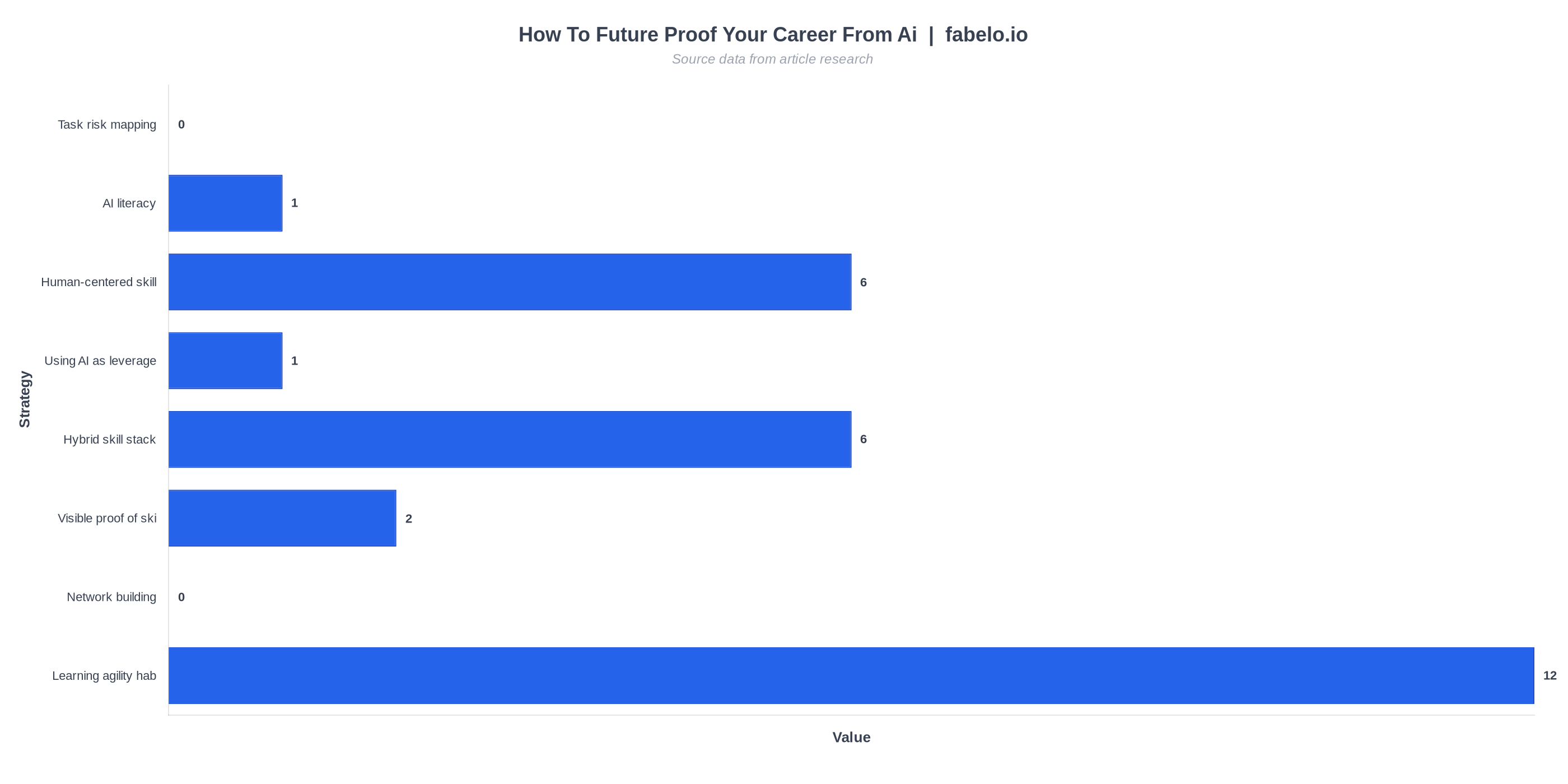
AI-Proof Career Strategies at a Glance
\n
| Strategy | AI Resistance Level | Time to Visible Impact | Best For |
|---|---|---|---|
| Task risk mapping | Foundation | Immediate clarity | Everyone |
| AI literacy | High | 1–3 months | Knowledge workers |
| Human-centered skills | Very high | 6–18 months | Managers, client-facing roles |
| Using AI as leverage | High | 1–4 weeks | Everyone |
| Hybrid skill stack | Very high | 6–12 months | Specialists at risk |
| Visible proof of skills | High | 2–8 weeks | Job seekers, career changers |
| Network building | Highest | Ongoing | Mid-career professionals |
| Learning agility habit | Highest | Compounds over 12+ months | Long-term career protection |
\n
Watch This First
Watch: the Ian J United K YouTube channel on future-proofing your career from AI in 2026 🎬
The answersQ YouTube channel breaks down five skills with strong market demand heading into 2026: AI and machine learning fluency, data analysis, digital marketing, cybersecurity, and emotional intelligence combined with adaptability. The key framing that's worth holding onto: AI literacy is to 2026 what Excel fluency was to 2000. Not a specialty — a baseline. If you're not at least conversationally competent with AI tools in your field, you're already behind the curve on professional expectations.
The channel also makes a critical point about learning method. Structured learning with verifiable outputs — projects, certificates, real deliverables — consistently outperforms scattered consumption of tutorials and videos. The advice: commit to one skill at a time, practice it for 30 minutes daily rather than bingeing on weekends, then build something real with it before moving to the next skill. That framework maps almost perfectly to what career data shows actually sticks. Pick your platform — whether it's Coursera, Udemy, or LinkedIn Learning — and commit to consistency over intensity.
The video's core thesis also aligns with the broader career research: the most valuable skill in the current environment isn't any specific tool or technology. It's learning agility — the ability to absorb new information, let go of outdated approaches, and adapt faster than the pace of disruption. That's the durable edge. Everything else is a layer on top of it.
What Real People Are Saying
The most honest, unfiltered conversations about future proofing careers from AI are happening in Reddit communities — not in corporate thought leadership. The patterns across multiple subreddits are revealing.
In r/ArtificialInteligence, the recurring consensus is that the right approach isn't to resist AI or pretend it doesn't affect your role — it's to figure out specifically how to apply AI to what you already do well. Users emphasize that knowing your domain deeply, then learning how AI tools work within that domain, creates a combination that's genuinely difficult to replace. The framing: AI handles the commodity work; your expertise handles the judgment calls that matter.
In r/AskWomenOver30, mid-career professionals note that you don't need to build AI products to stay relevant — there are many ways to work with the technology without becoming a developer. The most practical approaches discussed include learning how to evaluate and direct AI outputs in your current role, positioning yourself as the person in your team who bridges AI capabilities with business context, and treating AI fluency as an expansion of your existing expertise rather than a replacement for it.
In r/TieTalent, the discussion centers on building hybrid skill sets, staying adaptable, and protecting your professional digital presence. Several users note that the future of work isn't a human-vs-AI contest — it's a hybrid model, and the professionals who understand that early are building significant advantages over peers who are still treating it as a threat to react to rather than a reality to engage with strategically.
Frequently Asked Questions
Which jobs are actually safe from AI in the long run?
No job is completely immune, but roles with high complexity in human judgment, physical dexterity, emotional engagement, and unpredictable environments are substantially more protected. Healthcare providers, skilled tradespeople, complex negotiators, therapists, and senior leaders making high-stakes decisions in ambiguous conditions are far less exposed than roles defined by repeatable information processing. The pattern: jobs that require accountability, empathy, and real-world physical interaction are structurally resistant to AI replacement.
Do I need to learn to code to future proof my career from AI?
No. Coding is one path, but not a universal requirement. What's more broadly applicable is data literacy — the ability to work with data outputs, understand what they mean, and use them in decisions. Basic familiarity with tools like Python or SQL is useful in technical roles, but most knowledge workers can build substantial AI resilience through AI literacy, workflow automation tools, and human-centered skills without writing a single line of code.
How long does it take to future proof your career from AI?
There's no finish line — it's an ongoing process, not a one-time achievement. That said, meaningful protection becomes visible in six to twelve months of consistent effort. The first wins often come within weeks: learning an AI tool that multiplies your output, or completing a certification that gets noticed in your next performance review. The deeper protection — hybrid skill stacks, strong networks, established AI fluency — develops over twelve to eighteen months of deliberate work.
What are the best skills to future proof your career right now?
The highest-leverage skills to future proof your career combine technical fluency with human capability. In the technical category: AI tool competency, data analysis, and basic automation skills. In the human category: communication and storytelling, leadership and people management, negotiation, and cross-functional problem-solving. The combination — not either alone — is what makes a professional genuinely difficult to replace. Add learning agility as the meta-skill that keeps all of it current over time.
Is it too late to start if I'm mid-career or over 40?
Absolutely not, and in some ways mid-career professionals have structural advantages. Deep domain expertise is an asset that takes years to build — AI can't replicate it. The task for mid-career professionals is layering AI fluency and adjacent skills on top of a foundation that's already strong, not starting over. According to Forbes analysis of career resilience in the AI era, professionals who use their existing expertise to guide and evaluate AI outputs consistently outperform younger generalists who have AI skills but lack domain depth.
How do I know if my specific role is at high risk from AI automation?
Audit your task list against two criteria: how much of your work involves processing structured, predictable information (high risk), and how much involves judgment, relationship management, or cross-domain synthesis in ambiguous situations (low risk). Tools like O*NET Online provide task-level breakdowns of occupations and are useful for this analysis. You can also track which of your current tasks AI tools can already perform competently — that's your most reliable real-time indicator of exposure.
Your Next Steps
Knowing how to future proof your career from AI is only useful if it turns into action. The people who navigate this period well aren't the ones who consumed the most career advice — they're the ones who acted on it consistently and adjusted as they went. Here's where to start:
- This week: Map your current role's task list against AI vulnerability. Identify the two or three tasks most at risk and the two or three most human-dependent. That map becomes your personal career strategy document. Everything else follows from it.
- This month: Pick one skill from the categories in this guide — AI literacy, data analysis, or a specific human-centered capability — and commit to a structured learning plan. Thirty focused minutes per day, five days a week, applied to a real work output by the end of the month. One skill, one deliverable, one month.
- This quarter: Build visible proof. Complete a certification, publish a project on LinkedIn or GitHub, or document an AI workflow you've built and share it internally. Create the evidence that your skills are evolving in real time — not just on a resume that gets updated every five years.
The professionals who look back at this period and say they thrived won't be the ones who worried the most. They'll be the ones who started moving first. Start this week. One step is enough to build momentum.
About the Author
Written by Ufuk Yorulmaz
Digital entrepreneur and AI systems builder based in Istanbul. Founder of Fabelo.io, Aicall.pw (AI voice call automation), and WPcare. Has led digital strategy, automation, and SEO systems at PanicWorkz for over 16 years. Writes about AI tools, automation trends, and the future of work at Fabelo.
Disclaimer: This article is for informational purposes only. AI tool capabilities and pricing change frequently — verify before committing.
Last updated: April 13, 2026 — fabelo.io