
Salary Negotiation Email Template: The Complete Guide
A salary negotiation email template gives you a proven script to request more pay confidently. Most offers have 10–20% flexibility — here's how to capture


A salary negotiation email template gives you a structured, confident way to ask for more money without sounding demanding or awkward. Most initial job offers have between 10–20% flexibility built in — and a well-crafted email is often all it takes to capture it. This guide gives you ready-to-use templates for every situation, plus the strategy behind why each one works.
Salary ranges referenced in this guide are based on job board listings, BLS occupational data, and community-reported figures. Actual compensation varies by location, experience, and employer.
Most people accept the first number they're offered. Not because it's fair, but because they don't know what to say. The good news: salary negotiation over email is actually easier than doing it on the phone — you have time to think, edit, and get the tone exactly right. Whether you just received a job offer, want to push back on a lowball number, or need to make a case for a raise at your current job, the templates below cover every scenario.
Contents
- Why Email Beats the Phone for Salary Negotiation
- What Every Salary Negotiation Email Needs
- Salary Negotiation Email Template After a Job Offer
- Counter Offer Salary Negotiation Email Templates
- Salary Negotiation Email Template for a Raise
- Common Mistakes That Kill Salary Negotiations
- How to Research Your Market Value Before You Write
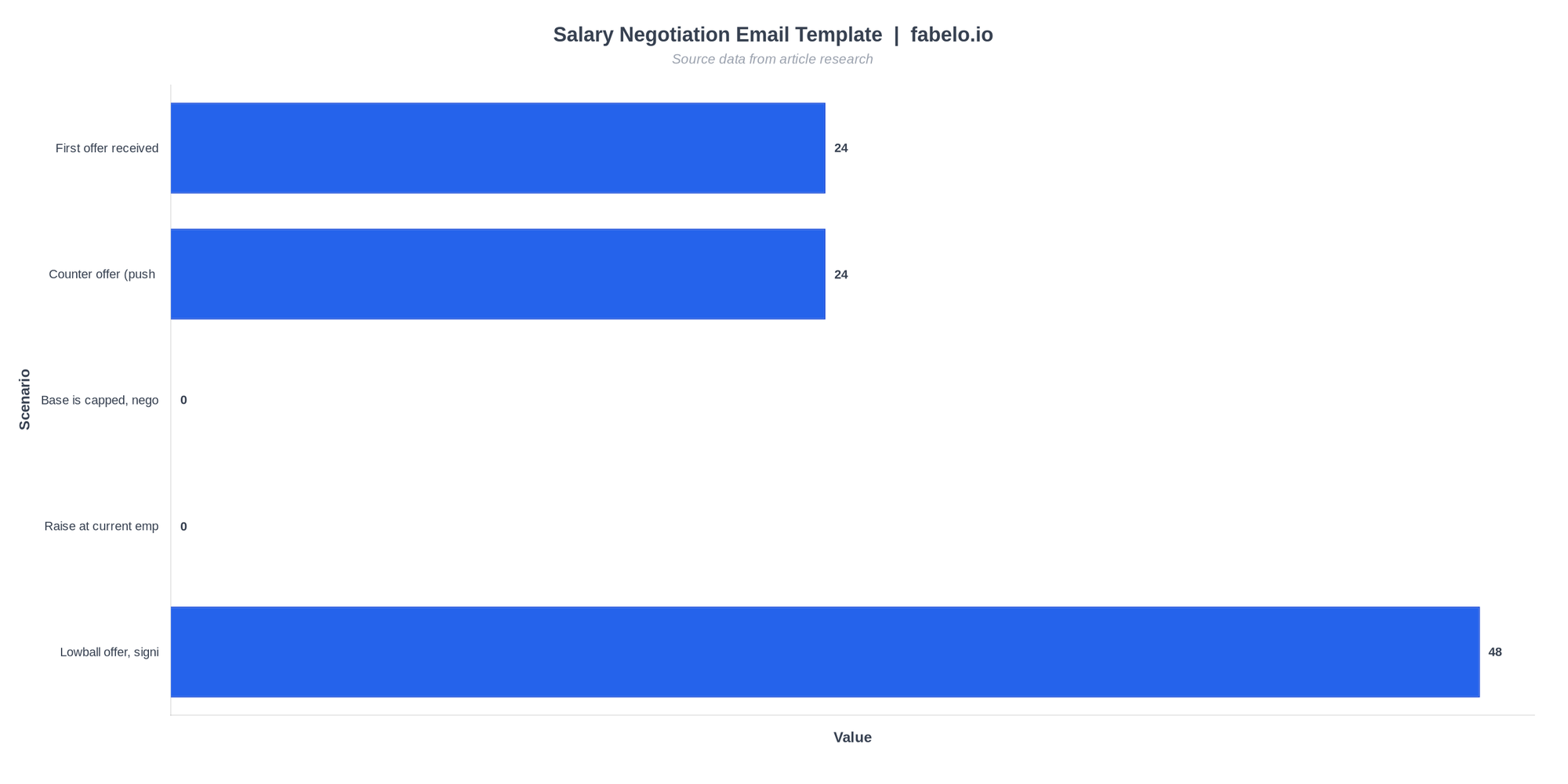
- Salary Negotiation Email Scenarios Compared
- Watch This First
- What Real People Are Saying
- Frequently Asked Questions
- Your Next Steps
Why Email Beats the Phone for Salary Negotiation
Phone calls put you on the spot. Your brain is processing the conversation in real time, trying to sound calm while doing mental math on what you should ask for. Email removes all of that pressure. You can spend an hour crafting five sentences, get a friend to review it, and send it at 9 a.m. When the hiring manager is fresh and alert.
There's a strategic reason to prefer email beyond your own comfort level. A written request creates a paper trail. The recruiter or manager has to respond in writing, which means every number, every promise, is documented. That matters later when the formal offer letter arrives.
Email also gives the other person time to process. When you drop a counter offer on someone over the phone, they feel pressure to respond immediately and often default to "no" just to close the loop. An email lets them consult with HR, check budget authority, and come back with a real answer. Many negotiation professionals point out that the best counter offers aren't the ones that sound the most aggressive — they're the ones that give the other side room to say yes comfortably.
One more angle: if you're negotiating your first salary, the compounding effect is enormous. A $10,000 difference in starting pay, compounded through annual raises and bonuses over a 20-year career, can translate to hundreds of thousands of dollars in lifetime earnings. Getting this right once is worth more than almost any single financial decision you'll make as a young professional. The same principle applies to how compound interest works on savings — small differences at the start produce massive differences at the end.
What Every Salary Negotiation Email Needs
Before you look at any specific template, understand the anatomy of an effective salary negotiation email. Every strong one has five components, regardless of the scenario.
Gratitude without groveling. Open by thanking the person for the offer or for their time. One sentence. Don't over-thank — it signals desperation and weakens your position before you've said anything about money.
Enthusiasm for the role. Make clear you want the job. If they sense you're already one foot out the door, they have less incentive to negotiate. Something like "I'm genuinely excited about the opportunity to contribute to [specific team or project]" does this well without being sycophantic.
A specific number or range, anchored to market data. Vague requests get vague responses. "I was hoping for something a bit higher" gives them nothing to work with. "Based on market data for this role in [city], and given my [X years of experience / specific skills], I'm targeting a base salary of $[X]" is actionable. According to Fearless Salary Negotiation, leading with a specific number anchors the entire conversation and typically results in a better final outcome than leaving it open-ended.
Your value proposition in two to three bullet points. Don't make them guess why you're worth more. List the specific skills, achievements, or certifications that justify the number. Keep it short — three bullets maximum. This is where your research pays off.
A clear call to action. End by inviting a conversation, not demanding an answer. "I'd welcome the chance to discuss this further" keeps the tone collaborative and professional.
Salary Negotiation Email Template After a Job Offer

This is the most common scenario: you've received an offer, the number is lower than you expected (or you know there's room to push), and you want to respond professionally. The goal here is to keep the employer excited about you while making a clear, confident case for more money.
Use this template when you've just received a written job offer and want to counter within 24–48 hours:
Subject: Re: [Job Title] Offer — [Your Name]
Hi [Hiring Manager's Name],
Thank you so much for the offer to join [Company] as a [Position]. I'm genuinely excited about the role and the opportunity to contribute to [specific team, project, or company goal you learned about during interviews].
After reviewing the offer carefully, I'd like to discuss the base salary. Based on my research into market compensation for this role in [City/Region], and given my [X years of experience] in [specific field or skill set], I believe a base salary in the range of $[X] to $[Y] would better reflect the value I'd bring to the team.
Specifically, I'm confident I can contribute in these ways from day one:[Relevant achievement or skill — e.g., "Led a team of 8 engineers and shipped three major product features in under six months"][Relevant achievement or skill — e.g., "Certified in [relevant certification] with demonstrated results in [outcome]"][Relevant achievement or skill — e.g., "Directly comparable experience at [previous company type], where I increased [metric] by [percentage]"]
I'm very much looking forward to joining [Company] and I'm confident we can reach an agreement that works for both of us. Would you be available for a brief call this week to discuss?
Thank you again for this opportunity.
Best regards,
[Your Name]
[Phone Number]
A few notes on this template. The subject line references the job title — makes it easy to find in a busy inbox. The range you cite ($X to $Y) should be set so that the lower bound of your range is acceptable to you; the company will typically land somewhere in the middle. And asking for a call at the end keeps the conversation moving without putting everything in writing at once.
This is your foundational salary negotiation email after job offer template. Customize the bullet points heavily — generic bullets don't move the needle.
Counter Offer Salary Negotiation Email Templates
A counter offer email is different from the initial negotiation email. Here, you've already pushed back once (possibly verbally), the company has responded with a revised number, and you're either accepting, pushing again, or negotiating non-salary elements. Each situation needs a slightly different approach.
Template 1: Counter Offer When You Want to Push Higher
Subject: Re: [Job Title] — Updated Offer Discussion
Hi [Name],
Thank you for coming back with an updated offer — I genuinely appreciate the flexibility. I remain very enthusiastic about the role and the team.
I want to be transparent with you: the current offer of $[revised amount] is closer, but I'm still receiving offers in the $[target range] range for comparable positions. I'd love for [Company] to be the clear choice, and I believe closing this gap would make that an easy decision.
Is there any additional flexibility to reach $[specific target number]?
I'm committed to making this work and excited about the contribution I can make. I appreciate you going to bat for me on this.
Best,
[Your Name]
Template 2: Counter Offer Email Negotiating Benefits and PTO Instead
Sometimes the salary ceiling is genuinely fixed. That doesn't mean negotiation is over. Remote work stipends, signing bonuses, extra PTO, and accelerated review timelines are all negotiable at many companies. In r/PMCareers, users regularly discuss negotiating PTO alongside base salary when the company can't move on the number itself.
Subject: Re: Offer for [Job Title] — A Few Questions
Hi [Name],
Thank you for confirming that the base salary is firm at $[amount]. I understand, and I want to find a way to make this work.
Given the base, would [Company] be open to any of the following:A one-time signing bonus of $[amount] to bridge the gapAn additional [X] days of PTO annuallyA performance review at the 6-month mark (rather than 12) with an opportunity to revisit base salary
I'm genuinely excited to join the team and I'm confident these conversations can bring us to an agreement. Looking forward to hearing your thoughts.
Best,
[Your Name]
These counter offer salary negotiation email templates give you flexibility. Use Template 1 if you have competing offers or strong market data. Use Template 2 when you sense the base is truly capped but want to maximize total compensation.
Salary Negotiation Email Template for a Raise
Negotiating a raise at your current employer is a different beast. You don't have the leverage of a competing offer (unless you do), and the relationship is ongoing. The email needs to feel collaborative rather than adversarial — you're making a business case, not issuing an ultimatum.
The strongest raise requests are tied to specific achievements that happened since your last review. "I've been here three years" is not a business case. "I led the initiative that reduced customer churn by 18% and directly contributed to $400K in retained revenue this quarter" absolutely is.
Subject: Salary Discussion — [Your Name]
Hi [Manager's Name],
I've genuinely enjoyed my work here at [Company] over the past [time period], and I'm proud of what the team has accomplished. I'd like to request some time to discuss my current compensation.
Since my last review, I've taken on expanded responsibilities including [specific examples]. Some of the results I'm most proud of:[Quantified achievement — e.g., "Managed the migration to our new CRM, cutting onboarding time by 30%"][Quantified achievement — e.g., "Took on three additional direct reports after the restructuring without a change in title or pay"][Quantified achievement — e.g., "Closed $1.2M in new business in Q3, exceeding my quota by 22%"]
Based on my research into market rates for my role and level in [location], and given this expanded scope, I'd like to discuss a salary adjustment to $[target amount].
Would you be available for a 20-minute conversation this week or next? I'm happy to put together any additional documentation that would be helpful for this discussion.
Thank you for your consideration.
[Your Name]
Pair your raise conversation with a strong LinkedIn profile that reflects your updated responsibilities — it signals market awareness and that you're paying attention to your professional standing.
Common Mistakes That Kill Salary Negotiations
Knowing what not to do is just as valuable as having the right template. These are the most common ways people undermine their own negotiation before it even gets started.
Revealing your number first. If a recruiter asks "what are you looking for in terms of salary?" before making an offer, deflect. "I'd prefer to learn more about the full scope of the role first" or "I'm open to a competitive offer for someone with my background" buys you time. The first person to name a number often loses leverage.
Apologizing for negotiating. Phrases like "I'm sorry to ask, but..." or "I feel bad bringing this up..." immediately signal that you're uncomfortable with the ask. The employer expects negotiation. According to career professionals at the University of St. Thomas, most hiring managers anticipate a counter offer and budget for it — your hesitation costs you money.
Being too vague. "I was hoping for a bit more" tells them nothing useful. Give them a specific number. Specific anchors specific.
Accepting a verbal offer before reviewing the written one. Never negotiate off a verbal offer. Wait for the written offer letter, review every line, and then respond in writing. Verbal promises disappear.
Going silent after the counter. If you send a counter offer email and hear nothing for three days, follow up. One polite nudge — "Wanted to check in on my previous email and see if you had any questions" — is completely professional.
Making ultimatums on the first counter. Unless you have a competing offer you're genuinely willing to accept, ultimatums close doors. Keep the tone collaborative through at least two rounds before you ever hint at a deadline.
How to Research Your Market Value Before You Write
Every salary negotiation email template is only as strong as the market data behind it. Walk into the negotiation with no research, and you're guessing. Walk in with three credible data points, and you're making a business case.
Start with salary aggregators. Search the job title plus your city on sites like Glassdoor, Salary.com, and LinkedIn Salary to pull a range. Be aware that self-reported data skews slightly high — the people most motivated to report their salary tend to be earning on the higher end. Use those figures as your ceiling reference, not your floor.
Cross-reference with active job postings. Many states now require salary transparency in job listings. Filter for comparable roles and note what companies are actively advertising. That's live market data — more current than aggregated surveys.
Talk to people in the field. Your network is your most valuable research tool. A 10-minute conversation with someone in a similar role at a different company can tell you more than any salary website. People are more willing to share compensation information than most job seekers assume, especially in online communities dedicated to specific industries.
Finally, factor in your specific geography and seniority. A software engineer in Austin earns significantly less than one doing the same job in San Francisco, and that gap is real whether or not cost of living justifies it. Your negotiation target should be anchored to your market, not a national average.
Once you have a range, add 10–15% above your acceptable floor. That becomes your ask. If the company comes back at your floor, you've still won. If they meet your ask, you've outperformed your own expectations. This is the same compounding logic that applies to building a zero-based budget — every dollar has a purpose and a trajectory.
Salary Negotiation Email Scenarios Compared
Different negotiation situations call for different approaches. Here's a quick reference to match your scenario to the right strategy:
| Scenario | Tone | Key Element | Ask Type | Timing |
|---|---|---|---|---|
| First offer received | Enthusiastic + firm | Market data + specific range | Base salary | Within 24–48 hours of offer |
| Counter offer (push higher) | Transparent + collaborative | Competing offers or market range | Specific number | Within 24 hours of revised offer |
| Base is capped, negotiate benefits | Flexible + solutions-focused | Signing bonus, PTO, early review | Non-salary compensation | After salary ceiling is confirmed |
| Raise at current employer | Business case + long-term framing | Specific achievements + market data | Base salary adjustment | Before annual review cycle |
| Lowball offer, significant gap | Calm + data-driven | Market benchmarks + your unique value | Large counter, justify clearly | Within 48 hours, after reflection |
Watch This First

Watch: the Joe Zeplin YouTube channel on how to negotiate a job offer salary →
According to the Joe Zeplin YouTube channel, one of the most powerful negotiation tactics is deliberately avoiding giving a single specific number when pressed. Instead of saying "I want $67,000," responding with "a salary in the mid-60s" keeps the range open and forces the company to make the next specific move. This approach is particularly effective during second-round negotiations, because it preserves wiggle room on both sides and makes the conversation feel collaborative rather than transactional.
The Joe Zeplin channel also breaks down the compounding math behind first-salary negotiations: a $10,000 difference in starting pay, factored into annual raises and bonus percentages over 20 years, can accumulate to dramatically higher lifetime earnings. That single data point reframes the awkwardness of negotiating — it's not about being greedy, it's about understanding the long-term financial stakes of a five-minute email.
What Real People Are Saying
Real-world salary negotiation looks messier than any template suggests. Reddit communities dedicated to careers have thousands of threads where people share what actually happened when they hit send.
In r/LifeProTips, one highly upvoted template follows a simple structure: acknowledge the offer, cite years of experience, name a specific target figure anchored to that experience, and close by expressing genuine interest in the role. The thread generated hundreds of comments from users confirming that this approach works — and that simply sending the email at all, rather than accepting silently, resulted in a higher offer more often than not.
In r/digitalnomad, a user trying to negotiate from a $57K offer up to $65K got community advice that boiled down to three things: express genuine appreciation for the offer, anchor the ask to market data rather than personal need, and make clear that accepting their compensation figure would make the decision easy. The company came back with $63K — not the full ask, but $6K more than the original offer just for sending one email.
In r/Salary, a former recruiter shared a candid perspective: companies almost universally expect negotiation, budget for it, and frankly lose a small amount of respect for candidates who immediately accept without at least a gentle push. The recruiter framed polite, confident negotiation as a sign of professionalism — not entitlement — and said that the candidates who negotiated well were actually viewed more favorably in the hiring process, not less.
Frequently Asked Questions
How long should a salary negotiation email be?
Keep it under 250 words. Recruiters and hiring managers read dozens of emails a day. A concise email with a clear ask, brief value statement, and a call to action performs better than a lengthy justification. Three to four short paragraphs is the sweet spot — enough to make your case without burying the actual request.
What is a reasonable salary counter offer percentage after receiving a job offer?
A counter offer of 10–20% above the initial offer is considered reasonable in most industries. Asking for more than 20% above the offer without a specific justification (like a competing offer) risks souring the relationship. If the gap between what they offered and what the market pays is larger than 20%, provide detailed market evidence and frame it as education, not confrontation.
Is it okay to negotiate salary via email if the offer was made by phone?
Yes — and in many cases it's preferable. Responding by email gives you time to craft a measured, professional response. Thank them verbally on the call for the offer, tell them you'll review the full package and respond within 24–48 hours, then send your counter via email. This is completely standard practice and signals that you're thoughtful, not difficult.
What if the company says the salary is non-negotiable?
Negotiate something else. Sign-on bonuses, additional PTO, remote work flexibility, professional development budgets, and earlier performance reviews are all fair game even when base salary is fixed. A signing bonus in particular is often easier for HR to approve because it doesn't affect the permanent budget line. Always ask — the worst answer is "no," and you're already at "no."
How soon after receiving a job offer should I send a salary negotiation email?
Within 24–48 hours of receiving the written offer is ideal. Waiting longer than 72 hours without communicating can signal indecision or disorganization. If you need more time to research — and you should always research — tell the recruiter you'd like a day or two to review the full offer package before responding. That's completely reasonable and gives you the time to write a strong counter.
Can a salary negotiation email cause an employer to rescind a job offer?
Virtually never, as long as your tone is professional and collaborative. Employers understand that negotiation is part of the hiring process. An offer is almost never rescinded over a reasonable counter offer. The risk goes up significantly only if you're aggressive, make ultimatums on the first counter, or suggest you're not actually interested in the role. Keep your email professional and enthusiastic, and you're safe.
Should I mention a competing job offer in my salary negotiation email?
Only if it's real. Bluffing about competing offers is a high-risk strategy — experienced recruiters can often sense it, and if you're caught, the negotiation is over. If you genuinely have another offer, you can reference it transparently without naming the company: "I'm also considering another offer in the $X range." That framing creates leverage without sounding threatening. Never fabricate competing offers.
Your Next Steps
Salary negotiation feels uncomfortable until you've done it once. After that, it becomes one of the most straightforward career skills you own — because the structure is always the same. Here's how to move from reading this to actually sending the email.
- Research before you write. Pull salary data from at least two sources for your specific role and city. Calculate your target range — your floor, your ask, and your stretch goal. Without this step, any template is just words on a screen.
- Customize every template you use. Generic bullet points don't move hiring managers. Replace every bracketed placeholder with a specific achievement, a real number, or a named skill. The more concrete, the more credible.
- Send the email. The single biggest mistake people make is not sending anything at all. According to iHire's salary negotiation research, a large share of workers who don't negotiate simply assumed the offer wasn't flexible — even when it was. You miss every counter offer you don't send.
Once you've secured a stronger salary, make that extra income work harder. Explore how to budget your paycheck effectively so the raise actually changes your financial picture — not just your gross pay line. And if you're thinking about the longer arc of your career, consider how to position yourself in roles that remain high-value as the job market keeps evolving. Negotiating your salary is just the first move — building on it is where the real leverage lives.
About the Author
Written by Fabelo
The Fabelo editorial team covers career strategies, job market trends, and professional development. Research-backed guides for ambitious professionals.
Disclaimer: This article is for informational purposes only. Career data, salary figures, and job market trends reflect available research and may change. Always do your own research before making major career or education decisions.
Last updated: April 16, 2026 · fabelo.io