

Index funds and ETFs often hold the exact same stocks — a Vanguard S&P 500 index fund and the VOO ETF differ by just 0.01% in annual expense ratio. The real difference is structural: ETFs trade throughout the day like stocks with no minimum investment, while index funds settle once daily and often require $1,000–$3,000 minimums. Same exposure, different wrapper.
The index funds vs ETF debate comes down to a handful of practical distinctions: when you can trade, how capital gains taxes work, whether you can automate contributions, and what your brokerage makes easiest. Get those right for your situation and you'll make the smarter call. Get them wrong and you'll either pay unnecessary taxes or constantly fight your own brokerage's interface to set up automatic investing.
This guide breaks down every meaningful difference with real fund examples, a side-by-side comparison table, and a direct answer to the question most articles dodge: which one should you actually use?
Contents
- What Is an Index Fund
- What Is an ETF
- Index Funds vs ETF: The Key Differences Explained
- Index Funds vs ETF vs Mutual Fund: Adding the Third Player
- Index Funds vs ETF Examples: Real Funds Side by Side
- Should I Invest in Index Funds or ETF
- Index Funds vs ETF: Which Is Better for Taxes
- Index Funds vs ETF: Which Is Better for Long-Term Investing
- Index Funds vs ETF Comparison at a Glance
- Watch This First: ETF Investing Explained Visually
- What Real People Are Saying
- Frequently Asked Questions
- Final Verdict: Index Funds vs ETF
What Is an Index Fund
An index fund is a type of mutual fund built to mirror the performance of a market index — like the S&P 500, the total U.S. Stock market, or the Bloomberg U.S. Aggregate Bond Index. Instead of a portfolio manager picking individual stocks based on research and judgment, the fund simply buys every stock in the index (or a representative sample) in the same proportions the index dictates.
The result is passive management, which translates directly into lower costs. Because nobody is getting paid to make active stock-picking decisions, expense ratios stay low. Vanguard's VFIAX (S&P 500 index fund) charges 0.04% annually. Fidelity's FXAIX charges the same. At those prices, fees are essentially noise on a multi-decade investment horizon.
Index funds are priced once per day — at the market close (4 PM Eastern). When you place a buy or sell order, you don't execute at the current moment's price. You execute at whatever the Net Asset Value (NAV) is when the market closes that day. This structure has a subtle advantage: it removes the temptation to react to intraday volatility. You can't panic-sell at 10:47 AM because the price ticked down 2%. Your order waits until the end of the day regardless.
Most index mutual funds allow fractional investing down to the penny, making it easy to invest exactly $500 or exactly $1,000. They also support automatic investments — you set a recurring buy on a schedule, and the fund executes it without you touching anything. This is a genuinely useful feature for people building wealth through regular paycheck contributions rather than lump-sum investing. Many 401(k) plans are built entirely around this automatic contribution model, which is why index mutual funds dominate retirement accounts.
The main downside is minimum investment requirements. Some index mutual funds require $1,000, $3,000, or more to open a position. Vanguard's Admiral Shares require $3,000 minimums for many funds. Fidelity and Schwab have eliminated minimums on their own index funds, which has made index mutual funds more accessible to newer investors with smaller starting balances.
What Is an ETF
An ETF, or exchange-traded fund, is a fund that trades on a stock exchange exactly like an individual stock. You buy shares of VOO (Vanguard S&P 500 ETF) the same way you'd buy shares of Apple — through your brokerage, at a real-time price, during market hours. The price fluctuates throughout the day based on supply and demand.
Here's what trips people up: many ETFs are also index funds. VOO tracks the S&P 500, just like VFIAX. SPY tracks the S&P 500. IVV tracks the S&P 500. When people say "index funds vs ETF," they're really talking about index mutual funds vs ETFs, because a large majority of ETFs on the market are passively managed index trackers. The ETF wrapper and the index-tracking strategy are two separate things — it's just that they're commonly paired together.
ETFs offer genuine flexibility. You can buy one share of VOO for around $550 (prices vary — verify on your brokerage before purchasing) and own a slice of 500 companies immediately. Many brokerages now offer fractional ETF shares, dropping the effective minimum to $1 or $5. You can sell any time the market is open, set limit orders, use stop-losses, or trade options on many ETFs if that's relevant to your strategy.
The tax efficiency of ETFs is structurally superior to traditional mutual funds. The mechanism behind this involves something called in-kind redemptions — when large institutional investors exit an ETF, they receive a basket of the underlying securities rather than cash. This means the ETF itself rarely needs to sell holdings to meet redemptions, which would otherwise trigger capital gains distributions passed on to all shareholders. As a result, ETF shareholders typically only realize capital gains when they personally sell their shares, not when other investors exit the fund.
The main considerations with ETFs are bid-ask spreads (a small cost embedded in every trade that doesn't exist with mutual funds) and the fact that some brokerages don't support automatic recurring ETF purchases as seamlessly as they support automatic mutual fund contributions. Both of these are minor friction points, not dealbreakers — but they're worth knowing about.
Index Funds vs ETF: The Key Differences Explained

The structural differences between these two vehicles affect real outcomes — not dramatically, but enough to matter depending on your account type and investing habits. Here's where they genuinely diverge.
Trading and Pricing
Index mutual funds price once daily at NAV. ETFs price in real time throughout the trading day. For long-term investors holding for decades, this distinction is largely irrelevant — what matters is the price over 20 years, not the price at 11:30 AM. But for investors who want to deploy a large lump sum at a specific market level, ETF intraday pricing gives more control. For investors who tend toward anxious checking and reactive decisions, the mutual fund's end-of-day pricing acts as a useful behavioral guardrail.
Automatic Investing
This is one area where index mutual funds have a real practical edge. Setting up automatic monthly investments in a mutual fund is seamless on virtually every brokerage platform. ETFs have historically required manual purchases. That's changing — Fidelity and Schwab now support automatic ETF investing — but it's still not as universally frictionless as mutual fund auto-investing. If you're the type of investor who does best on autopilot, index mutual funds are often easier to set up and forget.
Minimum Investment
ETFs have no meaningful minimum — one share, or fractional shares on platforms that support it. Index mutual funds vary: Fidelity's zero-expense-ratio index funds have no minimum, while Vanguard's Admiral Shares require $3,000. Schwab's index mutual funds start at $1. For investors with limited capital starting out, ETFs or Fidelity's zero-fee index funds are the easiest entry points.
Tax Efficiency
ETFs win this category in taxable accounts. The in-kind redemption mechanism means ETFs rarely distribute capital gains to shareholders. Index mutual funds are more tax-efficient than actively managed funds, but they can still occasionally distribute capital gains — particularly in large-scale redemption events. In a Roth IRA or traditional IRA where taxes are deferred anyway, this difference is irrelevant. In a taxable brokerage account, it matters.
Expense Ratios
At the major fund companies, expense ratios are nearly identical between comparable index mutual funds and ETFs. VOO (ETF) charges 0.03%. VFIAX (mutual fund) charges 0.04%. The difference on a $100,000 portfolio is $10 per year. Not worth making a major decision over. Where expense ratios still diverge significantly is with actively managed mutual funds — but those aren't index funds, so they're a separate conversation.
Index Funds vs ETF vs Mutual Fund: Adding the Third Player
The index funds vs ETF vs mutual fund comparison adds a third dimension that changes the picture. Here's how to think about all three together.
A mutual fund is the broadest category. It's a pooled investment vehicle that can be actively managed or passively managed. Actively managed mutual funds employ portfolio managers who research and select holdings trying to beat their benchmark. These funds typically carry expense ratios of 0.5% to 1.5% or more — dramatically higher than index funds or ETFs. The research on whether active management consistently beats passive strategies long-term is not favorable to active managers, which is a major reason money has flowed toward passive vehicles for the last 20 years.
An index fund is a specific type of mutual fund (or ETF) that uses a passive strategy to track a market index. When most people say "index fund" in conversation, they mean an index mutual fund — a passively managed mutual fund that doesn't trade throughout the day.
An ETF can be either passively managed (tracking an index) or actively managed. The overwhelming majority of ETFs by assets under management are passive index trackers. The ETF structure is simply the wrapper — it determines how the fund trades, not what it holds.
According to SmartAsset's breakdown of ETFs, index funds, and mutual funds, index funds are types of mutual funds or ETFs that aim to replicate the performance of a specific index. The taxonomy matters because people often use these terms interchangeably when they mean different things — and that causes confusion when comparing actual products and their real costs.
The practical hierarchy for most investors: avoid high-cost actively managed mutual funds unless you have a specific reason. Between index mutual funds and ETFs tracking the same index, choose based on your account type, investing method, and tax situation.
Index Funds vs ETF Examples: Real Funds Side by Side
Abstract comparisons only go so far. Here are real-world index funds vs ETF examples showing how the same index can be accessed through different wrappers at different cost structures.
S&P 500 Coverage
ETF: VOO (Vanguard S&P 500 ETF) — expense ratio 0.03%, trades like a stock, no investment minimum beyond one share price, highly tax-efficient
Index Mutual Fund: VFIAX (Vanguard 500 Index Fund Admiral Shares) — expense ratio 0.04%, $3,000 minimum, end-of-day pricing, supports automatic investing
Index Mutual Fund (no minimum): FXAIX (Fidelity 500 Index Fund) — expense ratio 0.015%, no minimum, end-of-day pricing, excellent for automated contributions
All three own essentially the same 500 companies. The choice between them comes down to account type, brokerage, and investing behavior — not meaningful performance differences.
Total U.S. Stock Market
ETF: VTI (Vanguard Total Stock Market ETF) — expense ratio 0.03%, covers over 3,500 U.S. Companies
Index Mutual Fund: VTSAX (Vanguard Total Stock Market Index Fund) — expense ratio 0.04%, $3,000 minimum, the fund that made "VTSAX and chill" a personal finance mantra
VTSAX became culturally famous in the FIRE (Financial Independence, Retire Early) community precisely because of its combination of extreme diversification, low cost, and simplicity. VTI is its ETF equivalent — same holdings, marginally lower expense ratio, no minimum.
International Diversification
ETF: VXUS (Vanguard Total International Stock ETF) — expense ratio 0.07%, covers developed and emerging markets outside the U.S.
Index Mutual Fund: VTIAX (Vanguard Total International Stock Index Fund) — expense ratio 0.11%, $3,000 minimum
Here the ETF has a small but real expense ratio advantage: 0.07% vs 0.11%. On a $200,000 position over 30 years, that 0.04% difference compounds to a meaningful dollar amount. This is a case where the ETF version isn't just structurally different — it's genuinely cheaper.
Bond Market
ETF: BND (Vanguard Total Bond Market ETF) — expense ratio 0.03%
Index Mutual Fund: VBTLX (Vanguard Total Bond Market Index Fund) — expense ratio 0.05%, $3,000 minimum
Same story. The ETF version is available at a lower cost with no minimum and trades intraday — relevant for investors who want to rebalance their portfolio during the day rather than waiting for end-of-day pricing.
Should I Invest in Index Funds or ETF
The answer depends almost entirely on three factors: your account type, your investing method, and your tax situation. There is no universal winner in the index funds vs ETF debate — but there are clear winners for specific investor profiles.
Choose an Index Mutual Fund If...
- You invest through a 401(k) — most 401(k) plans only offer mutual funds, not ETFs, so the choice is often made for you
- You want fully automated, recurring investments on a fixed schedule and your brokerage doesn't support automatic ETF purchases
- You want to invest odd dollar amounts precisely (e.g., exactly $350/month) — mutual funds accept any dollar amount, while ETFs require whole or fractional shares
- You're investing in a tax-advantaged account (Roth IRA, traditional IRA, 401k) where the ETF's tax efficiency advantage disappears
- You're at Fidelity and want their zero-expense-ratio index funds (FZROX, FZILX) — these have no ETF equivalent at any other brokerage
Choose an ETF If...
- You're investing in a taxable brokerage account where capital gains distributions create a real annual tax bill
- You want to start with a small amount — one share of VTI or VOO gets you in with no minimum
- You want intraday pricing flexibility, whether for rebalancing or deploying a lump sum at a target price
- You're holding investments across multiple brokerages and want portability — ETFs like VOO work at any brokerage, while some mutual funds are brokerage-specific or carry transaction fees when purchased outside their home brokerage
- You want to pair your portfolio with options strategies — ETFs are optionable, mutual funds are not
According to Charles Schwab's comparison of ETFs and mutual funds, ETFs tend to be more tax-efficient than index mutual funds — a recommendation to consider the ETF structure for taxable accounts — while noting that mutual funds make more sense for investors who invest frequently in small amounts. That framing captures the practical divide well.
Index Funds vs ETF: Which Is Better for Taxes
In a taxable brokerage account, ETFs hold a structural tax advantage that isn't marginal — it's meaningful, especially as your portfolio grows. Understanding why requires a quick look at how capital gains distributions work.
When investors redeem shares of a traditional mutual fund, the fund manager must sell holdings to raise cash to pay those investors. If those holdings have appreciated, the sale generates capital gains — which the fund must distribute to all remaining shareholders, whether they want to realize that gain or not. You could hold a mutual fund all year, make no transactions, and still owe capital gains taxes on your year-end statement because other investors exited the fund.
ETFs sidestep this through the in-kind creation and redemption mechanism. Large institutional investors called authorized participants exchange ETF shares directly for the underlying basket of securities (and vice versa) without cash changing hands. No securities are sold. No capital gains are triggered. The ETF can hold appreciated stocks indefinitely without generating taxable events for shareholders.
As noted in Vanguard's guide to ETFs vs mutual funds, both index mutual funds and ETFs tend to be more tax-efficient than actively managed funds because they trade less frequently — but ETFs hold the additional structural advantage in taxable accounts due to this in-kind mechanism.
In a Roth IRA or traditional IRA, none of this matters. Gains aren't taxed until withdrawal (traditional) or never (Roth), so the capital gains distribution mechanics are irrelevant. In those accounts, choose whichever vehicle is cheapest and easiest to automate.
In a taxable account holding $100,000 or more? The ETF's tax efficiency advantage becomes increasingly real over time. A mutual fund distributing 1-2% of NAV annually in capital gains creates a consistent tax drag that compounds against you over decades.
Index Funds vs ETF: Which Is Better for Long-Term Investing
Long-term investing is where both vehicles genuinely shine — and where the index funds vs ETF which is better question is hardest to answer with a single winner, because both are excellent.
Consider the actual return data. A $10,000 investment in a Vanguard S&P 500 index fund 20 years ago would be worth nearly $78,000 today, a period that included the 2008 financial crisis, the COVID-19 crash, and the 2022 bear market. (For a deeper look at how this growth works mathematically, see our compound interest calculator guide.) That's the power of staying invested in a low-cost, diversified vehicle through market volatility — not the choice between mutual fund and ETF structure.
Warren Buffett has publicly endorsed low-cost S&P 500 index funds as the right vehicle for most individual investors. His principles — simplicity, diversification, low cost, long-term focus — apply equally to both index mutual funds and ETFs tracking the same index. The wrapper matters less than the underlying strategy and the discipline to hold through downturns.
Where the ETF vs index fund distinction becomes more meaningful over long horizons is in taxable accounts, as described above. The cumulative effect of avoiding annual capital gains distributions in a taxable account grows significantly over 20-30 years. A $500,000 portfolio that avoids 1% in annual capital gains distributions saves roughly $5,000 per year in potentially taxable events — and the compounding effect of keeping that money invested rather than paying taxes on it adds up.
For retirement accounts (401k, IRA, Roth IRA), the long-term performance difference between comparable index mutual funds and ETFs is negligible. Pick the cheapest available option for the index you want, set up automatic contributions if possible, and leave it alone. The behavioral discipline of consistent investing matters far more than the fund wrapper.
Index Funds vs ETF Comparison at a Glance
| Feature | Index Mutual Fund | ETF (Index) | Actively Managed Mutual Fund |
|---|---|---|---|
| Trading Hours | End of day only | Intraday (market hours) | End of day only |
| Typical Expense Ratio | 0.01% – 0.20% | 0.03% – 0.20% | 0.50% – 1.50%+ |
| Tax Efficiency (Taxable Account) | Good | Excellent | Poor to Fair |
| Investment Minimum | $0 – $3,000+ | $0 (fractional shares) | $0 – $3,000+ |
| Automatic Investing | Very easy | Available at select brokerages | Very easy |
| Bid-Ask Spread | None | Small (varies by ETF liquidity) | None |
| 401(k) Availability | Common | Uncommon | Common |
| Options Trading | No | Yes (most major ETFs) | No |
| Portability Across Brokerages | Varies (fees at outside brokerages) | Excellent | Varies |
| Best Account Type | 401(k), IRA, Roth IRA | Taxable brokerage, IRA | Any (but costs are high) |
| Management Style | Passive | Passive or Active | Active |
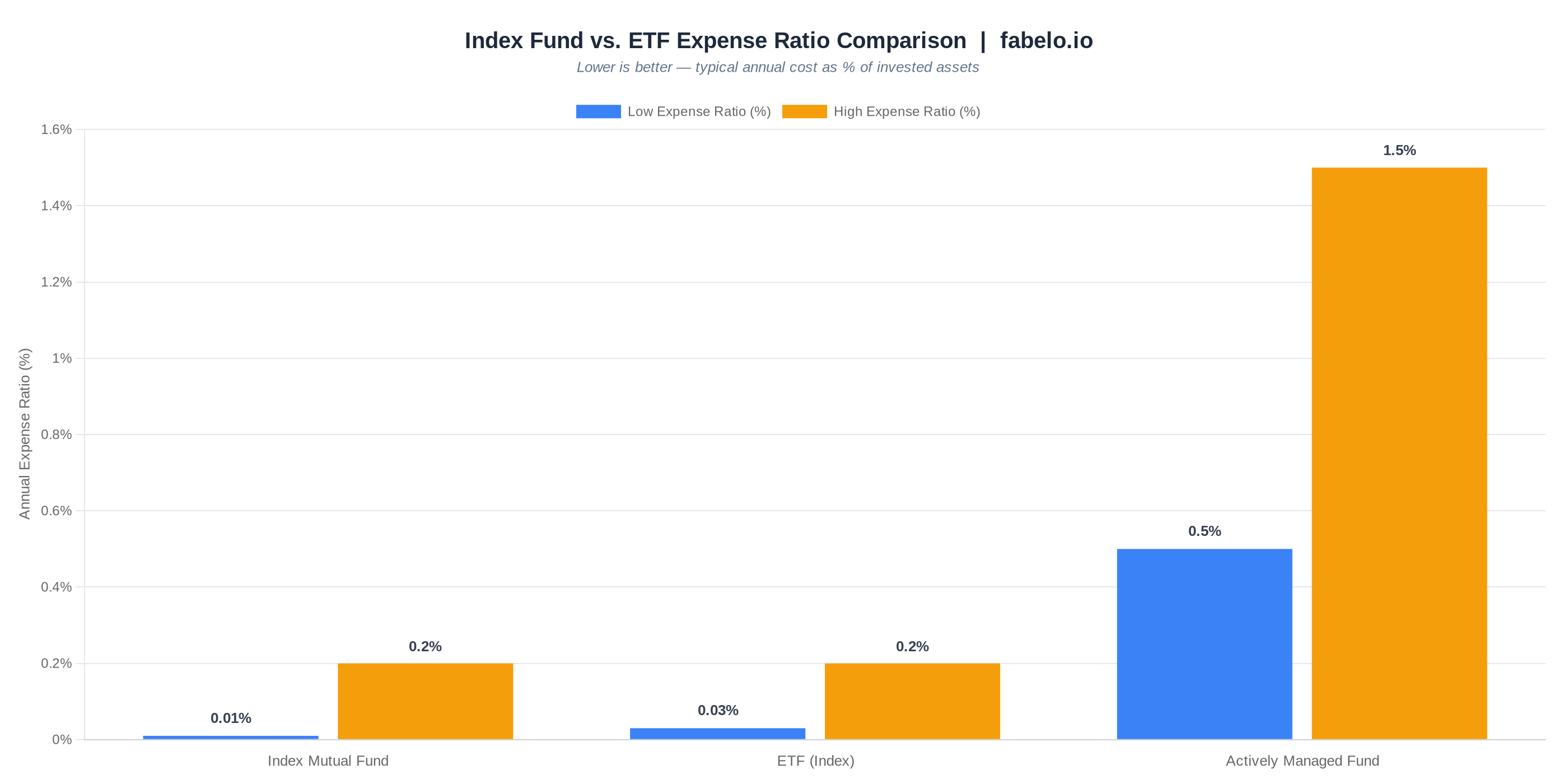
Here's every major dimension of the index funds vs ETF debate in one place, including the mutual fund comparison for full context.
Watch This First: ETF Investing Explained Visually
Before diving deeper into which option fits your portfolio, this video walkthrough offers a useful visual breakdown of how ETFs work across different categories — from S&P 500 trackers to global diversification funds to dividend-focused options. According to the Chris Palmer YouTube channel, a key concept most investors overlook is the distinction between accumulating and distributing ETFs: accumulating ETFs automatically reinvest dividends back into the fund (compounding your position without you doing anything), while distributing ETFs pay dividends out as cash. For long-term growth investors who don't need current income, the accumulating structure eliminates the risk of leaving money sitting uninvested in your account between dividend payments.
The video also makes a point worth sitting with: when you see multiple ETFs tracking the exact same index — say, five different S&P 500 ETFs from different providers — they own essentially identical holdings. The real differentiators are expense ratios, how dividends are handled, and the fund structure. That framing applies directly to the mutual fund vs ETF comparison too. Same index, similar holdings, different wrappers with different practical implications.
Watch: the Chris Palmer YouTube channel on ETF Investing →
What Real People Are Saying
The confusion between these two vehicle types shows up constantly in personal finance communities — and the honest questions people ask reveal where the real friction points are.
In r/FinancialPlanning, users asking about ETF advantages over index funds quickly learn that for most long-term buy-and-hold investors, the differences are genuinely minor. The top responses consistently land on the same core point: intraday trading is the most visible difference, but for someone investing for retirement over 20+ years, whether you execute at 2 PM or 4 PM on any given day barely moves the needle.
In r/fidelityinvestments, the ETF vs index fund debate gets more nuanced. Users there often point out that in taxable accounts, the ETF's tax efficiency advantage is the deciding factor — most experienced investors in that thread lean ETF for taxable, mutual fund for tax-advantaged. Several users note that for accounts inside a Roth IRA, it "really just comes down to personal preference" since taxes aren't a factor. This is accurate and reflects what the structural mechanics actually produce in practice.
In r/investing, a thread specifically exploring why anyone would still choose index mutual funds over ETFs got a particularly clear answer: mutual funds occasionally must distribute capital gains when forced to sell holdings — but the real reasons to stick with mutual funds come down to automated investing convenience and 401(k) availability. Several users in that thread point out that automation is underrated — if a mutual fund structure means you actually invest every month on autopilot rather than manually buying ETF shares and sometimes skipping months, the mutual fund wins on behavioral grounds regardless of the structural tax efficiency gap.
The consistent thread across all these community discussions: the choice between index funds and ETFs is far less important than choosing low-cost, diversified, passive funds over high-cost actively managed alternatives. Get that right first. Then optimize between fund structures.
Frequently Asked Questions
Which is better, mutual fund or index fund or ETF?
For most investors, a low-cost index fund or ETF beats an actively managed mutual fund over long time horizons. The evidence on active management consistently underperforming passive strategies — especially net of fees — is strong. Between index mutual funds and index ETFs, neither is universally "better." Index ETFs have a structural tax efficiency advantage in taxable accounts. Index mutual funds often offer better automation and are more commonly available in 401(k) plans. In tax-advantaged retirement accounts, the difference is negligible — pick the lowest expense ratio available for the index you want.
Why does Dave Ramsey say not to invest in ETFs?
Ramsey's concern with ETFs centers on behavioral risk rather than the vehicles themselves. Because ETFs trade like stocks throughout the day, they make it easy to react emotionally — selling during a market dip at 10 AM, chasing a hot sector at 2 PM, or constantly tinkering with a portfolio that would perform better if left alone. Traditional mutual funds, which only price once daily at market close, create a natural friction that prevents knee-jerk reactions. Ramsey's criticism isn't that ETFs are structurally flawed — it's that their liquidity invites overtrading for investors who haven't built the discipline to ignore short-term volatility. For a disciplined long-term investor, his concern largely doesn't apply.
What if I invested $10,000 in the S&P 500 20 years ago?
A $10,000 investment in a Vanguard S&P 500 index fund 20 years ago would be worth nearly $78,000 today — despite the 2008 financial crisis, the COVID-19 crash, the 2022 bear market, and multiple periods of significant volatility. That return required no stock picking, no timing decisions, and minimal management. It required staying invested. The lesson for the index funds vs ETF debate: the structure of your fund matters far less than the discipline of staying invested in a low-cost, diversified vehicle over long time horizons.
What did Warren Buffett say about ETFs?
Buffett has repeatedly stated that for most individual investors, a low-cost S&P 500 index fund is the most sensible equity investment over time. He has specifically endorsed the Vanguard S&P 500 ETF as an example of a vehicle that aligns with his core investing principles: simplicity, diversification, low cost, and a long-term holding mindset. He famously instructed the trustee managing his estate to put 90% of assets in a low-cost S&P 500 index fund after his death — a public endorsement of passive index investing that no amount of actively managed fund marketing can counter.
Are the differences between index funds and ETFs permanent or will they change?
The structural gap is narrowing. Brokerages like Fidelity and Schwab now support automatic ETF investing, which was historically a major mutual fund advantage. Fractional ETF shares have eliminated the minimum investment barrier. If this trend continues, the practical case for index mutual funds in taxable accounts weakens further. In 401(k) accounts, mutual funds will likely dominate for the foreseeable future simply because of how 401(k) plan infrastructure is built. In IRAs and taxable accounts, ETFs are increasingly the default choice for new investors starting portfolios today.
What about Vanguard specifically — ETF or index fund?
Vanguard is unique because its mutual funds and ETFs share the same share class structure, meaning VFIAX and VOO own identical portfolios and Vanguard manages them as one pool. This makes Vanguard's mutual funds unusually tax-efficient compared to other fund companies' mutual funds. Even so, in a taxable account, VOO (the ETF) still has a marginal tax efficiency edge. For Vanguard accounts specifically, according to Vanguard's own guidance on ETFs vs mutual funds, both index mutual funds and ETFs generally trade less frequently and thus tend to be more tax-efficient and have lower expense ratios than actively managed funds — reinforcing that the ETF/index fund choice matters less than the active/passive distinction.
Are there situations where neither index funds nor ETFs make sense?
For very short-term cash holdings (under 1-2 years), both stock index funds and bond ETFs carry more market risk than is appropriate. For money you need within 12-24 months, alternatives like high-yield savings accounts, Treasury bills, money market funds (such as VUSXX or SPAXX), or short-term Treasury ETFs like SGOV are more suitable. These preserve principal in a way that equity index funds cannot guarantee over short time horizons. The index fund vs ETF debate is a long-term wealth-building question — for short-term capital preservation, the answer is neither.
Final Verdict: Index Funds vs ETF
The headline answer to index funds vs ETF which is better: use ETFs in taxable brokerage accounts, and use whichever is cheapest and easiest to automate in tax-advantaged accounts.
For taxable accounts, ETFs win on tax efficiency due to the in-kind redemption structure that prevents capital gains distributions. Over a decade or more, this structural advantage compounds into real money — particularly for investors with portfolios in the six-figure range and above.
For 401(k) plans, the choice is usually made for you — most 401(k)s offer mutual funds. Choose the lowest-cost index fund available in your plan, typically an S&P 500 or total market fund. For Roth IRAs and traditional IRAs, both structures work well. If your brokerage makes ETF auto-investing easy, use ETFs and get the marginal tax efficiency benefit even in a tax-advantaged account. If mutual fund auto-investing is simpler to set up and ensures you actually invest consistently, the behavioral advantage of automated mutual fund contributions outweighs the structural ETF advantage.
The bottom line: don't let the index funds vs ETF debate paralyze you. Both vehicles, when tracking a broad low-cost index, will serve long-term investors well. The gap between a well-chosen index mutual fund and a comparable ETF is far smaller than the gap between either of them and a high-cost actively managed mutual fund. Get into a low-cost, diversified, passive fund — mutual fund or ETF — and stay invested. According to Charles Schwab's guidance on ETFs and mutual funds, both fund types simplify investing, aim to keep expense ratios low, and reduce risk through diversification. That's the foundation. Everything else is optimization.
About the Author
Written by Varn Kutser
Personal finance writer covering savings, investing, and budgeting with a data-first approach. Every rate, limit, and claim is verified against official sources — FDIC, IRS, and Federal Reserve. No clickbait, no guesswork, just numbers.
Disclaimer: Rates and terms mentioned in this article are subject to change. Verify current rates directly with financial institutions before opening any account.
Last updated: April 13, 2026 · fabelo.io