

The best side hustles from home for beginners require no upfront investment and can generate $500–$2,000/month within 90 days. Freelance writing, social media management, virtual assistance, and online tutoring consistently convert fastest for people starting from zero. Every one of them can be launched this week using skills you already have — no certification, no equipment, no existing audience required.
The good news: you don't need a special degree, a huge following, or startup capital to find legitimate side hustle ideas from home for beginners. Plenty of people are pulling in an extra $500 to $2,000 a month from their couch — doing things like freelance writing, virtual assistance, or selling digital products. A few are replacing their full-time income entirely. The difference between them and everyone else is that they picked one thing and got specific about it.
Below you'll find ten genuinely actionable options — organized by how fast you can start earning, what skill level they require, and which ones pay daily or weekly. Read through, pick the one that fits your situation, and take the first step today.
Contents
- Step 1: Pick the Right Model for You
- Step 2: Freelancing — The Fastest Path to Paid
- Step 3: Virtual Assistant Work
- Step 4: Sell Digital Products
- Step 5: Online Tutoring and Teaching
- Step 6: Social Media Management
- Step 7: AI-Powered Services for Local Businesses
- Step 8: Reselling and Flipping Online
- Side Hustle Comparison Table
- Watch This First
- What Real People Are Saying
- Frequently Asked Questions
- Your Next Steps
Step 1: Pick the Right Model for You
Before jumping into a specific hustle, answer three questions honestly: How fast do you need money? How many hours per week can you realistically commit? And what do you already know how to do — even a little bit?
Side hustles generally fall into two buckets. Service-based hustles — freelancing, tutoring, virtual assistance — pay faster because someone is hiring you directly. You can have money in your account within a week of starting. Asset-based hustles — selling digital products, affiliate marketing, content creation — take longer to ramp up but scale without trading time for dollars indefinitely. Neither is better. They just serve different situations.
If your rent is due in two weeks, start with a service hustle. If you have three to six months of patience and want something that compounds over time, build an asset. Most people reading this are better served starting with services to generate cash flow, then layering in assets as they go.
One more thing worth saying clearly: the best side hustle ideas from home for beginners online are the ones that match what you can actually execute. A $10,000/month hustle that requires skills you don't have is worth less to you right now than a $500/month hustle you can start tomorrow. Start there. Upgrade later.
Here's a simple framework to narrow it down:
- You have a skill (writing, design, coding, Excel): Go to Step 2 (Freelancing) first.
- You're organized but not sure what your skill is: Go to Step 3 (Virtual Assistant).
- You want something that earns while you're not working: Go to Step 4 (Digital Products).
- You love teaching or explaining things: Go to Step 5 (Online Tutoring).
- You're comfortable on social media: Go to Step 6 (Social Media Management).
- You want recurring monthly income from day one: Go to Step 7 (AI Services for Businesses).
- You like hunting for deals and selling stuff: Go to Step 8 (Reselling).
Step 2: Freelancing — The Fastest Path to Paid
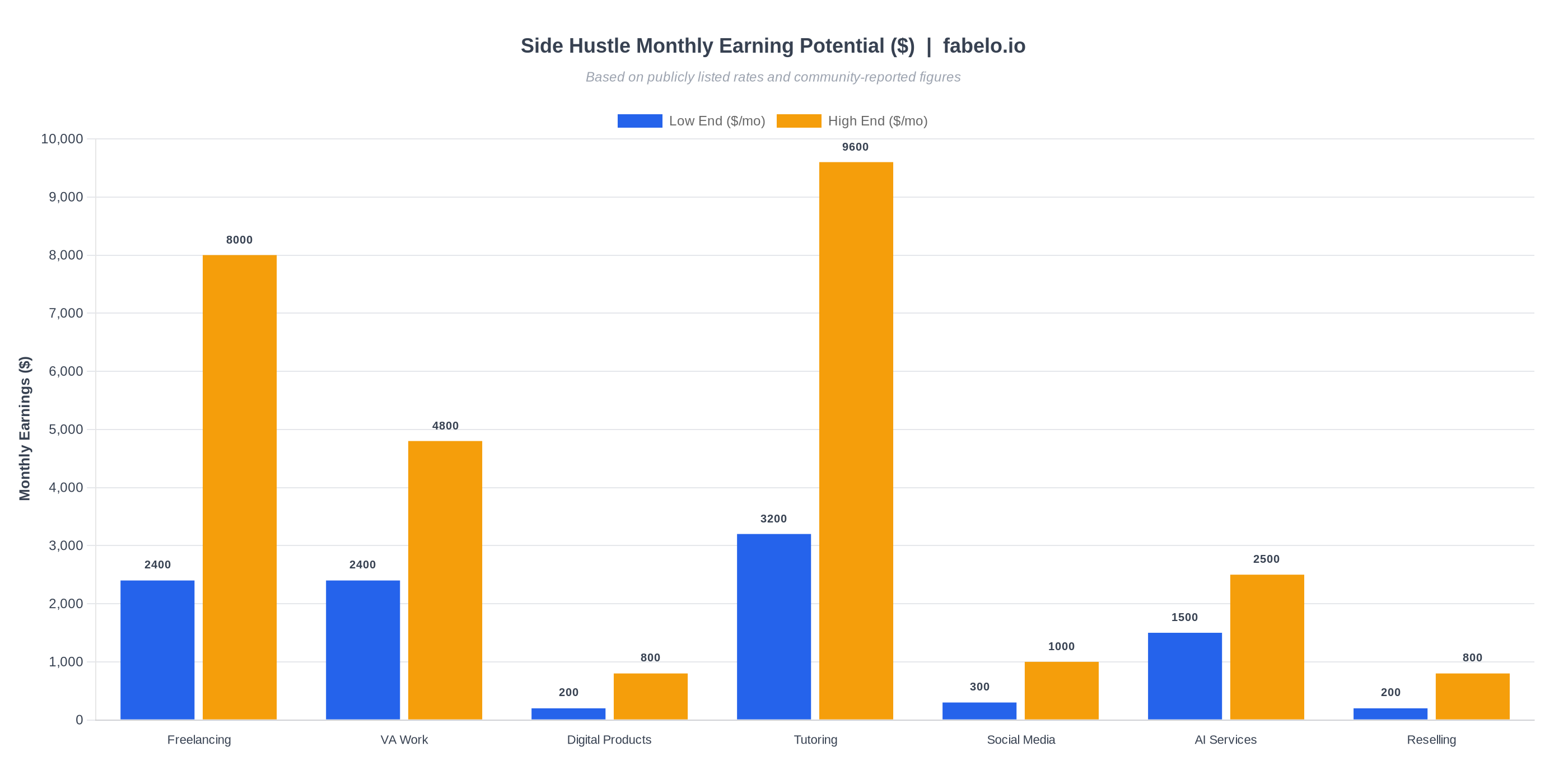
Earning ranges in this guide reflect publicly listed rates on freelance platforms, job boards, and community-reported figures from Reddit and industry forums. Actual earnings vary by skill level, niche, and hours invested.
Freelancing is the single fastest way to turn an existing skill into cash. Writing, graphic design, video editing, web development, data entry, copywriting — if you can do it, someone will pay you for it. And according to side hustle community research, freelancing consistently ranks as one of the highest-earning and most popular side hustles by raw numbers.
Where to start:
- Pick one service. Don't offer six things on your profile. Pick one. "Blog posts for SaaS companies" beats "I write stuff" every time. Specificity books clients.
- Create a profile on Fiverr or Upwork. Fiverr works better if you're totally new — buyers come to you. Upwork pays more once you build reviews. Start on Fiverr, migrate to Upwork.
- Set a beginner rate, not a zero rate. Charging $5 signals low quality. Charge $25–$50 for your first gig. Deliver excellent work. Get five reviews. Then raise prices.
- Send five cold pitches on day one. Don't wait for buyers to find you. Go to LinkedIn or Facebook groups in your niche and message five people who might need your service. Keep it short: "Here's what I do, here's who I've helped, here's my rate. Interested?"
- Deliver on time, every time. This sounds obvious. It's the entire game in the early stages. Reviews are your currency.
Realistic earnings: Beginners typically earn $15–$35/hour. Experienced freelancers with a niche commonly charge $75–$150/hour. Writers can earn $0.10–$0.50 per word. Designers charge $300–$1,500 per logo project at mid-tier rates.
One of the genuinely underrated platforms is covered in depth by financial research sites — answering questions on services like JustAnswer, where professionals in law, medicine, veterinary care, and finance earn $2–$50+ per answer depending on the category. If you have a professional background, this is an overlooked gem.
Side hustles that pay daily: Freelance platforms like Fiverr allow instant payouts to your PayPal once you reach a $1 minimum. Upwork pays weekly. If daily access to cash matters, Fiverr with PayPal is your best setup.
Step 3: Virtual Assistant Work

Virtual assistance is one of the most beginner-friendly paths available. The core tasks — inbox management, calendar scheduling, data entry, customer service, social media scheduling — require almost no specialized training. What they require is reliability, attention to detail, and basic computer competence. Most people reading this already qualify.
In r/povertyfinance, users frequently flag virtual assistant work as one of the most approachable options for people with no prior side hustle experience — specifically because the skills transfer directly from regular office or administrative jobs most people have already held.
How to get started as a VA:
- Define your service package. Pick two or three tasks you're comfortable with. Example: "Email management, calendar coordination, and basic WordPress updates." Don't oversell yourself early.
- Create a simple one-page portfolio. This can be a Google Doc or a free Canva page. List your services, your availability, and a contact email. You don't need a website yet.
- Find clients on Upwork, Zirtual, or Belay. Belay and Boldly tend to pay more ($15–$35/hour) but are more selective. Upwork has more volume at lower starting rates ($10–$20/hour). Both are legitimate.
- Pitch directly to solopreneurs. Coaches, consultants, real estate agents, and online course creators are constantly drowning in admin work. Find them on Instagram or LinkedIn. A short, clear pitch explaining what you'll handle for them lands more clients than any job board.
- Specialize over time. General VAs earn $15–$20/hour. VAs who specialize in, say, podcast management or Kajabi platform administration can charge $40–$65/hour. The niche is where the money is.
Realistic earnings: $15–$30/hour to start. $40–$65/hour with a specialty. Many VAs work 10–20 hours per week with two or three long-term clients — a reliable $1,000–$2,500/month range that's stable once established.
Step 4: Sell Digital Products
Digital products are the closest thing to a genuinely scalable home side hustle. You create something once — a template, an ebook, a Notion dashboard, a Lightroom preset pack, a printable planner — and sell it repeatedly without additional work. The product doesn't care if you're sleeping or not. That's the real appeal.
What sells well:
- Budget spreadsheets and financial templates (Google Sheets or Excel)
- Resume templates and cover letter frameworks
- Social media content calendars
- Wedding planning checklists and printables
- Canva templates for small businesses
- Study guides and tutoring materials
- Photography presets (Lightroom)
Where to sell: Etsy is the dominant marketplace for digital downloads — low barrier to entry, built-in traffic. Gumroad works well for courses and ebooks. Creative Market caters to designers. Payhip has zero transaction fees on the free plan.
How to launch in one week:
- Identify what you already know how to do better than most people — even slightly.
- Create a product that solves a specific problem for a specific person. "Budget template for recent college grads" beats "budget template."
- Build it in Canva, Google Sheets, or Notion. Keep it simple and functional.
- Open a free Etsy shop. Write a description that speaks directly to the buyer's pain point.
- Price between $5 and $25 to start. Volume and reviews matter more than margin early on.
- Share it in relevant Facebook groups and subreddits where buyers hang out.
Realistic earnings: Many sellers earn $200–$800/month within six months of consistent effort. Top Etsy sellers with multiple products regularly report $3,000–$10,000/month — but that's a long game requiring SEO work, quality photos, and product iteration. Expect slow ramp-up; plan accordingly.
Step 5: Online Tutoring and Teaching
If you know a subject — math, science, history, a foreign language, music, test prep — you have a marketable skill that commands solid hourly rates with zero startup cost. Online tutoring is one of the few side hustle ideas that make the most money on a per-hour basis for beginners, particularly in STEM subjects.
Teaching English online remains one of the most accessible entry points globally. Platforms like Cambly pay $10.20/hour for conversation practice — no lesson planning required. VIPKid (now operating under different branding in some markets) and iTalki allow you to set your own schedule and rates, with experienced tutors earning $20–$40/hour or more.
For academic tutoring:
- List yourself on Wyzant or Tutor.com. Wyzant lets you set your own hourly rate ($25–$80/hour is common). Tutor.com pays a flat rate per session.
- Pick one or two subjects. "SAT Math and AP Chemistry" is a selling point. "Everything" is not.
- Build a simple profile with your education background. A degree, relevant coursework, or even strong personal expertise qualifies you for most platforms.
- Market locally too. Post on Nextdoor and local Facebook groups. Parents looking for tutors trust a neighbor recommendation over a stranger online. This can fill your schedule faster than any platform.
According to career education research, tutoring and digital creative work consistently appear in the top tier of home-based side hustles for immediate income potential and skill alignment.
Realistic earnings: $20–$40/hour for general academic subjects. $50–$100/hour for specialized test prep (LSAT, GMAT, GRE). Consistent tutors with ten students can earn $1,500–$4,000/month working part-time hours.
Step 6: Social Media Management
Small businesses know they need to post on Instagram and Facebook. Most of them don't have time to do it consistently, don't know what to say, and frankly find it stressful. That's the gap you fill. Social media management for local businesses is one of the best work from home side hustles precisely because demand is everywhere and the bar to get started is lower than most people assume.
You don't need 50,000 followers. You don't need to be an influencer. You need to understand what content performs on a given platform, be able to write decent captions, use Canva or a basic design tool, and show up consistently for your clients.
Getting your first client:
- Pick a niche. "Social media for restaurants" or "Instagram management for real estate agents" makes outreach ten times easier than a generic pitch.
- Do a free audit for your first prospect. Look at their current Instagram or Facebook page. Note three specific problems and three specific improvements. Send it as a loom video or PDF. This demonstrates competence without requiring a portfolio.
- Offer a 30-day trial package. Charge $300–$500/month for 12 posts and basic engagement. Once you prove results, raise to $750–$1,500/month.
- Use scheduling tools like Buffer or Later to batch content creation. You can manage three or four clients in 10–15 hours per week once you have systems dialed in.
Realistic earnings: $300–$500/month per client as a beginner. $1,000–$2,500/month per client as an experienced manager. Three to five clients puts you at $3,000–$7,500/month. The ceiling is high; the floor is accessible.
Step 7: AI-Powered Services for Local Businesses
This is the one most beginners overlook completely, and it's arguably the highest-ceiling option on this list right now. Local businesses — restaurants, dental offices, plumbers, law firms — are hemorrhaging revenue from missed calls and poor online reputation management. They know it. They just don't have the tools or time to fix it.
According to the Whitney Bonds YouTube channel, a content creator who documents her own income experiments, setting up AI voice receptionist services for small businesses generates recurring monthly fees — she charges clients $497/month for an AI that answers calls, books appointments, and handles FAQs automatically. Her second service — automating Google review requests for local businesses — brings in $297/month per client. Once the systems are built, the ongoing maintenance is minimal. A friend of hers left an initial setup session with one paying client and an extra $1,000 per month added to her income.
This model works because businesses are paying for outcomes (answered calls, more reviews, booked appointments) not your time. That makes it one of the most legitimate side hustle ideas that make the most money on a per-hour-worked basis once you get past the first client acquisition hurdle.
How to launch this service:
- Learn one AI tool. Platforms like VAPI, Synthflow, or GoHighLevel let you build AI voice agents and automation workflows. Most have free trials or low-cost starter plans.
- Choose a business niche. Dental offices, real estate agents, and home service contractors are ideal targets — high call volume, frequent missed calls, motivated buyers.
- Build a demo before pitching. Create a sample AI receptionist for a fictional business in your niche. When you call a prospect, you can offer a live demo. This closes clients faster than any slide deck.
- Price on a monthly retainer. Don't charge a one-time fee. Monthly recurring revenue compounds. Start at $297–$497/month and adjust based on what the market accepts.
- Get your first client through cold outreach. Call or email five businesses in your niche per day. Rejection is part of it. The first "yes" is the hardest.
Realistic earnings: $297–$497/month per client on retainer. Five clients = $1,500–$2,500/month. This model scales to full-time replacement income faster than most options on this list — but it requires a real sales process and genuine persistence to land those first clients.
Step 8: Reselling and Flipping Online
Buy low, sell high. It's one of the oldest business models in existence and it still works — particularly when you focus on niche second-hand markets where you have more knowledge than the average buyer. Think vintage electronics, designer handbags, rare sneakers, collectible books, or specialty sporting equipment.
Apps like Gazelle let you sell used electronics quickly with instant price quotes. EBay, Poshmark, Mercari, and Facebook Marketplace cover most physical goods. The key to making this work as a serious side hustle from home for beginners online is picking a niche you understand, sourcing reliably (thrift stores, estate sales, online liquidations), and pricing competitively.
How to start flipping this week:
- Sell what you already own first. Go through your house. Electronics, clothes, furniture, kitchen appliances — anything unused is working capital. List ten items on Facebook Marketplace this weekend. This teaches you photography, pricing, and negotiation with zero risk.
- Pick one reselling niche. Vintage clothing, video games, tools, baby gear — one niche lets you build pricing expertise fast. Random resellers plateau quickly.
- Source from estate sales and thrift stores. EstateSales.net lists local estate sales by zip code. Show up early. Learn what items sell quickly in your niche.
- Learn eBay's sold listings feature. Before buying anything to flip, search eBay for that item, filter by "Sold" listings, and confirm actual selling prices — not asking prices. This one habit prevents bad buys.
In r/sidehustle, experienced resellers consistently highlight niche second-hand markets and selling 3D prints as among the most sustainable home-based hustles — noting that the real advantage comes from category expertise, not just hustle volume.
Realistic earnings: $200–$800/month for casual resellers doing 5–10 hours per week. Full-time resellers routinely report $3,000–$8,000/month with systems in place. One thing to know: this is not a daily-pay hustle. Most platforms pay within 3–7 business days of a sale completing.
Side Hustle Comparison Table
| Side Hustle | Startup Cost | Time to First $ | Beginner Earning Range | Pay Frequency | Scalability |
|---|---|---|---|---|---|
| Freelancing | $0 | 1–2 weeks | $15–$50/hr | Daily/Weekly | Medium |
| Virtual Assistant | $0 | 1–3 weeks | $15–$30/hr | Weekly/Biweekly | Medium |
| Digital Products | $0–$30 | 2–8 weeks | $200–$800/mo | Per sale | High |
| Online Tutoring | $0 | 1–2 weeks | $20–$60/hr | Weekly | Medium |
| Social Media Mgmt | $0–$20/mo | 2–4 weeks | $300–$1,000/mo/client | Monthly | High |
| AI Business Services | $50–$200/mo | 3–6 weeks | $297–$497/mo/client | Monthly retainer | Very High |
| Reselling/Flipping | $0–$500 | Days to 1 week | $200–$800/mo | Per sale (3–7 days) | Medium |
Watch This First

Watch: the Whitney Bonds YouTube channel on Side Hustles for Beginners →
According to the Whitney Bonds YouTube channel, one of the most overlooked angles in the side hustle space right now is selling AI-powered services to local businesses — specifically voice receptionist automation and Google review management. The model she outlines charges clients $297–$497 per month on a recurring retainer. Once the system is set up, the maintenance is minimal. She describes helping a friend land her first client in a single afternoon — after several rejections — resulting in $1,000 per month in new recurring income. The key lesson: getting the first client is the hardest part, and most people quit before they get there.
What's worth noting about this video beyond the AI services angle is her broader framework: stop chasing every new hustle idea online and instead pick exactly one thing, learn the specific first steps, and execute. That framework applies across every option in this guide. The hustle that makes you money isn't the most exciting one on paper — it's the one you actually follow through on.
What Real People Are Saying
The community conversations around home-based side hustles are more nuanced than most YouTube videos let on. In r/sidehustle, experienced users consistently point to niche reselling, 3D print sales, and selling advertising space as legitimate long-term earners — not the flashy options that dominate most top-ten lists. The consensus: niche expertise compounds. The more you know about a specific product category, the better your sourcing and pricing decisions become over time.
In r/sidehustle, users specifically call out photo and video editing for small content creators, freelance writing, and online tutoring as the strongest low-cost, beginner-accessible options. Several mention that the biggest mistake beginners make is spreading across too many platforms at once instead of mastering one before moving on.
In r/Entrepreneur, the advice for newcomers zeroes in on dropshipping and affiliate marketing as low-barrier entry points — though experienced commenters are quick to note that the real learning curve is understanding digital marketing and traffic, not the business model itself. The hustle is free to start. The education is what costs you.
One thread in r/sidehustle sums up a frustration many beginners share: people try surveys, games, and selling random household items — and while those work, they don't scale. The users who report meaningful income shifts are the ones who treated their side hustle like a small business from week one: defined service, specific clients, consistent outreach, and a real pricing structure.
Frequently Asked Questions
Which home side hustles can I start today with a laptop and zero dollars?
Freelancing and virtual assistant work are the strongest zero-cost starting points. Both require only skills you likely already have and a free profile on platforms like Upwork or Fiverr. Online tutoring is another. You can list yourself on Wyzant for free and start earning within days of getting your first client. The common thread: sell a service before you ever try to sell a product. Services generate cash immediately; products require inventory, marketing, and time to ramp.
What is the most profitable home side hustle that scales past $1,000 per month?
By hourly rate, specialized freelancing — particularly software development, legal writing, technical SEO, and financial consulting — pays the most. Rates of $100–$250/hour are achievable once you establish a track record in a high-value niche. By total monthly income potential, digital products and social media management scale the highest because income isn't capped by hours worked. AI-powered business services are emerging as the top contender for recurring income relative to time invested, once you land clients.
Which work-from-home side hustles pay same-day or within 48 hours of completing a job?
Fiverr allows instant payouts to PayPal with a $1 minimum balance — effectively daily access to earnings. Freelance platforms that support same-day or next-day ACH transfers give the fastest access to cash. Reselling on Facebook Marketplace lets you collect cash or Venmo payment at pickup. For digital products, Gumroad and Payhip process payouts on a rolling schedule. If daily pay access is a hard requirement, Fiverr with PayPal is the most reliable setup for beginners.
Can I start a side hustle from home with no experience?
Yes — but "no experience" requires some nuance. You don't need professional experience in a field to start, but you do need a genuine skill or willingness to learn one quickly. Virtual assistant work, reselling, and basic social media management are the most accessible to true beginners. Tutoring requires knowledge of a subject. Freelance writing requires writing competence. The fastest path to income is identifying what you already do reasonably well and monetizing that first, before expanding into unfamiliar territory.
How much can a beginner realistically earn from a home side hustle in the first 90 days?
With consistent effort — meaning 5–15 hours per week of actual work and outreach — beginners can realistically earn $300–$1,500 in their first 90 days from service-based hustles like freelancing, tutoring, or VA work. Product-based hustles like Etsy digital downloads typically earn less in the first 90 days ($50–$300) but compound over time as reviews and search traffic build. The outliers who earn $5,000+ in 90 days do exist, but they're usually bringing prior skills, existing networks, or more weekly hours than average.
Do I need to report side hustle income on my taxes?
Yes. The IRS requires you to report all income, including side hustle earnings. If you earn more than $400 (IRS threshold) net from self-employment in a year, you're required to file a Schedule SE and pay self-employment tax. Many platforms — Fiverr, Etsy, PayPal, Venmo — are required to issue 1099-K forms once you hit certain thresholds. Track your income and any legitimate business expenses (software subscriptions, home office costs, equipment) from day one. A simple spreadsheet works fine when you're starting out.
Your Next Steps
Most people read a guide like this, feel motivated for twenty minutes, and then do nothing. Don't be that person. The only thing separating someone earning an extra $800 a month and someone not earning it is one concrete action taken today.
Here's your three-step action plan:
- Step 1 — Pick exactly one hustle from this list. Not two. One. Base it on what you can start this week with the skills and time you currently have. If you can't narrow it down, default to freelancing or virtual assistance — both have a clear path from zero to first client within two weeks.
- Step 2 — Take one visible action in the next 24 hours. Create a Fiverr profile. List ten items on Facebook Marketplace. Send three cold pitches to businesses in your area. Open an Etsy account. The action has to create an artifact in the real world — not just a note in your phone.
- Step 3 — Commit to 30 days before evaluating. No side hustle reveals its real potential in a week. The people who succeed are almost always the ones who gave a single idea a genuine month of consistent effort before deciding whether to continue, pivot, or quit. Thirty days. One thing. That's the entire strategy.
The best side hustle ideas from home for beginners aren't secret. They're just the ones you actually start.
About the Author
Written by Fabelo
The Fabelo editorial team covers career strategies, job market trends, and professional development. Research-backed guides for ambitious professionals.
Disclaimer: This article is for informational purposes only. Career data, salary figures, and job market trends reflect available research and may change. Always do your own research before making major career or education decisions.
Last updated: April 12, 2026 · fabelo.io