

The best at-home side hustles for beginners in 2024 require zero startup capital and pay $15–$50/hr. Freelance writing, virtual assistance, online tutoring, and print-on-demand stores consistently rank as the easiest to start — most people generate their first income within 2–4 weeks. All you need is a laptop, an internet connection, and one skill someone else is willing to pay for.
This guide cuts through the noise. Every side hustle idea listed here can be started from home, requires minimal upfront investment, and is realistic for someone with no prior experience. Some pay daily. Some build toward serious monthly income. A few can become full-time businesses inside two years. The goal is to get you moving — not just informed.
Whether you have five hours a week or twenty-five, there's a legitimate path here for you. Work through the steps, pick one idea that matches your skills, and treat the first 30 days as a test run. That's it.
Earning ranges in this guide reflect publicly listed rates on freelance platforms, job boards, and community-reported figures. Actual earnings vary by skill level, niche, and hours invested.
Contents
- Step 1: Figure Out What You Already Have
- Step 2: Choose the Right Side Hustle for Your Situation
- Step 3: The Top Side Hustle Ideas for Beginners at Home
- Step 4: Set Up Your First Offer in 48 Hours
- Step 5: Land Your First Client or Sale
- Step 6: Scale What Works and Drop What Doesn't
- Side Hustle Comparison Quick Reference
- Watch This First
- What Real People Are Saying
- Frequently Asked Questions
- Your Next Steps
Step 1: Figure Out What You Already Have
Before picking a hustle, take a realistic inventory. Most beginners skip this and chase whatever sounds exciting — then quit after three weeks because the work doesn't match their personality or schedule. Spend 20 minutes on this step and save yourself months of wasted effort.
Ask yourself four questions:
- What do people already ask me for help with? Editing emails, fixing computer issues, explaining recipes, organizing things — these are real signals about marketable skills you're overlooking.
- How many hours per week can I realistically dedicate? Five hours weekly is enough to launch a freelance writing profile or a reselling operation. It is not enough to run a social media management agency from scratch.
- Do I want active income or passive income? Active means you trade time for money — tutoring, freelancing, virtual assistance. Passive means you build something once and sell it repeatedly — digital products, templates, print-on-demand. Most beginners should start active and layer in passive later.
- What's my startup budget? Most of the best home-based side hustles cost $0 to $50 to begin. If you're budgeting more than $100 before making your first dollar, reconsider the plan.
Write your answers down. You'll use them in Step 2 to filter the list. This isn't busywork — it's the reason some people make $500 in their first month while others spin their wheels indefinitely.
One more thing: don't disqualify yourself because you think you're "not an expert." Your definition of expert is almost certainly too high. If you know more than a total beginner, you can teach, assist, or create value for someone else. That's the only bar that matters when starting out.
Step 2: Choose the Right Side Hustle for Your Situation
Not every side hustle fits every person. A night-shift nurse has different availability than a stay-at-home parent. A college student with graphic design skills needs a different plan than a 45-year-old accountant looking to monetize spreadsheet expertise. The category of hustle matters as much as the hustle itself.
Here's a fast framework for matching hustle type to situation:
- You have a skill but no audience: Freelancing on platforms like Fiverr or Upwork gets you in front of buyers immediately. No marketing required to start.
- You have time but no specific skill: Virtual assistance, transcription, or task-based work on platforms like TaskRabbit or Rev are entry-level and pay weekly or faster.
- You want something that can grow into serious income: Digital products, online tutoring, or a niche service (video editing, copywriting, SEO) have the highest long-term ceiling of any home-based option.
- You need money fast — within the week: Selling unused items on Facebook Marketplace or eBay, doing paid surveys on Swagbucks, or completing micro-tasks are the fastest cash options — low income ceiling, but genuinely immediate.
The biggest mistake beginners make is choosing a hustle based on income potential alone. A $200/hour skill you hate doing will lose to a $30/hour skill you're consistent with — every single time. Consistency beats ceiling, especially in year one.
Narrow your list to two or three options before moving to Step 3. Trying five side hustles simultaneously is a reliable path to burning out and making nothing.
Step 3: The Top Side Hustle Ideas for Beginners at Home

These are the side hustle ideas that consistently appear in legitimate community discussions, produce real income for beginners, and can be started without quitting your day job or making a risky investment.
1. Freelance Writing
Freelance writing is one of the most accessible side hustle ideas for beginners online. Businesses, blogs, and media companies constantly need written content — product descriptions, blog posts, email newsletters, and social copy. Entry-level writers typically earn $15–$50 per article, while specialized writers (finance, health, SaaS) can charge $100–$500+ per piece. Start on Upwork or Fiverr, pick one niche, and write three sample pieces to use as a portfolio. That's genuinely all you need to land your first paid job.
2. Virtual Assistant (VA)
Virtual assistants handle tasks that business owners don't have time for — scheduling, email management, data entry, research, customer service. No degree required. Beginners commonly earn $15–$25/hour, and experienced VAs charge $40–$75/hour. Platforms like Upwork, Zirtual, and Belay connect VAs with clients. This is one of the strongest side jobs from home for people with good organizational skills and zero technical background.
3. Video Editing
The demand for short-form video content has exploded. YouTube creators, small businesses, and TikTok brands need editors who can turn raw footage into polished content. Beginners using free tools like CapCut or the free version of DaVinci Resolve charge $50–$150 per video. Experienced editors working on long-form YouTube content earn $200–$500 per video. As multiple creators have documented, editing photos or videos for small content creators is one of the lowest-cost ways to start earning online fast.
4. Graphic Design
If you're comfortable with tools like Canva or Adobe Illustrator, there's consistent demand for logo design, social media graphics, Etsy templates, and presentation design. Even Canva-only designers sell templates on Etsy as digital products — create once, sell repeatedly. This is one of the side hustles that pay well once you build a niche portfolio.
5. Online Tutoring
You don't need a teaching certificate to tutor online. Platforms like Tutor.com, Wyzant, and Varsity Tutors pay $15–$40/hour for K-12 subjects. College-level math, test prep (SAT/ACT/GRE), and foreign language tutoring commonly fetch $50–$80/hour. If you excelled in any subject in school, this converts directly into income. Reselling knowledge is genuinely one of the most underrated side hustle ideas for beginners at home.
6. Selling Digital Products
Templates, planners, spreadsheets, Notion dashboards, resume kits, and social media packs are all digital products that sell on Etsy, Gumroad, and Payhip. You create the file once and can sell it an unlimited number of times. This is one of the top passive income options in r/povertyfinance discussions, where users consistently highlight digital downloads as a low-overhead way to generate recurring revenue. A well-designed budget template can sell 50–200 copies per month at $5–$15 each with no ongoing work.
7. Social Media Management
Small businesses know they need social media. Most of them hate managing it. That gap is your opportunity. A social media manager handles posting, scheduling, basic copywriting, and engagement for one to five clients. Beginners charge $300–$700/month per client. With three clients, that's $900–$2,100/month in additional income — working from home on a schedule you control. Start with local businesses in your area who have weak or inconsistent social presence.
8. UGC (User-Generated Content) Creation
Brands pay real people to create casual, authentic-looking video reviews of their products. The content gets used in paid social ads. Unlike being an influencer, you don't need an audience — just a smartphone and the ability to speak naturally on camera. Creators earn $100–$500 per video clip. Platforms like Fiverr and Billo connect UGC creators with brands actively looking for this content right now.
9. Proofreading and Copyediting
If catching typos and grammatical errors comes naturally, proofreading is a legitimate work-from-home option. Academic documents, self-published books, legal briefs, and business reports all need clean copy. Entry-level proofreaders earn $15–$25/hour. As noted by career development resources covering at-home work, proofreading requires almost no startup cost and is one of the few side jobs from home online that suits detail-oriented beginners immediately.
10. Reselling
Buy low, sell higher. Source from thrift stores, garage sales, clearance aisles, or your own closets and resell on eBay, Poshmark, Mercari, or Facebook Marketplace. Niche resellers — vintage clothing, used electronics, specific book categories — consistently outperform general resellers. This is one of the genuine side hustles that pay weekly or even daily depending on platform payout schedules and sales volume.
Step 4: Set Up Your First Offer in 48 Hours
Speed matters here. The longer you wait to make your first offer, the more psychological friction builds. A perfect profile that launches in three weeks makes less money than a good profile that launches tonight.
Follow this 48-hour checklist based on your chosen hustle:
For freelancing (writing, design, editing, VA):
- Create a profile on Fiverr or Upwork with a professional photo and a concise bio that names your niche. "I write SEO blog posts for health and wellness brands" outperforms "I write all kinds of content."
- Build two to three portfolio samples if you don't have client work. Write mock blog posts, design fake brand assets, edit a sample video using free stock footage. Clients need to see the work, not hear about your potential.
- Set your starting rate 20–30% below market rate. You're buying reviews and social proof, not selling your time cheaply forever. Raise rates after five positive reviews.
- Write a personalized proposal for every job application. Copy-paste applications are immediately recognizable and immediately ignored.
For digital products:
- Pick one product type — a budget tracker, a content calendar, a resume template.
- Build it in Canva or Google Sheets. Keep it clean and functional over decorative.
- Open an Etsy shop or Gumroad account (both are free to start).
- Write a product description that answers the buyer's specific problem, not just what the product is.
For tutoring:
- Apply on Wyzant or Tutor.com. Both have straightforward applications and verify within a few days.
- List your specific subjects and academic level — the more specific, the better your match rate.
- Price competitively at first, then raise rates as you collect reviews.
Don't overthink the branding. You don't need a business name, a logo, or a website to make your first $100. Those things come after the money starts coming in — not before.
Step 5: Land Your First Client or Sale
The first dollar is the hardest. Once you've made it, the psychological barrier disappears and the process becomes repeatable. Here's how to accelerate getting there.
Warm outreach first. Before posting on freelance platforms, message five people you already know who might need your service or know someone who does. A former coworker who runs a small business. A neighbor who mentioned their Instagram looks unprofessional. This isn't begging — it's smart distribution. You're offering something valuable to someone who already trusts you. Conversion rates on warm outreach are dramatically higher than cold applications on crowded platforms.
Lower the barrier to yes. Offer your first one or two clients a discounted or even free project in exchange for a testimonial and permission to use the work as a portfolio sample. This is not devaluing your work — it's buying the social proof that makes all future clients pay full price. One genuine five-star testimonial on Fiverr is worth more than a hundred cold applications.
Show up where your clients are. Facebook Groups for small business owners are full of people asking for freelance help. Local entrepreneur communities on Meetup or LinkedIn are the same. Spend 30 minutes per day in three relevant groups, provide value without selling, and mention your services when genuinely relevant. This compound approach generates organic leads within two to four weeks.
For product-based hustles: Your first sale on Etsy or Gumroad is mostly a traffic problem, not a quality problem. Share your product link in relevant Reddit communities that allow self-promotion (check the rules first), your personal social media, and niche Facebook groups. One post in the right community can generate 20–50 visits overnight.
Step 6: Scale What Works and Drop What Doesn't
After 30 days, you should have data. Maybe you landed two writing clients but hated the work. Maybe your Etsy template sold three copies with almost no promotion. That data tells you everything.
Scaling isn't complicated. It means doing more of what's working and ruthlessly eliminating what isn't. Here's a practical approach:
Double down on one hustle before adding another. The temptation to diversify income streams early is real — and it kills momentum. A freelance writer making $800/month should try to reach $2,000/month before starting a second income stream. Depth before breadth, especially in year one.
Raise your rates every 90 days. If you're booked solid at your current rate, you're priced too low. Every time you hit near-full capacity, raise rates by 15–25% with new clients while grandfathering existing ones. Experienced freelancers who consistently deliver quality regularly reach $75–$150/hour. That trajectory starts with your first $25/hour project.
Automate and productize. Once a service has repeatable steps, document it. Then either create a template to speed your own delivery or package it into a digital product. A social media manager who builds content calendar templates can sell those templates passively on Etsy while still taking on clients. A tutor who builds study guides can sell them on Gumroad. Every repeatable process is a potential product.
Track your hourly rate, not just total income. Twenty hours of survey-taking at $4/hour produces less than two hours of freelance writing at $50/hour. Know your real numbers. According to research on side hustle income patterns, people who track their effective hourly rate consistently migrate toward higher-value activities over time — while those who don't often stay stuck doing high-effort, low-reward work indefinitely.
Side Hustle Comparison Quick Reference
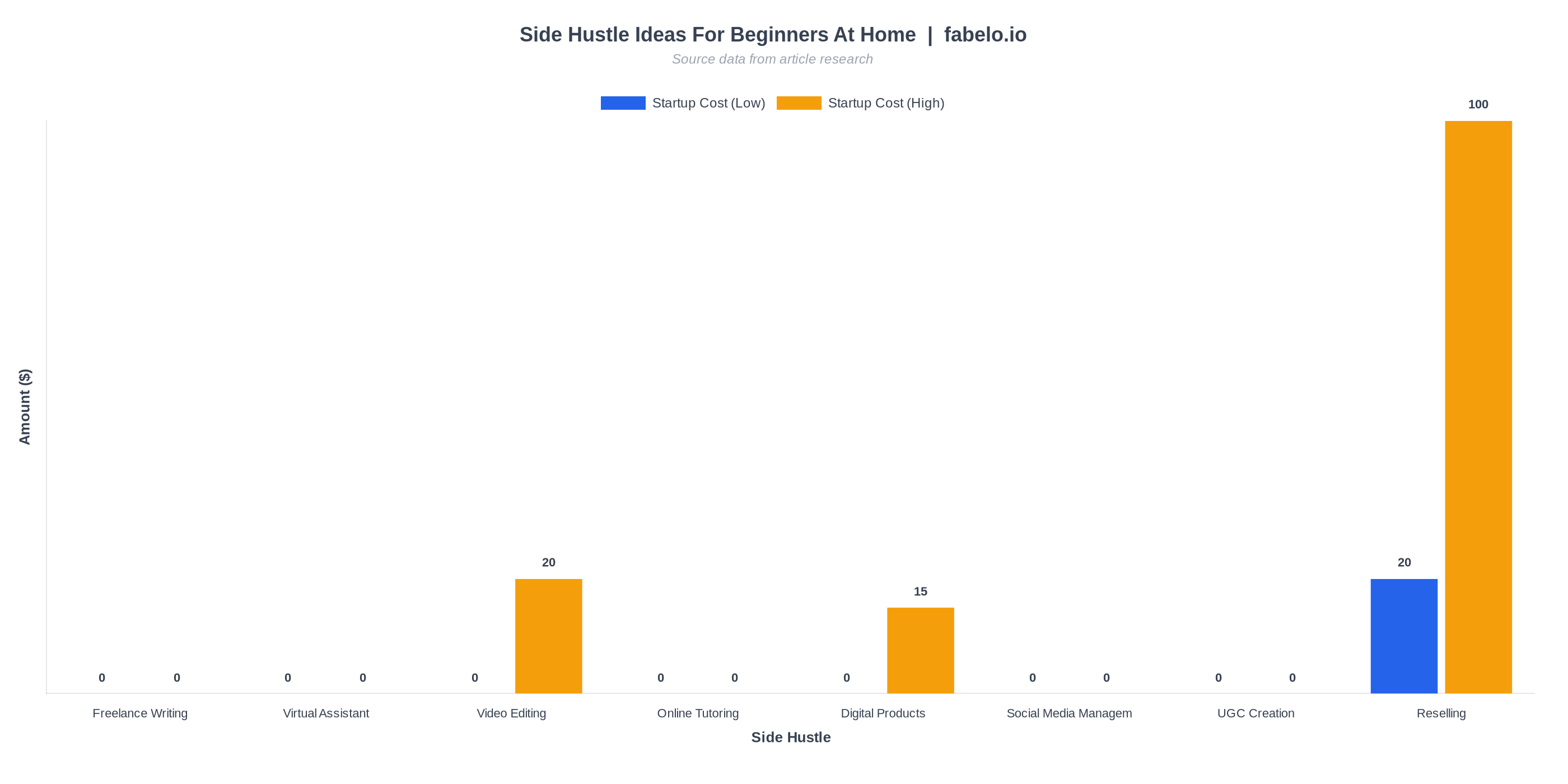
| Side Hustle | Startup Cost | Typical Beginner Rate | Pay Speed | Skill Required |
|---|---|---|---|---|
| Freelance Writing | $0 | $20–$75/article | Weekly | Low–Medium |
| Virtual Assistant | $0 | $15–$25/hour | Weekly | Low |
| Video Editing | $0–$20 | $50–$150/video | Per project | Medium |
| Online Tutoring | $0 | $20–$50/hour | Weekly | Medium |
| Digital Products | $0–$15 | $5–$30/sale | Daily (varies) | Low–Medium |
| Social Media Management | $0 | $300–$700/client/month | Monthly retainer | Low–Medium |
| UGC Creation | $0 | $100–$300/video | Per project | Low |
| Reselling | $20–$100 | $200–$800/month | Daily–Weekly | Low |
Watch This First
Before committing to any specific path, this video is worth 20 minutes of your time.
Watch: the NerdWallet YouTube channel on the best side hustles tier list →
According to the NerdWallet YouTube channel, the single most important filter when evaluating a side hustle is whether it aligns with something you're genuinely interested in — not just what pays the most. The reasoning is practical: you could end up doing this for five, ten years or longer, and starting something you already resent is a fast path to quitting. The channel walks through a tiered evaluation of popular options using three criteria: how well it aligns with your interests, how low the startup costs are, and whether the opportunity has a viable 10-year outlook given market saturation and AI disruption.
One specific takeaway stands out for beginners: UGC (user-generated content) creation scores high on all three criteria because the entire value proposition is authenticity and low production quality — meaning you can genuinely start with a smartphone and $0. The channel also makes a pointed counterargument against jumping into full content creation as a primary hustle — it's highly competitive, costs more to do well than most people expect, and is increasingly threatened by AI-generated content. For someone brand new, service-based hustles (writing, editing, VA work) offer a faster, cleaner path to first-dollar income than building an audience from scratch.
What Real People Are Saying
Community feedback from people actually doing this is more useful than any top-ten list. Here's what real beginners and side hustlers are reporting right now.
In r/sidehustle, users consistently name niche reselling and online tutoring as the most reliable legitimate earners from home. Several threads highlight that reselling in specialized secondhand markets — not just dumping random items on eBay — produces meaningfully better margins. One commenter running a tutoring operation noted they pulled consistent income with near-zero overhead once they had their first two or three repeat students.
In r/povertyfinance, the conversation around digital products has gotten specific. Users highlight Etsy templates, downloadable planners, and spreadsheet tools as genuinely effective low-overhead hustles — not because they're glamorous, but because the barrier to entry is low and the income compounds with each listing you add. Multiple posters mentioned that surveys and reward sites like Swagbucks work fine for immediate, small amounts of cash, but they're a supplement to real income — not a strategy. The thread consensus: use survey apps to cover a coffee habit, not rent.
In r/sidehustle, a thread specifically on low-startup-cost options surfaced a consistent theme: the hustles that work for beginners are the ones where the platform handles distribution. Fiverr puts your profile in front of buyers. Etsy brings in organic search traffic. Tutor.com matches you with students. You provide the skill; the platform provides the audience. Building your own client pipeline is a Phase 2 problem — not something you need to solve on day one.
Frequently Asked Questions
What are the easiest work-from-home side hustles that pay at least $20 per hour?
The easiest home-based side hustles to start are virtual assistance, proofreading, survey completion (for small amounts), and reselling household items you already own. These require no specialized skills, no startup investment, and can generate income within days. For slightly more setup but much higher income potential, freelance writing and social media management are still accessible to complete beginners.
Which at-home side hustles let beginners get paid within 48 hours of starting?
Reselling on platforms like Facebook Marketplace and Mercari can generate same-day or next-day payments. Gig platforms like DoorDash and Instacart (though not strictly home-based) also offer daily pay. For home-based options, digital product sales on Gumroad pay out frequently and can technically generate revenue any day you make a sale. Fiverr and Upwork hold funds briefly but release them quickly once work is marked complete — often within a few business days.
What at-home side hustles require zero experience and have no startup cost?
Yes. Virtual assistant work, basic social media management, proofreading, and UGC creation all have low skill floors. The key is to start with what you already do naturally — whether that's organizing, writing clearly, or speaking comfortably on camera — and frame it as a service. Platforms like Fiverr allow you to create a profile with zero reviews. Your first few clients are buying your time and effort, not a decade of expertise.
How much can a complete beginner realistically make from an at-home side hustle in the first 30 days?
Most beginners earn $200–$800 in their first month if they're consistent. That figure rises steeply by month three to six as they collect reviews, refine their service, and build a small client base or product catalog. Freelancers who specialize and raise rates strategically commonly reach $1,500–$3,000/month within their first year. The income ceiling depends almost entirely on how niche your service is and how consistently you deliver quality work.
Do I need to report side hustle income on my taxes?
Yes. The IRS requires you to report self-employment income once it exceeds $400 in a tax year. If you earn $600 or more from a single platform, that platform is typically required to issue a 1099 form. Keep records of all income and any business-related expenses (software subscriptions, equipment, home office costs) because those expenses reduce your taxable income. When in doubt, consult a tax professional who works with self-employed individuals — the cost of that consultation is also deductible.
What work-from-home side hustles pay $500 to $1,000 per month for beginners with no portfolio?
Among side hustles that pay well from the start, video editing and UGC creation offer some of the strongest beginner rates relative to skill required. A new video editor charging $75 per short-form video edit and completing four per week earns $1,200 weekly — far above survey sites or micro-task platforms. Online tutoring in high-demand subjects (math, test prep, coding) also pays $40–$80/hour at the beginner level, which is competitive with many salaried part-time jobs.
Your Next Steps
You have the information. The only thing between you and your first dollar is a decision and a few hours of setup. Here's the honest three-step plan:
- Pick one hustle and set it up this week. Not two. Not three. One. Based on your inventory from Step 1, choose the option that best matches your available time, existing skills, and income timeline. Create your profile or list your first product within seven days — that deadline is self-imposed and completely within your control.
- Make your first offer within 14 days. Send five warm outreach messages or submit ten proposals on Fiverr or Upwork within the first two weeks. Don't wait for the perfect profile. A functional offer to real buyers today beats a polished offer to nobody next month.
- Evaluate after 30 days with real data. How many hours did you work? How much did you earn? What was your effective hourly rate? If the number excites you, double down. If it doesn't, switch to your second-choice hustle from this list with the experience you've gained. Most people who find their best side hustle found it on attempt two or three — not attempt one.
The best side hustle ideas for beginners at home are useless without execution. Pick the one that fits your life and start today.
About the Author
Written by Fabelo
The Fabelo editorial team covers career strategies, job market trends, and professional development. Research-backed guides for ambitious professionals.
Disclaimer: This article is for informational purposes only. Career data, salary figures, and job market trends reflect available research and may change. Always do your own research before making major career or education decisions.
Last updated: April 13, 2026 · fabelo.io