
Skills To Future Proof A Legal Career: The Complete Guide
The top skills to future proof a legal career combine emotional intelligence, critical thinking, tech literacy, and communication — abilities AI cannot rep


The skills to future proof a legal career break down into two non-negotiable categories: human capabilities that AI cannot replicate, and technical fluencies that make you a better operator of AI tools. Lawyers who master both categories are already commanding stronger client relationships, higher billing rates, and more resilience against automation. Those who ignore either side are falling behind — faster than most people realize.
This guide ranks and compares the most critical skills for legal professionals navigating a rapidly shifting industry. Whether you're a first-year associate, a mid-career attorney, or a law student planning your trajectory, the recommendations here are concrete, ranked by impact, and grounded in what firms and clients are actually rewarding right now.
Contents
- Critical Thinking and Analytical Reasoning
- Emotional Intelligence and Client Relationships
- Communication, Written and Verbal
- Technology Fluency and AI Literacy
- Data Literacy and Commercial Awareness
- Adaptability and Continuous Learning
- Collaboration and Project Management
- Skills Comparison, Human vs Technical Legal Abilities
- Watch This First
- What Real People Are Saying
- How We Chose These Skills
- Frequently Asked Questions
- Final Verdict
Critical Thinking and Analytical Reasoning
Every ranking of lawyer skills and qualities puts critical thinking at the top — and for good reason. It's the skill that defines whether a lawyer provides genuine value or simply processes information. AI tools can retrieve case law, generate contract drafts, and flag regulatory inconsistencies. What they cannot do is evaluate whether a particular legal argument is strategically wise given a client's broader business context, risk appetite, and long-term relationships.
Critical thinking in law means more than reading statutes carefully. It means identifying what's missing from a brief, spotting the logical flaw buried in opposing counsel's argument, and recognizing when a technically correct answer leads to a commercially disastrous outcome. According to the Financial Times, the skills most valued in future-ready lawyers include identifying misinformation, adapting to change, and asking analytical questions — all fundamentally human cognitive acts.
The practical development path here is deliberate. Build the habit of asking second-order questions: not just "what does this contract say" but "what are the three most likely ways this contract could be contested, and which scenario is most likely given this client's counterparty?" Read across disciplines — behavioral economics, systems thinking, philosophy of argumentation. Partners at top firms consistently say the associates who stand out aren't those who know the most law; they're the ones who see problems from unexpected angles.
Consider a concrete example. A junior associate reviewing an M&A deal might flag every legal risk in the disclosure schedules — that's compliance. A critically thinking lawyer additionally identifies that the target company's IP licensing terms create a jurisdictional exposure the client hasn't modeled in their financial projections. That second-layer insight is what drives client retention and partner-track promotions. AI won't generate that observation unprompted. You need the cross-domain pattern recognition that only comes from deliberate, diverse reading and genuine intellectual curiosity.
Lawyers who want to strengthen this skill should practice structured argument mapping — breaking every complex issue into claims, evidence, warrants, and rebuttals. It sounds academic, but it directly translates into tighter briefs and sharper negotiating positions. This is also a skill that transfers cleanly to AI-proof roles across multiple industries, making it foundational well beyond law itself.
Pros
- Directly irreplaceable by AI — requires contextual judgment and creative synthesis
- Applicable across every practice area and seniority level
- Correlates strongly with partner-track and client origination success
Cons
- Takes years to develop to a high level — no quick certification path
- Difficult to demonstrate on a resume without concrete examples or case studies
Who It's For
Every lawyer at every stage. But it's especially critical for associates in their first five years, when the temptation is to over-rely on precedent and under-invest in original thinking.
Emotional Intelligence and Client Relationships
Emotional intelligence — the ability to read, understand, and appropriately respond to the emotions of others — is arguably the single most AI-resistant skill in the legal profession. Clients hire lawyers at some of the most stressful moments of their lives: a business crisis, a custody battle, a criminal investigation, a hostile acquisition. They need someone who not only understands the law but who can hold the weight of their anxiety while remaining strategically clear-headed.
The Law Gazette notes that effective communication, active listening, and emotional intelligence are increasingly cited as differentiating traits among lawyers who retain clients long-term versus those who lose them to competitors after a single matter. This isn't soft data — it directly affects revenue. Clients who trust their lawyer emotionally are far more likely to refer peers, return for new matters, and accept higher fees without pushback.
The skills within emotional intelligence that matter most in legal practice include: active listening without interruption, recognizing when a client's stated goal differs from their underlying need, managing your own stress reactions during high-pressure negotiations, and delivering difficult news with honesty and empathy simultaneously. None of these are trainable via software. They require human practice, feedback, and reflection.
Solicitor-client relationships are explicitly identified in multiple professional development frameworks as core "human capabilities" that define the future of law. The Law Society Journal highlights these relationships, alongside professionalism and ethical judgment, as the capabilities most resistant to automation. And the data from client satisfaction surveys consistently shows the same pattern: clients rate their lawyer's listening skills and emotional responsiveness above technical legal knowledge when evaluating overall satisfaction.
Developing emotional intelligence is a deliberate practice. Seek feedback from clients after matters close. Record and review your client call behavior. Study negotiation psychology. Work with a coach or mentor who can observe your interpersonal patterns and give you honest assessments. These aren't luxuries — for anyone building a sustainable legal career, they're professional infrastructure.
Pros
- Strongest driver of long-term client retention and referral business
- Completely immune to automation — requires genuine human empathy
- Improves negotiation outcomes and team leadership effectiveness
Cons
- Hard to measure or certify — progress is qualitative
- Law school training largely ignores it, creating a development gap for new lawyers
Who It's For
Client-facing lawyers in every practice area. Especially valuable in family law, criminal defense, employment law, and any transactional work where relationships span multiple years.
Communication, Written and Verbal

Communication is listed in every credible ranking of lawyer skills — but the nature of excellent legal communication is more specific than most people acknowledge. It's not simply "write clearly." It's the ability to translate complex legal concepts into terms that a non-lawyer CEO, a frightened parent, or a jury of twelve civilians can not only understand but act on. That translation skill — precision without jargon — is genuinely difficult and genuinely valuable.
Written communication in law runs the full range: client emails, demand letters, briefs, contracts, regulatory filings, and internal memos. Each format has different standards, audiences, and stakes. The best legal writers know that every unnecessary word costs credibility. They cut ruthlessly. They structure arguments so the most critical point lands first, not buried in paragraph four. Career guidance from Prospects consistently identifies written communication as among the most essential attributes for legal sector success at every level.
Verbal communication matters equally — and differently. In depositions, court appearances, client meetings, and business development conversations, the ability to speak with authority, clarity, and appropriate emotional register is what separates competent lawyers from exceptional ones. Persuasion in oral argument is a distinct skill from persuasion in a written brief. Both matter. Neither can be fully delegated to an AI that doesn't read the room.
AI tools can help with first drafts and structural suggestions, but they cannot replace the judgment required to calibrate tone for a specific judge's preferences, or to know when to go direct and when to build context before delivering a difficult message. Communication will remain one of the legal skills that AI cannot replace precisely because its effectiveness depends on reading a specific human in a specific context at a specific moment.
To sharpen communication skills, join a litigation team even if you're a transactional lawyer — courtroom exposure builds persuasive discipline. Take on pro bono matters that require explaining legal concepts to people with no legal background. Get a senior partner or mentor to redline your writing not just for accuracy but for persuasive impact. The feedback loop is irreplaceable.
Pros
- Directly measurable — writing quality is visible and improvable
- Applies equally to every practice area and career stage
- Strong communication accelerates promotion and business development simultaneously
Cons
- AI is improving written drafting rapidly — the baseline expectation from clients is rising
- Requires ongoing investment; communication habits calcify quickly if unchallenged
Who It's For
All lawyers. But particularly critical for litigators, appellate specialists, general counsel candidates, and any lawyer aiming to develop a client portfolio through thought leadership.
Technology Fluency and AI Literacy
Here is where the future of law in the age of AI gets concrete. Technology fluency doesn't mean you need to know how to code — though basic programming literacy is increasingly useful. It means you understand what AI legal tools can and cannot do, how to evaluate their outputs critically, and how to integrate them into your workflow without creating liability. Lawyers who treat AI as a black box they simply accept output from are taking serious professional risks. Lawyers who understand the tool's logic and limitations are using it as genuine leverage.
The current landscape of legal AI tools is broad: contract review platforms, due diligence automation, predictive litigation analytics, e-discovery AI, and general-purpose large language models used for research and drafting. Each category has different reliability profiles, different failure modes, and different implications for professional responsibility. A technically fluent lawyer knows which tools are appropriate for which tasks and verifies AI output before it goes anywhere near a client or a court.
Figures cited from the SKILLS 2026 Showcase are based on conference-reported practitioner data and are illustrative. Individual results vary by firm size, technology platform, and implementation.
The data from real legal technology deployments is striking. Insights from the SKILLS 2026 Showcase featuring a White and Case partner's experience showed that lawyers using structured legal technology platforms in complex closings reported time savings ranging from 50% for mid-level associates to as high as 80% for paralegals on certain workflow tasks. More importantly, those teams could handle significantly more simultaneous deals without quality degradation. The competitive advantage wasn't the technology itself — it was the lawyers who knew how to deploy and manage it effectively.
This is exactly the career advice circulating in r/legaltech: "Be a lawyer who can effectively leverage AI. That'll probably guarantee yourself the next five years." The framing matters — not "learn AI to replace yourself" but "learn AI so you can do what only a lawyer can do, faster and at higher quality."
Practical steps: complete a legal technology certification (several bar associations now offer these), experiment with at least two AI contract review platforms on real matters, and join your firm's technology committee or innovation group. If your firm doesn't have one, suggest starting one. Early movers in tech fluency consistently end up as the internal experts that firms promote and rely on during transformation. This also directly connects to broader career resilience — the same principles covered in our guide on how to future proof your career from AI apply with specific legal-sector nuance.
Pros
- Immediately differentiating — most lawyers are still behind on this
- Enables higher-value work by automating the mechanical layer
- Opens career paths into legal operations, legal tech startups, and ALSPs
Cons
- Tools change rapidly — knowledge has a shorter shelf life than doctrinal law
- Overconfidence in AI output is a real professional responsibility risk
Who It's For
Junior and mid-level associates who want to accelerate promotion, and partners who want to win RFPs from sophisticated clients increasingly demanding tech-enabled service delivery.
Data Literacy and Commercial Awareness
Data literacy is the capacity to read, interpret, and argue from quantitative information — financial statements, statistical evidence, regulatory data, market analysis. It has become non-negotiable in corporate law, regulatory practice, and any matter involving damages or valuation. The lawyer who can read a balance sheet and a damages model is fundamentally more useful than the one who outsources all numerical analysis to an expert witness.
Commercial awareness extends this further. It means understanding the business context your client operates in — their competitive pressures, their margin structure, their regulatory environment, their stakeholder relationships. The Colleges of Law identifies data literacy alongside commercial awareness as among the skills lawyers most urgently need to develop for the next decade. Clients are sophisticated. They can tell when their lawyer genuinely understands their business versus when they're operating purely from legal doctrine. That difference in comprehension translates directly into trust, retained relationships, and referrals.
For corporate and transactional lawyers, commercial awareness means knowing the difference between EBITDA and free cash flow, understanding why a specific covenant matters given a borrower's capital structure, and being able to discuss deal economics intelligently with the CFO across the table. For litigators, it means understanding industry dynamics well enough to contextualize expert testimony effectively and cross-examine opposing experts without being lost in the weeds.
Building this skill requires deliberate exposure to financial literacy content. Read The Wall Street Journal's deal coverage. Take a corporate finance course — many are available online. Review the annual reports of your clients' industries. Ask your firm's financial analysts to walk you through the models they build for transactions. Over 12 months of consistent engagement with commercial content, your ability to spot the commercially relevant legal issue in a complex transaction will improve dramatically.
The lawyers in r/Ask_Lawyers who report the strongest career trajectories are those who invested time in skills adjacent to law — accounting, project management, and in some cases, basic programming. That adjacent knowledge pays dividends precisely because most of their peers didn't bother.
Pros
- Massively expands your value in transactional, regulatory, and litigation contexts
- Builds client trust at the executive level — where origination decisions are made
- Creates genuine differentiation in a crowded market
Cons
- Requires sustained investment — this isn't a weekend course
- Can feel outside traditional legal training, creating initial resistance
Who It's For
Corporate, M&A, regulatory, banking, and securities lawyers especially. But increasingly relevant for any lawyer advising businesses of any size.
Adaptability and Continuous Learning
Adaptability is the meta-skill that makes all the others possible. Thomson Reuters has called it the most essential skill for first-year legal associates navigating a rapidly evolving industry. That claim extends well beyond junior associates — it applies throughout an entire career. The legal landscape is shifting structurally: new practice areas emerging from technology regulation, climate law, digital assets, and AI governance; traditional transactional work being compressed by automation; and client expectations accelerating in complexity.
Lawyers who built their identity around a single specialty without the flexibility to expand or pivot face real risk. Those who treat their skills as permanent assets rather than depreciating resources will find themselves less relevant within a decade. The half-life of specific procedural knowledge is shrinking. The value of learning agility — the capacity to pick up new frameworks quickly and apply them effectively — is rising correspondingly.
Continuous learning in law doesn't just mean CLE credits. It means genuinely engaging with new legal developments before they're mandatory to understand. It means reading scholarship outside your practice area. It means attending technology and business conferences, not just bar association events. The lawyers in r/Lawyertalk who describe the strongest skill development practices are unanimous on one point: never stop reading, never stop asking questions, and deliberately try things outside your comfort zone. That mindset is not common in the legal profession, which tends toward conservatism and precedent. That's exactly why it creates an advantage for those who embrace it.
Practically, adaptability means building a system for tracking regulatory change in your practice area, establishing relationships across different practice groups within your firm, and having a 12-month learning plan that you actually review quarterly. Treat your professional development the way your best clients treat their business strategy — with intentionality and regular review.
Pros
- The foundational capability that allows all other skills to keep evolving
- Creates resilience against practice area disruption
- Strongly associated with leadership potential and partner selection
Cons
- Requires psychological comfort with uncertainty — which legal training often suppresses
- Difficult to demonstrate on a CV without specific, tangible examples
Who It's For
Every lawyer, but especially critical for those in practice areas facing significant automation pressure: document-heavy transactional work, standard contract drafting, and routine due diligence.
Collaboration and Project Management

Modern legal work is rarely solo. Complex deals and litigation require coordination across multiple lawyers, paralegals, financial advisors, technical experts, and client stakeholders — often across time zones. The lawyer who can manage this orchestration efficiently is worth dramatically more than the one who can only manage their own workload. Law firms are increasingly operating as project-based organizations, and the project management skills that tech and consulting industries have embedded for decades are now essential in law.
Project management in legal practice means: scoping a matter accurately at the outset, tracking milestones and budget in real time, communicating proactively when timelines shift, and closing out matters with structured documentation. These are learnable skills with established methodologies — legal project management (LPM) frameworks now exist specifically for legal practice. Law firms using these approaches consistently outperform on client satisfaction and matter profitability.
The White and Case experience highlighted at the SKILLS 2026 conference illustrated this directly — teams that deployed structured collaboration technology on complex multi-jurisdictional transactions reported that the real competitive advantage wasn't time savings alone. It was the shift from reactive communication (chasing email updates) to proactive transparency (real-time status visibility for all parties). That shift requires lawyers who know how to design and manage collaborative workflows, not just execute individual tasks.
Collaboration also means working effectively with legal operations professionals, technologists, and alternative legal service providers. The legal team of 2030 is likely a hybrid: lawyers doing the judgment-intensive work, AI tools handling the mechanical layer, and legal operations specialists managing the process infrastructure. Lawyers who can lead and collaborate within that hybrid structure — rather than resist it — will be indispensable. Those who see non-lawyer team members as competitors rather than collaborators will find themselves increasingly isolated.
For anyone considering how to present these skills on a professional profile, collaboration and project management experience should be quantified wherever possible — deal counts, matter sizes, team sizes managed, and client satisfaction outcomes.
Pros
- Directly tied to matter profitability and client satisfaction metrics
- Enables leadership of larger and more complex matters earlier in career
- Transfers to legal operations, in-house counsel, and general management roles
Cons
- Requires reorienting from individual contributor mindset — uncomfortable for some lawyers
- Project management tools add a learning curve on top of already demanding workloads
Who It's For
Mid-level associates targeting partnership, in-house lawyers managing external counsel, and any lawyer working on multi-party, multi-jurisdiction matters.
Skills Comparison, Human vs Technical Legal Abilities
The following table compares each skill category across the dimensions that matter most for career planning: AI replacement risk, development timeline, and impact on earning potential and career trajectory.
The pattern is clear. Human-category skills carry the lowest AI replacement risk and the highest long-term career impact. Technical skills like AI and data literacy have medium-term urgency — the window for differentiation through tech fluency is open now but will narrow as the baseline expectation rises across the profession. Lawyers who develop both columns simultaneously are building the most durable career infrastructure available.
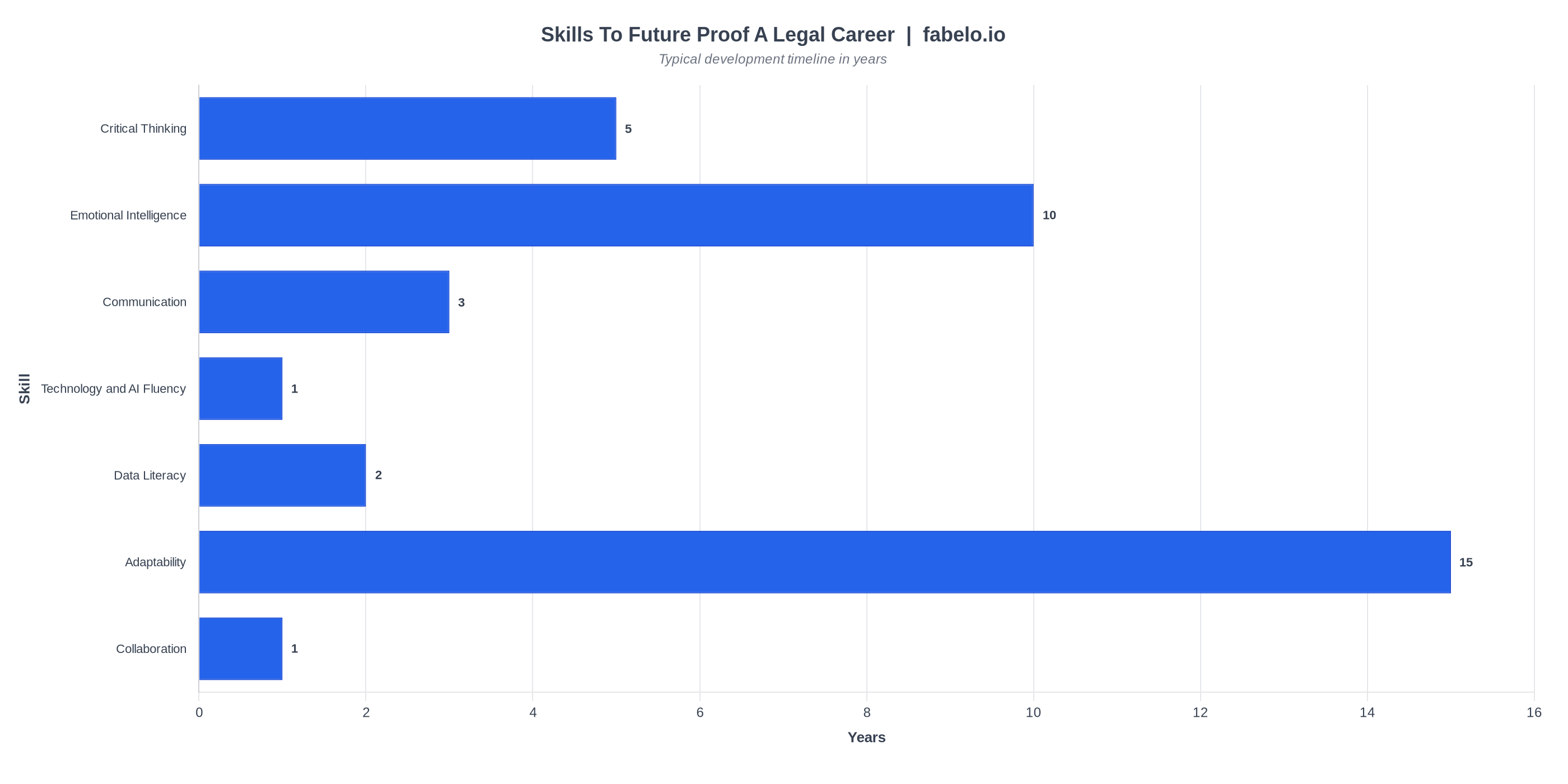
| Skill | Category | AI Replacement Risk | Typical Development Timeline | Career Impact |
|---|---|---|---|---|
| Critical Thinking | Human | Very Low | 3–7 years | Very High |
| Emotional Intelligence | Human | Negligible | Ongoing | Very High |
| Communication | Human | Low (drafting) / Very Low (oral) | 2–5 years | High |
| Technology and AI Fluency | Technical | Low (requires human judgment) | 6–18 months | High and Rising |
| Data Literacy | Technical | Medium (interpretation remains human) | 1–3 years | High |
| Adaptability | Human | Very Low | Cultivated continuously | Very High |
| Collaboration and Project Management | Mixed | Low | 1–2 years with deliberate practice | High |
Watch This First
Before committing to a skill-building roadmap, this video from the SKILLS 2026 showcase offers a grounded look at how legal technology ROI actually plays out in practice — and what it reveals about the human skills that remain non-negotiable.
Watch: the SKILLS YouTube channel on future-proofing legal careers with technology →
According to the SKILLS YouTube channel, the real differentiator in legal technology adoption isn't the tool itself — it's how lawyers deploy it. A White and Case partner shared that their competitive advantage came from having a dedicated practice technology team that trained associates and paralegals to run matters through structured platforms confidently. The technology became table stakes; the human capability to implement and manage it became the actual value driver. Clients — particularly major financial institutions — began specifically requesting this capability in RFPs, signaling that tech-enabled legal service delivery is now a market expectation, not an innovation premium.
That insight reframes the entire debate about AI and legal careers. The question isn't "will AI replace lawyers?" It's "which lawyers are building the capability to lead AI-enhanced practice?" The answer to that question determines career trajectories over the next decade more than any individual doctrinal specialty.
What Real People Are Saying
The most useful signal on what actually works in legal career development often comes from practitioners themselves, not career services departments. Reddit communities for lawyers and legal tech professionals are unusually candid about what skills matter and what conventional wisdom misses.
In r/legaltech, a thread from a worried junior lawyer drew a consistent response: become the lawyer who can leverage AI effectively rather than the one who resists it. Multiple commenters noted that every profession transforms over time, and the lawyers best positioned for the next five years are those who develop fluency now while the differentiation is still meaningful. The framing "AI won't take your job, but a lawyer using AI will" appeared repeatedly and resonated widely.
In r/Lawyertalk, the discussion around whether law is a future-proof career reached a fairly optimistic consensus — not because AI isn't changing the profession, but because the most valuable legal work requires creativity, careful analysis, and innovative thinking that AI cannot autonomously perform. One commenter made the point that as long as humans are running businesses, making deals, committing crimes, and disputing contracts, there will be demand for lawyers who genuinely understand human stakes. The risk isn't obsolescence — it's commoditization for lawyers who don't differentiate themselves.
In r/Ask_Lawyers, the question of which non-legal skills matter most for practice surfaced project management, accounting, and programming as the most frequently mentioned. What's striking is that these match almost exactly the "commercial awareness" and "technology fluency" categories that formal career development frameworks identify. The practitioners who figured this out empirically and the researchers who identified it through structured analysis are pointing at the same answer.
How We Chose These Skills
The skills in this guide weren't selected based on what sounds impressive in a law school brochure. They were selected based on three converging signals: what clients are actually rewarding in their hiring and retention decisions, what legal employers are explicitly requesting in job postings and RFPs, and what practitioners with strong career trajectories report as the capabilities that drove their advancement. Where these three signals aligned, the skill made the list. Where only one signal pointed to a skill, it didn't.
We also applied an explicit AI-resistance filter. Skills that AI tools are actively replacing — basic document review, standard contract drafting, routine legal research — were excluded not because they're unimportant to learn, but because proficiency in them is no longer a differentiator. The guide focuses on skills that remain human-dependent either because they require contextual judgment, emotional attunement, or the kind of creative synthesis that current AI architecture cannot perform.
Sources consulted include practitioner frameworks from the Financial Times, career guidance from Prospects, industry analysis from Colleges of Law, and real practitioner discussions from legal Reddit communities. Conference content from SKILLS 2026 provided the technology deployment data that informed the AI fluency and collaboration sections.
| Evaluation Factor | How We Measured It | Weight in Selection |
|---|---|---|
| AI Replacement Resistance | Assessed against current AI capability benchmarks in legal practice | High |
| Client and Employer Demand | Cross-referenced against job postings, RFP requirements, and client surveys | High |
| Practitioner Consensus | Validated against Reddit discussions and conference practitioner testimony | Medium |
| Career Trajectory Impact | Correlation with partnership track, origination success, and client retention | High |
| Development Feasibility | Whether a working lawyer can realistically build this skill alongside active practice | Medium |
Skills were excluded if they were either already table stakes (basic legal research, case file organization) or if they fell primarily into the mechanical execution layer now being absorbed by AI tooling. The goal of this guide is not to describe what every lawyer already knows — it's to identify what separates lawyers who will thrive in the next decade from those who plateau.
Frequently Asked Questions
What are the best examples of legal skills to list on a resume in 2025?
The strongest legal skills examples for a resume combine both hard and soft competencies with evidence behind each one. Rather than listing "communication skills," specify the context: "led client-facing negotiations on 12 M&A transactions across three jurisdictions." High-impact skills to list include analytical reasoning, technology fluency (with specific tools named), commercial awareness, client relationship management, and legal project management. Generic skill lists are ignored by hiring partners — specific examples paired with outcomes are what get attention.
Which legal skills does AI genuinely cannot replace right now?
The legal skills that AI cannot replace in current practice are those requiring contextual human judgment: ethical decision-making in ambiguous situations, empathetic client counseling during personal crises, creative litigation strategy, and relationship-based business development. AI is highly capable at pattern recognition, document processing, and predictive analytics — but it cannot hold a client's hand through a custody dispute or persuade a skeptical appellate judge through the nuance of oral argument. Those remain definitively human.
How long does it realistically take to develop future-proof legal skills as a working attorney?
It depends heavily on the skill. Technology fluency and data literacy can be meaningfully improved within 6 to 18 months of deliberate practice — taking structured courses, experimenting with tools on real matters, and joining firm technology initiatives. Critical thinking and emotional intelligence develop over years, not months, and require feedback loops (mentoring, client feedback, peer review) to accelerate. A realistic 3-year plan would prioritize AI fluency in year one, data literacy in year two, and deliberate communication and relationship-building investment throughout all three.
Is law actually future-proof as a career given how fast AI is advancing?
Law is future-proof for lawyers who adapt — and increasingly risky for those who don't. The demand for legal services isn't disappearing: as long as businesses operate, people make deals, governments regulate, and disputes arise, lawyers are needed. What's changing is which lawyers are needed and for what. Commodity work — routine drafting, basic research, standard document review — is being compressed by automation. High-judgment, relationship-intensive, and strategically complex work is if anything becoming more valuable. The profession is bifurcating, and the split favors lawyers who invest in human-capability skills alongside technical fluency. If you're wondering whether broader career transformation is worth studying, the guide on whether AI should replace jobs provides useful context.
What technical skills for lawyers are worth investing in if you're a generalist?
If you're a generalist lawyer without a strong technology background, the highest-ROI technical skills to develop are: (1) proficiency with at least one AI legal research tool and understanding its reliability limitations; (2) basic data literacy — being able to read financial statements and interpret statistical evidence without needing an expert to explain them; and (3) legal project management fundamentals, including matter budgeting and milestone tracking. These three investments will serve you across every practice area and distinguish you from peers who haven't made them.
How do skills for law students differ from what practicing lawyers need to develop?
Law students have a structural advantage: they can build habits before bad ones form. The priority for law students is developing critical thinking through Socratic engagement, writing precision through deliberate feedback cycles, and technology awareness through legal clinic and clinic tech tool exposure. Practicing lawyers are often retrofitting these skills onto established habits, which is harder. Students who graduate with genuine AI literacy, commercial awareness from internships in business settings, and demonstrated communication skills through moot court or legal writing competitions enter the market with a meaningful edge over peers who treated law school as purely doctrinal training.
Can skills in project management and accounting actually help a lawyer's practice in measurable ways?
Measurably, yes. Lawyers with project management skills consistently manage matters more profitably — they scope accurately, track budget consumption in real time, and communicate proactively when timelines shift, which directly reduces write-offs and client disputes. Accounting literacy allows corporate and transactional lawyers to understand deal economics without dependence on external advisors for basic financial analysis, which accelerates deal timelines and strengthens client trust. These are not theoretical benefits — they translate into higher realization rates on billed work and stronger client relationships at the executive level.
Final Verdict
The single most important skill to future proof a legal career is critical thinking — specifically, the capacity to apply cross-domain judgment to complex, high-stakes situations in ways that AI cannot replicate. Everything else on this list amplifies critical thinking: emotional intelligence allows you to apply it in service of client relationships; communication allows you to translate it into persuasive arguments; technology fluency allows you to work faster without sacrificing it; and adaptability ensures it keeps evolving as the landscape changes.
But the honest answer for anyone serious about their legal career in 2025 and beyond is that you need both columns. You need the human skills that clients and courts have always valued — judgment, empathy, persuasion, integrity — and you need the technical literacy to operate effectively in a profession that is rapidly becoming technology-mediated. Neither column alone is sufficient. A brilliant critical thinker who refuses to engage with AI tools will be outcompeted. A technically fluent lawyer with no client skills will be easily replaceable.
Step 1: Audit your current skill gaps. Rate yourself honestly across the seven skills in this guide. Pick the two where you have the widest gap between current level and where you need to be in three years. Write them down — vague intentions don’t drive development.
Step 2: Build one human skill and one technical skill in parallel. Choose one human-category skill (critical thinking or emotional intelligence) and one technical skill (AI fluency or data literacy) to develop simultaneously. Enroll in one structured learning path for the technical skill this month. For the human skill, find a mentor or establish a feedback loop before the end of the quarter.
Step 3: Review quarterly, not annually. Legal career development is a slow process but requires frequent checkpoints. Every three months, revisit your skill plan: what progressed, what stalled, and what new tools or practice areas require updated fluency. Treat it like a matter review — with dates, actions, and accountability.
Bottom Line: The lawyers who build durable, future-resistant careers are those who invest consistently in human capabilities while staying current with the technology shaping how legal work gets done. Start with the skill that has the longest development timeline — critical thinking and emotional intelligence — and build your technical fluency in parallel. Three years of deliberate investment in these areas, done correctly, will position you ahead of most of your peers regardless of how fast AI continues to advance.
About the Author
Written by Ufuk Yorulmaz
Digital entrepreneur and AI systems builder based in Istanbul. Founder of Fabelo.io, Aicall.pw (AI voice call automation), and WPcare. Has led digital strategy, automation, and SEO systems at PanicWorkz for over 16 years. Writes about AI tools, automation trends, and the future of work at Fabelo.
Disclaimer: This article is for informational purposes only. AI tool capabilities and pricing change frequently — verify before committing.
Last updated: April 30, 2026 · fabelo.io